A wall, a ceiling, or a floor are, to some extent, silent time containers. Because layer after layer of concrete, paint, and other construction materials does not only hide the different architectural and spatial stages of a building, they also tell the stories of those who had something to do with it. In that sense, both neglect and conservation are part of the process. And Chilean artist Livia Marin appears to have confirmed this during her recent intervention at the Odeon Theatre Foundation entitled Marca No Registrada (Unregistered Trademark).
Marín is an artist who currently lives and works in London (England) and pursues a doctorate in Fine Arts from Goldsmith College in the same city. An important line of her work explores the potential of mass-produced objects for acquiring a particular form or even to become unique. A good example is a series of more than 2,000 women’s lipsticks that, although apparently mass-produced, upon closer inspection reveal unique features on each one of them. Just like what happens in real life when a woman unconsciously applies that fatty stick to paint her lips red. In even broader terms, it is about finding the individual, personal, and imperceptible in everything that was made to be universal or alien to human beings. Such reflection is usually translated by Marín into sculptural processes that include a mold, repetition, and a cast and materials as diverse as foam, wood, ceramic or gold thread, among many other things.
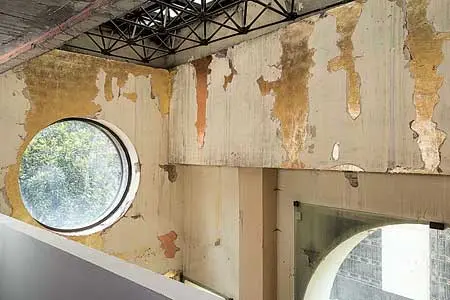
For this occasion, and according to a conversation with the curator, also from Chile, Oyanedel Beatriz Bustos, who has been present throughout Marín’s career, the artist uses the same strategy but begins with an additional challenge: to understand space as complex as an old theater; a place filled with traces of times gone by, with two totally different architectural structures whose dimensions exceed that of traditional exhibition venues. Cunningly, Marín turns these challenges to her advantage. She highlights with gold leaf—a noble material—all the spots and marks left by the evident deterioration of the building. At the same time, she creates a series of engravings or impressions of some parts of the building with thick layers of latex. Thus, the noble and valuable gold is set in contrast to the repugnant and worthless latex. In the same manner that the Odeon Theatre is redefined as a result of both the neglect and preservation it has been subjected to, as a result of its past and present, for being both a forgotten ruin and the symbol of a new and shiny—golden—era. Everything was condensed into a very thorough in-situ project that involved long hours with a group of collaborators and several art students from Bogota who had the opportunity to learn Marín’s artistic process. Thus viewers slowly begin to discover clues or marks that, as the title suggests—beyond the play on words about the commercial registry of a trademark—had not been registered. Nor had anyone noticed the soil accumulated between the bricks that are part of the outdoor plaza, or that the walls could very well be like abstract paintings created with pink, grime, and fragments of the wall; large pieces that appear before us like stretched canvases hung on the wall waiting for viewers to appreciate them as they walk through the place. It is an experience that probably sensitizes visitors to appreciate those small details that they would otherwise miss in the frenetic pace of everyday life.
In other words, and going back to Marín’s interests, these findings, these small things, these time capsules between walls, are the very things that matter. Marín is an artist, a sculptor, and a hoarder—as she readily accepts—who recognizes in the domestic, the anecdote, and the personal, a unique opportunity to express universal truths about humanity. And this is the case in this intervention that was on view until May 9, 2013, at the Fundación Teatro Odeón, It is a place that, since its first exhibition in 2012 has been taking important risks and showing projects that can only take place there. Large video installations projected on its walls and ceilings, machines that bring doves back to life, invisible architectures, meticulous narrations, and several other experiences have transformed it into a vital space in the city of Bogota.
DANIEL SALAMANCA