
Nan González (María Luisa González, Caracas, 1956) is an inescapable reference point when we speak of video art and, more generally, non-objectual art in Venezuela. Her already vast oeuvre combines a skilled interpretation of contemporary expressive media with preoccupations that are imbued with a calm subjectivity. From the beginning, her work has projected a poetic, philosophical, and metaphysical halo, with the body, self-awareness, and relationships with the surrounding space and with nature as its thematic axis. In recent years, and following very closely the ecologic, existential, and spiritual issues actualized by the consciousness of the new millennium, the artist started on creative paths that connect the energy of nature, life on the planet, with the fate of mankind, from a holistic perspective with transcendental implications.
The Beginning. Body, Space.
Nan González’s career is that of a conceptual art pioneer in Venezuela (she has practiced photography, video-art, video-installation, land art, performance) and, we can also say, that of one of the most relevant personalities in the explosion of a truly contemporary art movement in the country in the 1980s.
González studied art at the Cristóbal Rojas School in Caracas from1974 to 1978. Later, she traveled to Europe to continue her education at the Chelsea School of Art in London (1977-1978); she also studied photography and film in Cannes (1978-1980) and Caracas (1980). The artist first became interested in conceptual art and performance in London, and pursued these languages hand in hand with Jennifer Hackshaw, with whom she was associated for nine years (1977-1986); the contemporary art projects carried out by the duo, known as “Yeni and Nan”, had a significant impact on the Venezuelan art scene during that period. Their contribution was essential in introducing Venezuelan audiences to artistic forms that rejected conventional means of expression.
One of Yeni and Nan’s first actions after their return to Venezuela was the presentation of Presencias, Nacimiento I, and Nacimiento II, three performances that had first germinated in France and were highly innovative in the local context.
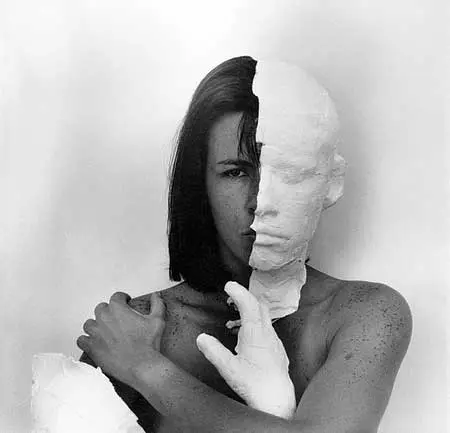
Essential to these performances was their work with the body and its relationship to the surrounding space. At the time, Nan González’s conceptual proposal centered on the dialectic of me/you, or interior/exterior world, as a way of exploring identity and the boundaries between outside space experienced as a sensorial category and subjective inner space, or, as was accurately noted by Venezuela critic Roberto Guevara, “an exploration of the ego as an axis for all interrelations.”
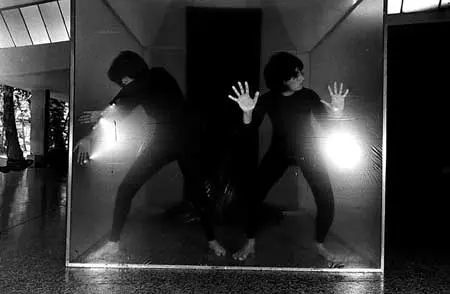
In Presencias, for instance, the artists introduced themselves inside a transparent cube, with gestural motions that underscored the spatial limitations imposed by the plastic walls. In the end, the cube was destroyed, thus completing the metaphor of a union between external and internal spaces and the liberation this implies.
Other works of the same period are Simbolismos sobre la identidad, which introduced the hypnotic sound of a metronome, two cubes, photographs, and twelve mirrors, while the artists searched for a space that symbolized their identity; and Integraciones en el agua I and II, which was part of Venezuela’s delegation to the 16th São Paulo Biennial, where they proposed an environment of transparent bags containing water into which they entered to execute a series of movements referred to transformations to recreate the human embryonic experience.
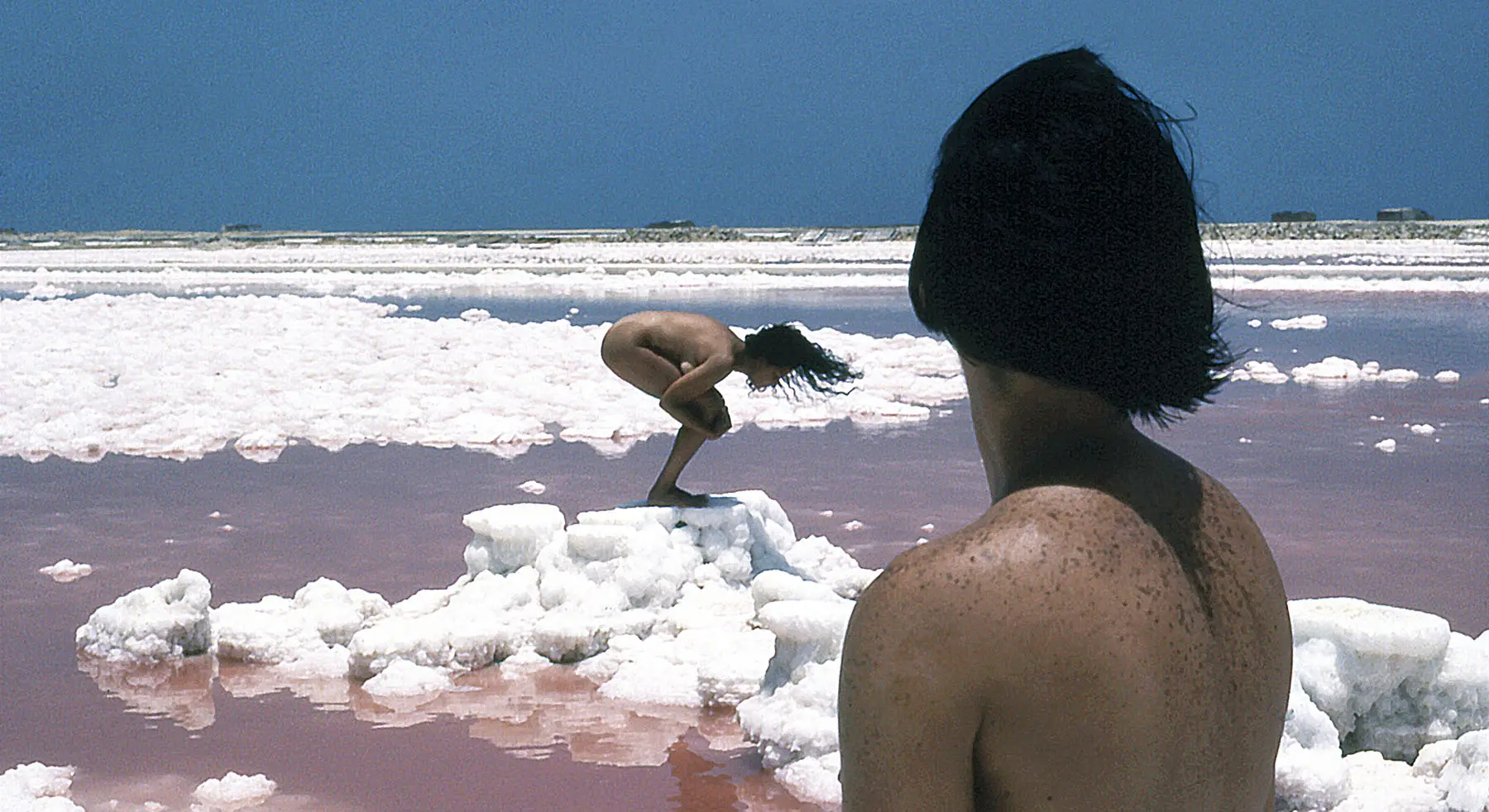
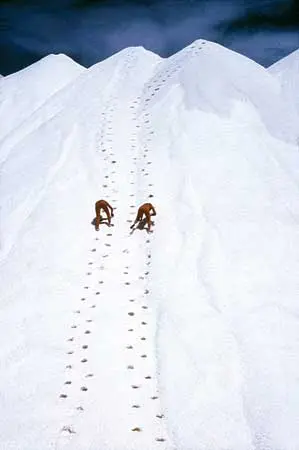
With Hombre y sal, First Prize winner at the 3rd Young Artists Salon, Yeni and Nan arrived at one of the culminating points in their career, not only because of the experience’s soaring poetic and aesthetic heights but because of the audacity of a work of art that involved the landscape indirect, organic, sensorial ways. The strange and beautiful landscape of Salinas de Araya, in Venezuela, with its gleaming mounds of white salt, was the perfect background for their nude bodies to unfurl their plasticity and speak to us, from their contact with this “elemental landscape,” of a constant and secret natural process of transformation that involves Man in its entire being, a kind of alchemy of nature, of the Earth, clearly expressed in the external realm but whose deepest consequences are forged inside each individual.
These elements of a profound personal, psychological, and spiritual reflection identify Nan González’s work; for her, art is an instrument for meditation and change. The artist has pointed out more than once that her work has allowed her to achieve an inner transformation.
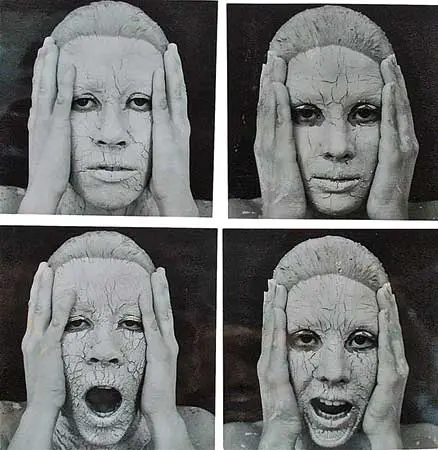
In 1986, after the dissolution of the “Yeni and Nan” creative partnership, González focused even more on video art. Her first individual exhibition Om: interioridad del hombre, Artisnativa Gallery, Caracas—comprised the installation Om, two masks, and twelve drawings that materialized gestures and movements on paper. The exhibition was a continuation of her exploration in the preceding years, centered around matters of individual identity and awareness, and had been foreshadowed in the actions Autorretrato and Transfiguración, elemento tierra, both from 1983, where faces and masks were key elements.
The 1990s. Flight.
The 1990s signaled Nan González’s definitive concentration on video art and video installation. The artist found in the video a way of expressing images of a potent poetic charge, through which she is able to represent the ephemeral, energy, light, the subconscious.
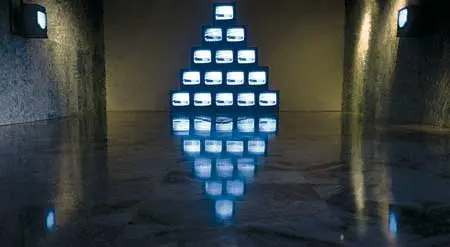
In 1991 she presented El vuelo del cristal, an exhibition at the Museo de Bellas Artes in Caracas. González built a pyramid with 15 monitors simultaneously displaying the same images. The images had been captured as the low-level flight of a crystal over the landscape. For this artist, the crystal is a metaphor for the journey of the subconscious, of the soul that wanders and becomes one with nature, with space, the motion of pure energy freed from matter.
Roberto Guevara understood El vuelo del cristal as one of Nan González’s most committed and wide-ranging works, where the artist unveiled “new capacities to anchor our concept and perception of the world.”
In videos like Proceso de un pensamiento, from 1991, we notice the use of the media as an instrument for the creation of a new visuality distorted by over-exposure and extreme close-ups. The artist explores video’s potential for fuzziness, for evading literal representation, and for sketching visual metaphors where the organic aspect of the body becomes indistinguishable from vegetal matter and even from micro-and macrocosmic images.
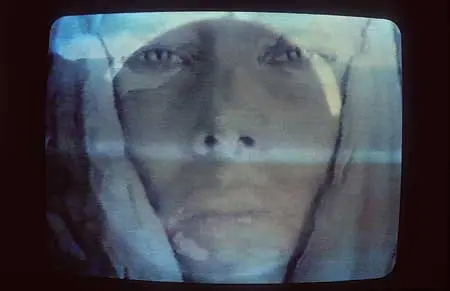
In 1994 González explored the topic of time as one of the dimensions in which mankind’s existence unfolds, with manifold symbolic connotations. That year she presented Códigos del tiempo, an exhibition at Sala Rómulo Gallegos (CELARG, Caracas) that included several proposals emphasizing the body's relationship to space-time.
In her 1996 video esfera de mi memoria, the artist repeatedly introduces a circle drawn and erased on a mud-covered female face. Once again González explores images of faces and the female body as a way of talking about the individual psyche, here expressed as unintelligible energy. Body and soul as an indivisible, complex unit.
The 1990s were truly prolific for Nan González. It was a time of constant activity when she created many works that today are landmarks in the development of Venezuelan video art. She also presented important individual exhibitions and garnered many recognitions. Works like Un brindis al universo (1992), and installation with video and wine glasses arranged in a spiral; Naturaleza muerta (1993), video installation with intervened photographs and metal nails in reference to the cross; and Los durmientes (1998), were acquired by the country’s most important collections.
In her installation El vuelo interior (2001), which won the 59th edition of the Arturo Michelena Salon (Valencia, Venezuela), the artist appropriated an image by German photographer Dieter Appelt featuring a man with artificial wings right before launching on an experimental flight. The image of this contemporary “Icarus” placed at the center of a mountain wall is close to González’s own spirit; she is fascinated with natural beauty, with nature’s relationship with humanity, and with flight as a metaphor for the manifestations of the soul. This work expressed, precisely, Nan González’s spiritual concerns regarding Man’s potential as a transcendent, unlimited being.
The New Millennium. We Are All the Earth
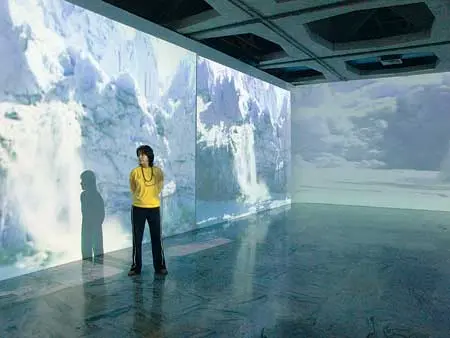
In 2005, González presented Titanes de hielo, an exhibition at the Museo de Bellas Artes in Caracas featuring her most recent production. This project developed after a trip the artist made to Patagonia, where, on the one hand, she felt moved by the imposing beauty of the great frozen masses and, on the other, became aware of their decay due to global warming.
The video Alma del glaciar (2001-2005) depicts the moment when a glacier’s segment breaks off and falls to the sea. González’s treatment underscores the beauty of the white structure that rises imposingly on the frozen landscape like a natural sculpture. The artist introduces a mirror-like resolution in the video as well as shifts to the natural speed of the event, emphasizing not only the drama of the break but the beauty and metaphorical power of nature.
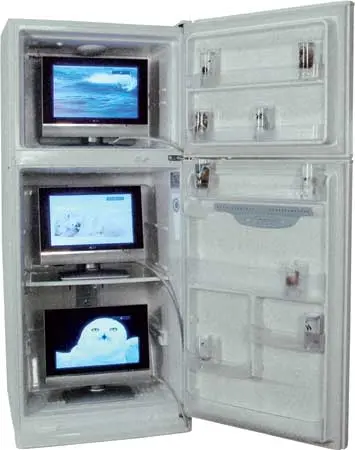
Also included in that show was the video-sculpture Vida en el congelador (2002-2005), which reflects her concern for the polar-region fauna. This work is comprised of a refrigerator with three TV monitors arranged inside, showing images of such animals in their habitat. Without being a protest work, Vida en el congelador confronts with an ironic accent the existence of a diverse polar habitat and the cold boxes we use in our urban domestic spaces to store and preserve dead animals.
In recent years, Nan González’s works have moved even closer to an exploration of images and sounds that connect with spirituality in the sense of a quest for one’s own identity and of care for the soul. The beautiful video Ashvini. Dioses gemelos del amanecer presents the image of two peacocks who at a given point become a single one. Using mirrored frames, González achieves kaleidoscopic shots that bring to mind hallucinatory states or those shapes that come freely to our minds when we meditate. In them, what is real, in this case, the peacocks, is transformed into a beautiful, colorfully abstract atmosphere that incites free association.
After a 30-year career, Nan González recognizes that what she has always intended with her images is to communicate we can feel and recognize ourselves as beings that carry transcendent energy. Her entire oeuvre is a quest for ways to translate the transit of the spirit into a language that grows ever more crystalline, where transparency, the body, and nature come together to connect us to our immaterial, divine, infinite being: light, transcendence, liberation, and flight.
KATHERINE CHACÓN
Venezuelan investigator and art critic.