In the contemporary world, heterogeneous elements swirl around our vertiginous character to form relationships of an inextricable complexity.
As Italo Calvino puts it, today we can no longer conceive a totality that is not potential, conjectural, multiple. 1
Calvino mentions, from the literary realm, the case of Paul Valery, a tireless seeker after the “total phenomenon, the whole of consciousness, of relationships, of conditions, of possibilities, of impossibilities,” 2 whose oeuvre features precision, mental order, and poeticism, while at the same time containing philosophy and science.
This relationship between art and science seems destined, more and more, to show us a reality that is perpetually in flight.
It is in seventeenth-century Mannerist art that we detect the weakening of the Renaissance’s isotopic space.
From the historical avant-garde to the contemporary age, the combination and hybridization of different technical sources and Spatio-temporal contexts have provided the visual image with a prodigiously wandering nature.
Electronic art, with its extraordinary capacity for transformation, occupies today a place that we can almost consider necessary because of its technical potential, the richness and variety of the artists who use it, and its search—traditional to art itself—for a connection, in this case, with poetry.
Mariano Sardón, Martín Bonadeo, Alejandro Schianchi, and Mariela Yeregui are some of the artists to whose work I will refer here.
They all possess a rigorous technical and scientific background: Sardón is a physicist; Bonadeo has a degree in Communication Science and Advertising; Schianchi is an IT Technician with a degree in Cinematography, and Yeregui graduated with studies in Art and Cinematography.
Each has chosen a separate path in their search for a connection to poetry.
In 1988, Mariela Yeregui was working on her residency at the University of California-Los Angeles (UCLA)’s Lab for New Media. During that period, she created Claustrofobia, which, in Graciela Taquini’s description, consists of a media environment with sensors that attempts to communicate the anguish provoked by closed spaces and the need to create in the viewer a feeling of frustration and paranoia.
It was in Los Angeles that she became aware that it was possible, using electronic technologies, to achieve a confluence of multiple languages in her works, in order to recover threads that had been left loose in her precious explorations and quests. Yeregui discovered that the electronic arts foster interdisciplinary dynamics.
As Elena Oliveras has noted, 3 in L.A. Yeregui perceived the isolation of human beings “encapsulated” in their automobiles and felt also the menace and marginality of pedestrians in a culture of no-contact, now generalized in the global world.
Yeregui says: “I trace the outlines of my space, of my position in the world. A small insignificant site among millions of personnel outlines demarcating protected territories, trespassing which generates both attraction and repulsion between beings. I experience my outlines as the result of interrelations and exchanges, physical, verbal, proxemic, and ideological dialogs. This idea of one is materialized in my contact with the other, with the context. And the catalyst of such self-awareness is the real being (animated or inanimate) that brushes against my boundaries.”
This is how the idea for Proxemia, presented at Espacio Fundación Telefónica in Buenos Aires in 2005, initially developed.
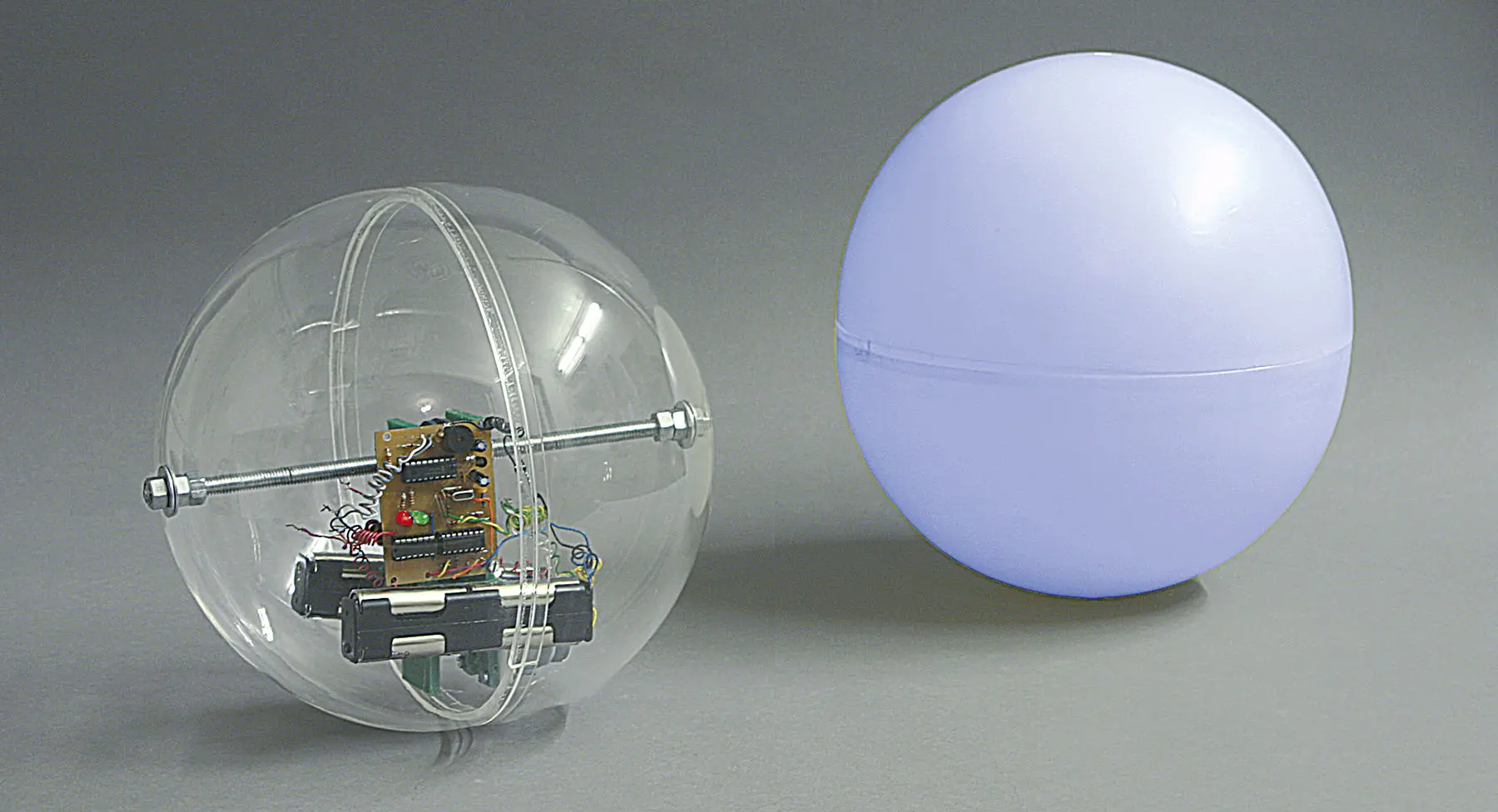
Twenty light spheres roll freely inside mechanical devices and, through sensorial detection developments, tend to shift their trajectories as any kind of physical contact takes place. The general dynamic installs a social metaphor: individuals in constant motion, avoiding other individuals, focused more on the motion itself than on its objective. But even if the standard behavior is to remain in motion, a minority (just one of the spheres) will continue to contradict the social norm, seeking a collision with the other agents.
The balls are made of white-colored acrylic material. They contain a mechanism capable of positioning and orienting their pieces and internal devices so that they roll around, detect the presence of others, and change paths depending on the external conditions. Their control units include microcontrollers that can perceive any shifts in the environment. In sum, their micro-controller and their sensors allow them to behave in adaptive ways (avoid/clash). The mechanism is powered by batteries. The micro-controllers and self-programmed, requiring no computer control.
Inside each sphere is a small LED light that shifts colors (white or blue) every time it finds an obstacle.
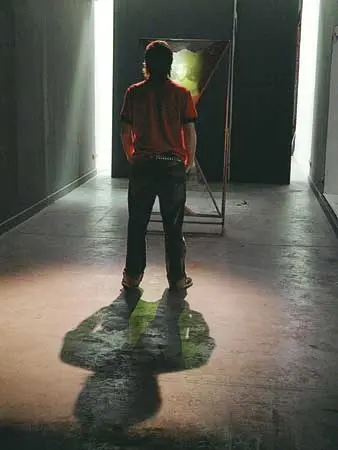
One of the spheres is translucent, allowing us to see the robotic mechanism. 4
The project is structured in two phases, the first one autonomous with respect to the second one; this is to say, the second phase complements the first one, but the latter is a complete, self-contained stage that can be viewed by itself.
In the second phase, the global behaviors of this community of agents are analyzed. Using “computer vision” systems, the behavior of the agents will be read and translated into sound codes. Each behavior will be assigned a number of sound variables.
The musical score generated by the agent’s behavior will be the sound landscape in the exhibition’s real physical space.
“Based on the experience of Proxemia and later works in the robotic field,” Yeregui says, “I decided to problematize the environment. Physical space not just as a background, not as a neutral dimension, but as a kind of cubist concern transferred into multidimensionality, registering data of ambient invisibility, data that has consequences in this network of social relationships.”
Argentine critic Valeria González has referred to Yeregui’s work as a “behavioral laboratory.” Professor Norberto Griffa linked it to Leibniz’s monads, which comprise the universe and whose activity consists of mutual perception based on a preexisting God-prescribed harmony.

Norbert Wiener finds that Leibniz, possessed as he was by the idea of communication, is in several ways the intellectual ancestor of the concepts developed in his book The Human Use of Human Beings. Cybernetics and Society, 5 equally interested in calculating machines and automata. Wiener’s ideas are, nevertheless, anything but Leibnizean; they support his thesis that “society can only be understood through the study of messages and communication mechanisms at its disposal, and the understanding that, in the future, messages between men and machines and between machines themselves will play an increasingly central role.”
The world of automata has a long tradition, from the duck built by Jacques de Vaucauson and Jacques Drouot’s designer in the 18th Century to the music-makers and toys that made the delight of noble families in that era.
Mariela Yeregui’s interactive installation is based, as announced by its title, on the proxemics studied by anthropologist Edward Hall in relation to the occupation of space, the subconscious structuring of the space each one of us occupies, and the interactions and cultural distances that are established on that basis.
As David Oubiña has accurately noted,6 in Yanegui’s work, the movements of each one of the robotic spheres come ineluctably to be based on the presence of the other. It would be tempting to find here an allegory of social behavior, although it is undoubtedly more interesting to see the work as a mere working mechanism, like a dynamic system in unending transformation, whose coordinates must be continually redefined.
Martín Bonadeo’s work triggers existential questions in many different directions. In some cases, all the questions seem to throng together in a single exhibition.
El cielo en la Tierra (2010) was a solo show where Bonadeo proposed poetics centered on the thesis/antithesis of heaven and Earth. This tension was debated in flat route charts that became a Möbius strip.
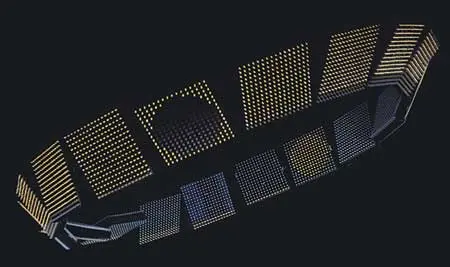
He had already done this in Moebius display (2006), development of an experimental expressive interface. This device is a LED screen with spatial and conceptual modification. Instead of being flat like most screens, it has the shape of a Möbius strip. This new, non-Euclidean space for expression is presented as an alternative output that brings to the surface many questions about our methods of visual and spatial representation. The idea of seeing a word or an image moving on a three-dimensional surface that joins together two faces in one expresses a unique ambiguity. The work allows, in this way, for two contradictory ideas, two poles, two opposites, to share a single space.
In one of his texts, the artist relates a childhood experience when he took a paper strip, folded it, and twisted it to form a ring. It was his pleasure to run his fingertip along this strip, never stopping. He couldn’t have known that he had moved from the world of flatness to the three-dimensional realm and that what he had in his hands was a representation of infinity and a non-orientable surface.
When he began Moebius Display, Bonadeo wanted to do away with the standard image encased in TV monitors, in projectors, or in printed sheets. He was interested—as he clarified in his wall texts—in creating a non-Euclidean, non-two-dimensional space. While the rectangular window is the predominant shape when we think of images (paintings, photographic devices, and film equipment), the introduction of an expressive space with a different typology adds tension to many issues related to traditional visual representation. By the very fact of presenting more than one point of view—different from the traditional perspective—Moebius's display confronts the viewer with the impossibility of apprehending all the images simultaneously presented in the strip. From that vantage, we can see how the course is on the same plane: inside and outside, the good and the bad, light and darkness.
Bonadeo refers to John Wallis’, Henry Moore’s, and August F. Moebius’ concern with the four dimensions in the 17th Century; in particular, Moebius (1790-1868) took a significant step towards the study of higher-dimensional spaces.
The symbols for infinity used by Bonadeo is also the symbol for the assimilation of opposites, which explains his frequent focus on issues of inside/outside, public/private, open/closed.
This brings to mind philosopher Gilles Deleuze, who wrote that a paradox is the simultaneous affirmation of two meanings and that it first destroys “good sense” as the sole sense, and then it destroys “common sense” as the assignation of fixed entities. 7
It was precisely professor Graciela Taquini who curated, in 2004, the show titled Vértigo, in the text for which she referred to paradoxes. In that show, Bonadeo presented No es, which featured a compass on a pedestal, forced to gyrate ceaselessly by four electromagnets. According to the curator, No es points out that “The abstracted dawn and dusk of a clock and a cardinal point appear practically identical, losing part of the birth and death symbolism and the reference to space and time. The double formal and iconographic plays, the spatial polarity, the strange experience of a landscape unhinged by chance, turn this work into something more than a geopolitical metaphor.
A historical view will reveal an interesting, almost paradoxical relationship since Max Bill used the Möbius strip in Continuity (1947), an important plaster sculpture painted in oil, and in Unidad tripartita (1947-48), made in steel with chrome and nickel that won First Prize at the 1951 São Paulo Biennial. According to Tomás Maldonado, these sculptures by Max Bill subtly refer to “the curved, non-orientable spaces” of topology and propose that the aesthetic conscience that constitutes art’s raw material accompany and expresses the shifts and enrichments that happen in the scientific awareness of space-time. 8
While they are a potent antecedent in terms of the relationship between art and science, the postures adopted by Concrete artists imply the concept of ideal handling of the matter, something that is entirely alien to electronic artists.
Bonadeo also uses the Möbius strip in Inmigrante/Argentino (2005). At one of the ends of the historical street used by immigrants as they arrived in the port of Buenos Aires, there is a white cement pedestal. On it, a transparent Möbius strip rests inside a glass cube. Written in the strip, in black letters, are the words inmigrante and Argentino, which appear with clarity or fade out depending on the time of day. In the gallery text, we found, among others, the following comment: “Through these cobbled streets, many suns came, hundreds of people who came filled with hope, people who came to these shores in search of a better life. They arrived with little more than their shadow and learned a new language, a new way of life, the customs of new land. I already knew this: after night, the sun always came back up (…). When did we become part of a culture that was alien to us? When did we start calling ourselves Argentinean?”
It is interesting to consider in some detail the questions Bonadeo poses about his identity as an Argentinean. In Cubiertas (2005), he refers to episodes of political confrontation; the horizontality of the landscape appears in several of his works. In El choclo interactivo (2005), he covered the surface of a lamp post located across from Centro Cultural Rojas with corncobs; the lamp post looks like a giant corn cob that changes as the area’s birds eat away at it and interact with the surface.
Cambio, cambio y Unámonos, both from 2002, reveal, with their critical emphasis, Bonadeo’s concern for his country. Just like Unamuno felt pain for Spain, Bonadeo feels it for Argentina.
The reflection about time that Bonadeo proposes for his viewers becomes central in Vanitas en tiempo real (2002) where, as has been traditional since the oldest memento mori exemplars, the fragility of existence and the inexorable weight of time on life and matter are evoked.
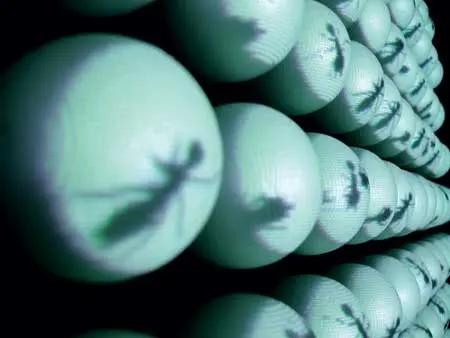
This work has a precedent in Vanitas empapelado, where, on the basis of photographic registers of the wallpaper in Victoria Ocampo’s home in Mar del Plata, generated images to be projected with insects that flew over the leaves and decorative flowers. This work was presented as part of the show Un mar de trampas, where Graciela Taquini wanted to show works situated between the secret (that which is but doesn’t seem to be) and the lie (that which isn’t but seems to be).
In Vanitas en tiempo real, a camera captures a middle shot of the viewers moving under a light source. This image is projected in real-time on an hourglass aromatized with naphthalene. As time passes, the projected image fades out and is lost on the glass of the timer, and the projection moves to the gallery floor, switching from the vertical to the horizontal.
The intense light that illuminated the skeletons or the broken objects in older Vanitas is turned here towards the audience, who—as in other works by Bonadeo, like those he made with thermometers—becomes a triggering factor.
The hourglass reminds us of the real-time passed, and its glass reflects our images as digital technology intervenes to push the image downwards. As Bonadeo puts it, the two superimposed mechanisms produce a strong representation of the impossibility of stopping the flow of time.
In conversation with Alejandro Schianchi, he tells me that having studied electronics in a technical college provides him with a way of seeing and understanding the world from a very different vantage than that of someone with a background in the humanities; thus, in order to generate an image or a sound, he focuses immediately on the logic-mathematical process that produces it.
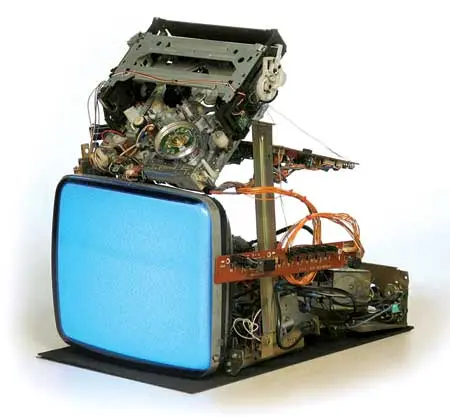
In the text for the catalog of Schianchi’s most recent exhibition, RE:VISIÓN errores de reproducción, 9 Jorge Zuzulich notes that in the contemporary context the world of images means, specifically, their technical configuration. The first device to relieve the artist from the manual inscription on the support was photography, then film, television, video, and digital images. This trajectory has been marked by the possibilities for constructing images that are inscribed in the very logic of the technical apparatus, which unfolds from photo-chemical sensitivity (photography) to mathematical algorithms (the digital realm), passing through projection and movement (film) and electronic signals (TV/Video).
In that show, Schianchi investigated the aesthetic potential of the use of error in audiovisual devices. His interest has been to propose a positive way of looking at events that can emerge from their malfunctions. Unlike those who use these devices without the knowledge of the process through which images are generated, and so are constrained to their predetermined functions, Schianchi uses unforeseen events as a way of transcending the supposed limitations of the technology. He likes to think of this as the device’s “imagination.”
This is because this artist, a tireless prober of boundaries—his own and those of the devices he employs—always seeks to expand the possibilities of creation.
Thus, one of the works in the exhibition mentioned above was produced on the basis of interferences on wires and a broken digitalizing board; another one was a recording that decayed as the days passed, disappearing in the end; and the third one presented a segment of Star Wars in an antique black and white television set, with interferences in the signal.
According to the artist, errors, failures, and accidents allow him to know the substance of the material with which he is working. This permanent awareness of the fact that his relationship with the image is always mediated, constructed, and destroyed by technology drove him in 2011 to create—among others—a work that took one of the best-known reels in the history of early cinema (1895 short by the Lumière brothers) and rendered it in digital form; this is to say, he transformed the image into pixels, the unit for digital imaging. Slowing down the original sequence and running through amplification, the pixels, which are normally hidden, are put clearly on display. Schianchi says he was interested in emphasizing digital aesthetics from its very support, traversing older technologies such as the videotape, VHS, and celluloid, in the understanding that the image moved through all of them.
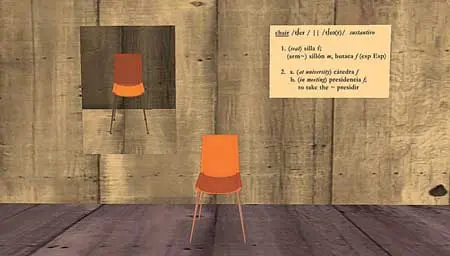
Schianchi situates himself in the tradition of conceptual art. One of his works alludes directly to this circumstance. It dates from 2009, and the idea was to update the conceptual-art tradition to the new conditions of electronic supports. For this, he chose Joseph Kosuth’s mid-1960s One and Three Chairs. 10
Kosuth posited that all artworks in an analogous relationship to a certain kind of linguistic proposition; thus his focus is on language. Schianchi resignifies Kosuth’s work through a performance in the virtual realm. He gives another turn to the conceptual screw.
Kosuth proposed three levels for the image of the chair. In transposing it to the virtual realm, a radical difference is established at the level of representation, as it has entered a virtual, mathematical universe where everything is to a degree the same: code. While the conceptual artist displayed the presence of the textual anchored in the matter, in the case of our electronic artist the work of art dissolves into the world of the virtual.
After exhibiting the video of his performance, Schianchi developed a second version as an installation. It consisted of a photograph of Kosuth’s work, a video projection of the recorded performance, and a mirror reflecting the projection.
The levels start to pile up: the idea of an author as a work of art; the idea of another author on that basis; and a virtual presentation of that idea reflected in a mirror. As professor Norberto Griffa said: "Kosuth, cubed".
Levels of reality and similarities are altered by a new concept. A view en abîme, a reality in flight.
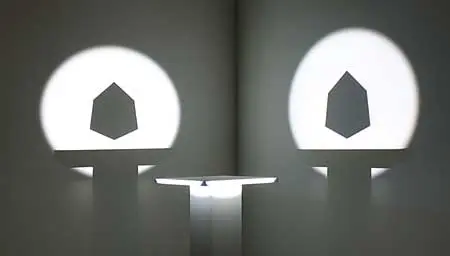
Another work by Schianchi connected to the issue of the virtual realm is Untitled (2010), an aesthetic and conceptual experiment about the possibility of bringing a purely virtual creation into the physical world.
It is comprised of a pedestal (for an absent work) that is in turn projected onto two light circles on two walls, and a video featuring the shadows of a three-dimensional volume seen from two perspectives. Based on the shadows, the viewer is able to reconstruct the object as if it were placed on a pedestal.
The sculpture is not there, and it shape-shifts. The shadow is generated by a video projection. We see the shadow, yet there is no object.
Once again Alejandro Schianchi explores the creative potential of technological devices and the limits (the traps?) of our perception.
Asked for his definition of the electronic arts in an interview, 11 Mariano Sardón replied: “While the electronic arts are all those that incorporate electronic technology into any part of the artistic process, these works are not pure. There is art… then the process engages with robotics, electronics in general, mechanics, sculpture, painting, etc.
“I am talking about formal, material aspects of electronic works, meaning video screens, robots tending artificial gardens, interactive works, etc. The artist also embodies different roles in such processes, involving electronic technology: at times, an engineer; at times, a scientist. The electronic arts, then, are arts that incorporate electronics, both formal and paradigmatically, into the artistic process. Behind any technology, there is a way of looking and construction of the world, and the artist operates with them.”
Sardón believes that in some cases there is no break with traditional modes of art centered around the closed object and the relatively passive role of the viewer, but in other cases, the artistic process is forcefully displaced in terms of those connections and the interactive relationship, so that the artistic object is built with the involvement of the audience.
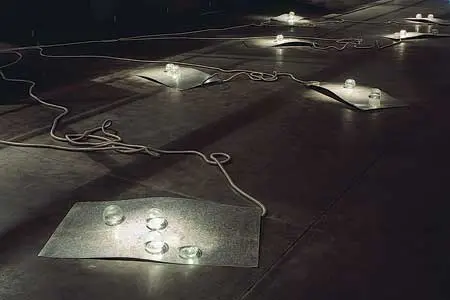
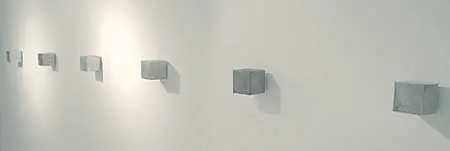
Some of Sardón’s works relate to natural processes. In four works included in the exhibitions titled Cero absoluto, 12 he brought to the fore systems based on the action of heat on water: Texto entrópico, water pipes and metal plaques; Cero grado, variable-measurement refrigerated pipes; Gradientes discretos, a series of aluminum cubes (12 x 12 cm.) that sustain different temperatures; and Lógica difusa, transfer on antimony cubes, 4.5 x 11 cm.
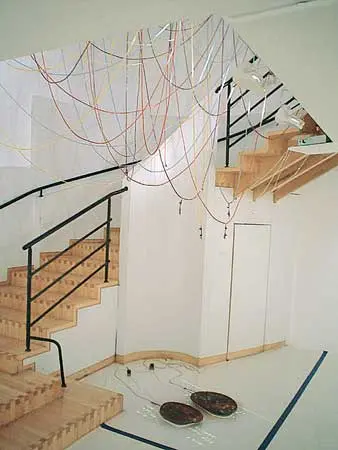
“Suddenly, we find ourselves in the middle of a field of forces and meanings, a space dominated by a chaotic assemblage of color pipes circulating water that descends from above and then changes into steam as it is heated by the planks resting on the floor, producing a text that reproduces the Second Law of Thermodynamics. At the same time, with its opposite, replicas of the frozen tubes in Cero grado.” 13
In these works, we notice a constant of Sardón’s work: the word, and also the presence of cubes.
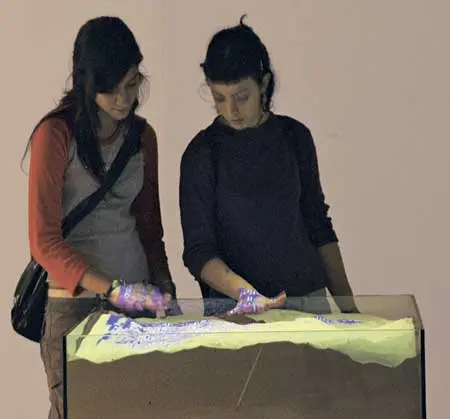
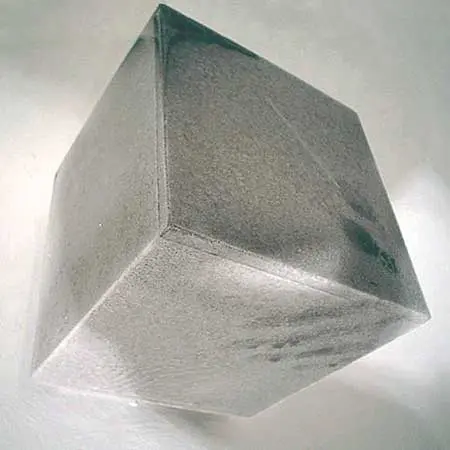
In Sardón, the cube is no longer a pure shape in space; it opens itself up to the action of the viewer. The installation Libros de arena (2003-2004) consists of two glass cubes filled with sand that, touched by our hands and interacting with their motion, produce lines of code taken from the Web.
In Libros de arena, a piece of the dynamics of textual interrelations that makes the Web emerges for an instant, materializing in the images of codes and site contents that emerge to follow the play of our hands in the sand and then disappear.
This work models the relationship between the viewer’s hand movements and code from Web sites containing texts by Jorge Luis Borges. In his story El libro de arena, Borges describes an infinite book, without beginning or end. Its pages are numbered in a random fashion, this book changes every time it is opened. The writing is impossible to follow; it only reveals fragments of itself as the pages sift through the reader’s fingers.
Writer Guillermo Martínez has spoken of Sardón’s work as a tactile game and emphasized the passage from gestural play to the contingent materialization of texts spread through the Web.
I see it, also, as an invitation to reflect on language, which is not a finished product but an ongoing process; as Cassirer has it, an energeia, not an ergon.
Not by chance, Sardón uses texts by Borges, a demolisher of certainties who anticipated the idea of a world in flux and who find in fictional plots the last refuge for a kind of thinking that unfolds in a realm of supreme freedom. 14
A precedent in the use of words was Divergencia diferente de (2001-2002), where the sounds of viewers are responsible for the exchange of words projected on two open books. Their clapping triggers the dissemination on the floor of texts that flow from two books containing opposing arguments.
Another interactive installation was a=b (2003), included in the show Variaciones sobre el museo: Recordar, Catalogar, Ordenar 15 There, the movements of the audience in the space leaves traces of letters that, in crossing one another, light up words on a screen.
Mariano Sardón has written that “game strategies disseminate, break apart, and rejoin the text. These works are like opening the game of interpretation so that there are no centers or univocal meanings so that questions are foregrounded so that there is a traffic of words that evolve.”
In the work of this artist, we perceive the prominent presence of the senses: sight, smell, hearing, the sensation of space, the passage of time, the flow of events.
It doesn’t always require objects: the appeals are many and do not resolve themselves in binary oppositions; rather, they seek to locate themselves in the Deleuzian “between.”
Sardón’s operation has continued to produce works that are increasingly more complex, open, and indeterminate.
Cultivos estocásticos (2005) is another interactive installation that produces the visualization and soundification of textual activity as it originates in computer keyboards from the Museum’s various administrative offices. 16
In Peristáltica (2008), we see transparent pipes through which colored water circulates. Each call received in telephone station 17 introduces an air bubble.
This last work was part of the large project titled Telefonías, developed by a group of professionals under Sardón’s direction. The proposal was, basically, to intervene in the space of the Foundation and site of the Juncal central, operating on the relationship that exists between its cultural and artistic activities, and the communication technologies developed there.
Telefonías proposes an experience of the static, solid architectural space that is traversed by the volatile and ethereal aspects of an electronic activity that moves through floors and walls as an invisible grid. This material, unmoving space becomes transportable and dynamic on the basis of the electronic flows and the communication it contains.
The works included in Telefonías are based on the notions of event and simultaneity, in that, they change and update in real-time. 18
These artists present us with the challenge of proposals articulated in a new kind of work of art, one that is open and process-centered. We must, in consequence, be able to find the possible interpretations, new conceptual apparatuses, new symbologies of meaning. ‘
Art offers no answers. It only poses questions.
NOTES
1. Calvino, Italo. Six Memos for the Next Millennium. New York, Vintage International, 1993.
2. Paul Valery, quoted by Italo Calvino.
3. Oliveras, Elena. Arte cinético y neocinetismo. Hitos y nuevas manifestaciones en el siglo XXI. Emecé arte, Buenos Aires, 2010.
4. The use of the word robot has been questioned from a linguistic standpoint. The word was put into circulation in Prague (the land of the Golem) by Karel Capek in 1920.
5. Wiener, Norbert. The Human use of Human Beings: Cybernetics and Society. New York, Da Capo Press, 1988.
6. In Arte y Nuevas Tecnologías. MAMBA award, Telefónica Foundation, 2004, 2003, and 2002.
7. Deleuze, Gilles. The Logic of Sense. New York, Columbia University Press, 1990.
8. Maldonado, Tomás. Max Bill. Ed. Nueva Visión, Buenos Aires, 1955.
9. At Arte x Arte Gallery, 2011.
10. Where he presents a chair, a photograph of the chair, and the dictionary definition of a chair.
11. Verónica Castro
12. Ruth Benzacar Gallery, 2004.
13. Griffa, Norberto. El gabinete del Dr. Sardón, unpublished.
14. Bulaccio, Cristina. Los escándalos de la razón en Jorge Luis Borges. Ed. Victoria Ocampo, Buenos Aires, 2003.
15. MALBA, Buenos Aires.
16. MALBA, Buenos Aires.
17. Telefonías, Espacio Fundación Telefónica, Buenos Aires, 2008.
18. Messi, Victoria and Sardón, Mariano. Investigación tecnológica y práctica artística. El proyecto Telefonías.
NELLY PERAZZO
Nelly Perazzo Member, Academia Nacional de Bellas Artes