
One thing that has been defined over the last decade in Regina Silveira’s potent, proliferating poetics, besides her construction of emblematic works in spaces and architectures conquered to the urban polis, is the pace of her artistic production, almost a fervid state as her ongoing poetics, also filled with decouplings, rereadings, and metamorphoses. This being the case, we can find and observe works that are entirely new and others that revisit matters previously left unresolved In this way, each work, as it peers into issues not exhausted before, becomes a ceaseless source of questions in the process, in motion. The artist’s restless gaze, then, is never regulated by mere chronology, by the linear itinerary of what occurs. Her poetics come closer to a signals-seeking radar. And in this veritable feedback, Fora de escala is a paradigmatic exhibition, as it contains invention and memory, history, and surprise. Silveira moves—in explicit and metaphorical ways—towards an impregnating sleight of hand: that which makes us uncertain of the proportions of the representation as an argument for visual readability, as a mandatory factotum; an entire system of fidelity to the image brought down at several points in this exhibition, like spectral traces.
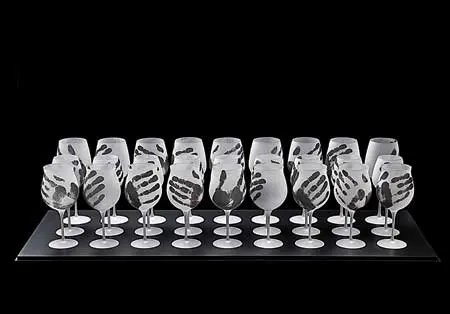
But Fora de escala doesn’t only have proportion as its referent. In fact, what is always in play, always under siege, is the very system of representation. Scale, as a guideline and measure of assumed proportions, directs us to a rational consolation of our understanding, for a certain kind of aesthetic journey. But Regina Silveira’s speculation about the image has for decades had as its poetic norm that very demystification of referents and codes. Thus, there is in Fora de escala a universe around the traces/marks/vestiges of our hands that links and articulates every work in the exhibition (except for one). The main work, Touch (2013), occupies the central area of the high Luciana Brito gallery with a large installation of metal plates (aluminum composite) engraved open-palmed hands, which places us in a Gulliverian situation and perspective, a state close to perceptual (sensorial, cognitive) perplexity. As the artist puts it: “Who is out of scale? The image or the viewer?” although a different, more political bias, frequent in her work, cannot be discounted. Here, the hands, despite their gilded seductiveness (with sacred undertones), are not calming; they have the character and the sign of power, of their at times overwhelming force. (It is not unimportant detail that both Touch and Dark Swamp (Nest), the show’s other large installation, originated in Silveira’s visit to New Orleans for the city’s second post-Katrina biennial, although neither was installed there; the second one was set up only for Extranjerías, MUAC, Mexico, 2012). On the other hand, what these hands involve is a denotation of the ancestral, another atavistic relationship between sign and body, which also extends, at a different visual register, to the phantasmagoria inscribed on the glass of a set of goblets that subvert any idea of their everyday use, since they are dream-like images as indicated by their title: Dreamer (2013). This mixture of everyday and strange—unequivocally surrealistic in flavor—destabilizes our common sense.
Our visual sanity is also poked at in the upper level of the gallery, with three connected works: the collection of images from the artist book and the video Arte de desenhar (1978 and 1980, respectively), where graphic and cultural gesturality is brought forward as a historical and conceptual matrix for two new works that are paradoxically intertwined: Classic (2012) and Una vez más (2012). The sculpture of a hand has almost-human proportions, but the imagination that raises its finger up, and the very material (Carrara marble), are loaded with potent irony. The middle finger, more insulting than accusatory, has the convincing air of a joke and an insult, as a countervailing contrast to the terrifying Touch, which climbs the walls. This sculpture-joke set against the air that envelops everything—our times, so open and so docile (in historic, ontological, and existential terms)—gains an unsuspected critical filiation, even greater if possible, in its “conversion” into an animation video, where the same hand and the same upraised finger turns slowly in a pink-tinted, almost holographic image, its fatal irony amplified by the metallic screech of the soundtrack (by Rogério Rochlitz).
If in Fora de escala there is such a narrow definition of repertoire and imagination, another universe opens up in the adjoining gallery, with Dark Swamp (Nest), an installation that involves an extension of the plagues already revisited by the artist in Admirabilis e outras pragas (2008). The mass or large-sized crocodiles arranged on the ground and the walls—taken from Natural History treatises—generates a terror-inducing environment, especially with its center occupied by an immense black egg that is the origin and organic, visual cell, and also a premonitory warning of cataclysms beyond nature itself. As the latent and threatening spread of a contemporary plague—“of the evil of power as fate and prophecy,” according to the artist. Fora de escala, in sum, calls us to the identity of an indispensable poetics that knows how to turn the image-fiction and the image-friction into a single nature.
ADOLFO MONTEJO NAVAS