
Titled July 14, the Manifest of the Wandering Rooster and Other Stories…, the second exhibition by Argentinean artist Sergio Vega (1959) follows his first show in 2009, and just like that one, it includes the results of a project that the photographer has been working on since 1995 about the notion of paradise in the New World. This time, the objects and texts by the artist have disappeared, and, punctuated with photographs, they become the connecting thread of his journey-stroll across Mato Grosso in Brazil. The enigmatic but suggestive title refers to the history of France and its emblem, the rooster. Then, what is the connection between that reference and Vega’s exploration inspired in a text by the Spanish chronicler from the seventeenth century, Antonio de León Pinelo, who in his writings placed the Garden of Eden in the middle of South America. We almost suddenly understand that Sergio Vega, a “lonely wanderer” from the 21st Century, associates memories and reality and that his “wandering” made of encounters, impressions, and remembrances, it is often reminiscent of dreaming while awake impregnated by contemporaneity without ever excluding it. Indeed, these “intimate diaries” on display for the viewers to evaluate, offer reflections that fit one inside the other, as each idea (or image) gives birth to another, in a mirror effect infused with poetry, humor, and diversity of inquiries. Literary or philosophical references are abundant and pertinent. Without overloading the narrative, they broaden his field of erudition and invite us to share the intellectual and iconographic associations of the photographer.
In this exhibition, Sergio Vega proposes that we accompany him through a journey that, with the last exhibition room, reveals its initiatic nature. Indeed, the spatial trajectory is constructed in such a way that it takes us to that which Vega calls “the sublime.” The progression is chaotic; crosses towns, forests, no man’s lands; stops, offers written and visual testimony; resumes, places the gaze upon a lost rooster, in a succession of extreme combinations that “New Realism” would not object to. And it culminates in contemplative ecstasy, beyond time and space, in landscapes surrounded by mist. The descriptive and reflective narrations by Vega for a second lead us to testimonies from those European travelers from the nineteenth century that “discovered” America, described nature—Los Andes and the Orinoquía with Humboldt—society—prints by Jean-Baptiste Debret in Brazil—or, like Désirée Charnat, the tropical forest and culture photographs of Mayan monuments in Mexico. But Vega is a knowledgeable witness of his time who does not solely navigate between two shores, like the travelers from the 19th Century, but also between several geographies and diverse cultures, in search of the (his?) lost paradise.
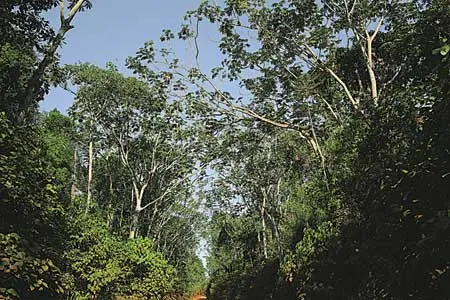
The exhibition begins in the largest exhibition hall, where eight medium and large format color photographs are on display. Four texts accompany the visual declaration and become part of it, as they invite viewers to a constant back and forth between both discourses to penetrate the significant imaginary of the artist. The texts Dans la Forêt (In the Forest), Le Chalet Américain (The American Chalet), Une Moitié et Une Moitié ne Font Pas Un, Mais Deux Moitiés Différentes (One Half and One Half Are Not One but Rather Two Different Halves), and Le 14 Juillet (July 14) determine the chiaroscuro photographs of undergrowth and trees, those of an ashlar house, of the satellite dish, or the steam shovel. Luck and coincidences unleash images and induce subliminal messages as they transform photography into a fetish.
The peregrination continues along the corridor with the text L’énigme du 1444 (The Enigma of 1444), in which the motif of a green portico, with no practical purpose in the middle of an empty plot, elicits a correspondence with the trimmings of some tree leaves—a fragment of Tristes Tropiques by Lévi-Strauss accompanies the text. The second exhibition room focuses exclusively on what Sergio Vega calls The Wandering Rooster Manifesto in Four Steps (four large-format photographs illustrate this title). A garbage dump where urinal reigns and a plucked rooster wanders about invokes surrealism and the ridiculous rivals the comical. Citations by Breton and Dante accompany the photographs, as well as Isidore Ducasse’s famous founding formula “As beautiful as the random encounter between an umbrella and a sewing-machine upon a dissecting table.”
In the last room, the text Le Sublime (The Sublime) is accompanied by nine small formats of a landscape enveloped in mist and two large photographs of trees and undergrowth. It is glare, “a world that—as Sergio Vega writes— where the phantom of maternity is the other that comes from within; the true and not the false. That which has no end since there was never a beginning.” Paradise is there, in all of its virginal purity. Sergio Vega has brilliantly known how to take us there through alternative routes, but never allowing us to lose sight of the fact that “randomness and the absurd, chaos and entropy” founded his conscience and gaze to help him rediscover with the “nostalgia of the Edenic condition,” that which Mircea Eliade denominated the “Great Time” or the “Primordial Time.”
CHRISTINE FRÉROT