
Ironic isn’t it? At a time when the ubiquity of images allows everyone to claim the mantle of artistry, a major response of artistic endeavors and artists is to turn into the everyday world of and for everyone. Obviously, this is not the first such attempt but usually, there’s some type of social revolution going on. Think Russian Productivists or post-Mexican Revolution fervor, the Bauhaus, or the populism of 1930s USA. But how does today’s momentum differ from early avant-garde modernism? The answer promises to be (we hope) more pervasively sustainable but with many miles yet to travel. The laboratory initiated by the Cuban artist Tania Bruguera is part of that exploration.
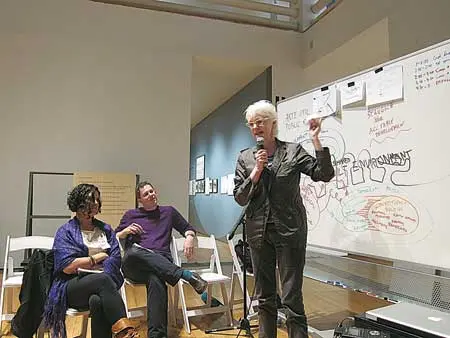
The phrase arte útil is more of a long-standing theme for Bruguera, and translates most commonly as “useful art.” The Arte Útil Lab is not an exhibition but a process for not one but multiple artists, spaces, and projects whose current and temporary staging of the first of three phases is in the Queens Museum. The two other phases will take place more broadly in the future. The second phase will select three artist residencies later this spring at Bruguera’s“Immigrant Movement International,” a community center located not far from the museum. And it will end, if it has an end, this fall in some sort of installation in the Van Abbemuseum in Eindhoven, the Netherlands.
The first phase has two major parts, but typical of Bruguera’s projects, each of those has multiple sections and continues past experiments while designed to continue into multiple futures. The most concretely physical component is the so-called Library which currently is a collection of emblematic objects and records well- and lesser well-known socially designed projects by whom the San Diego, California-based Ricardo Dominguez calls “artivists.”
His collective, the Electronic Disturbance Theater (EDT), the most infamous project hangs on the wall, its innocuous quietude at odds with the federal lawsuits and protests against it. The Transborder Immigrant Tool is a mobile phone programmed with their software and a GPA system designed to provide global position information as well as guidance to water for those crossing the Mexican-US border by foot. A document table provides literature for and images of Danny Samuels and Rick Lowe’s Row House Project in Houston, Texas.http://projectrowhouses.org/ which provides low-cost community housing that incorporates public spaces and preserves historical community relationships.
More recently in date, they (perhaps unintentionally) provide a contrast to the way activist art functioned earlier. Krzysztof Wodiczko’s Homeless Vehicle Project of 1988-89 is a vehicle built as a mobile street shelter to provide space and components for not only sleeping and washing but bottle collection and storage. Although it is purportedly utilitarian and co-designed with input from street dwellers, it operates more as an indexical symbol by bringing into visual prominence the often hidden (and disgraceful) social problem. The older more typical function of “art” objects with a social conscience has evolved into the more defiantly but less dramatic, by art standards, projects that Bruguera and the outreach of the Queen’s Museum supports.
There are at least nine other such projects currently in the Library, including a copy of Tom Finkelpearl’s most recent book What We Made: Conversations on Art and Social Cooperation. As museum director, his influence is also felt in the Queens Museum's separation of public programming from the more typical museum outreach programs of education. The Director of Public Events, Prerana Reddy, focuses on community engagements, working with artists’ projects near the museum, and has on staff a full-time community organizer to work with community organizations and connect artists and cultural producers. This role of the museum as a social practitioner and platform is unique and far-sighted.
Quieter still yet more far-reaching is the other section of the first phase, the labs. A series of panels and four different working groups were the most down-to-earth and refreshing conversations I’ve heard in a long time due to their engagement with not only real-life problems and projects but in their simultaneous acknowledgment of the important role for artists in helping to initiate and assist public projects while at the same time deal with their limits, dangers, and practical considerations. This is not the early 21st-century much-heralded (and quite self-serving) “creative class theory” but an admixture of old vanguardist coalitions with broader human capital, one more fully aware of the inherent problems of avoiding top-down directives or bottom-up chaos and the realization of the difficulties of maintaining sustainability. It is as labs should be, testing hypotheses based on current models and evolving protocols. Participants not only presented and debated current projects but will reconvene in several months to reassess and present reworked hypotheses for public input.
RICHARD LESLIE