There are automatic and mathematical associations. The former benefit from the mind’s proclivity to go on a whim down the first slide that it finds, while the latter invites it to follow an algorithm of familiar transit but of unexpected results. We automatically interpret a spoon’s vertical stem as a viscous drop about to pour into the pit of another spoon (Untitled, 2003). By contrast, we refuse to adjudicate the shadow of a fork to another spoon because (Untitled, 2000) the photographic medium—without Photoshop—in which the image is presented compels us to compute the absurdity of the situation and to infer in its design intelligence that defies us. In Chema Madoz’s photographic oeuvre similar kinds of relationships between objects spark in the viewer these types of associations. Even though Madoz has allowed himself ever-increasing degrees of autonomy with regard to the production of his images, his work has maintained a constant poetic dimension. The following lines are an attempt to understand Madoz’s unique oeuvre by placing it in a certain psychological and mathematical tradition of calculated photography.
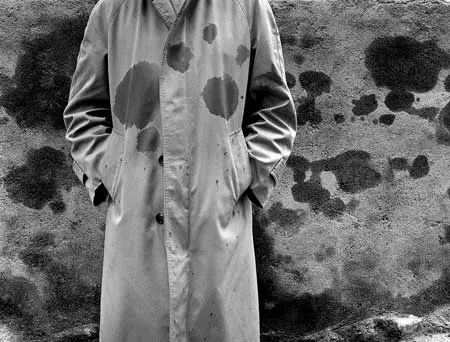
In the works Madoz produced in the eighties, his modus operandi resembled that of Henri Cartier-Bresson pre-photojournaliste (1929-1934), whose own vision and friendship with several Surrealists somehow predisposed his gaze.1 This stage of Cartier-Bresson’s work and of Madoz’s first phase is based on the unusual finding and/or the surprising coincidence. According to Arthur Danto, this work of Cartier-Bresson comes close to the automatic mental processes that nourished the Surrealists. Danto quotes Surrealism’s leader, André Breton: “automatic writing is a true photograph of thinking.” The idea was to use such writing to represent unusual situations whose logic (or illogic) would submit them as products of thinking liberated from reason’s governance.2 Translated to a photographic project Breton’s dictum warns the photographer against intervening in the situation that is to be photographed; in other words, against rational control. In Behind Saint-Lazare station, Paris, 1932 did Cartier-Bresson ask the man to jump over the puddle, or was he ready to photograph in the precise moment in which that individual jumped? Automatism requires the latter, although it would not surprise us for the answer to be the former. To raise this question to Cartier-Bresson appears irreverent while to ask a similar question about one of Madoz’s images is to insist on what is obvious. It is no coincidence that the man in the gray suit is wearing a three-pointed handkerchief that repeats the architectural pattern behind him (Untitled, 1985); and it is no accident for the man wearing the stained raincoat to be standing in front of the spotted wall (Untitled, 1984). We know that Madoz is capable of making stains on that raincoat of just the right size to produce the desired effect. For him, there are no “decisive moments,” 3 only visual ideas that a photographic way of looking suggests and that Madoz executes in a more calculated way than the one offered by the mere act of finding.
Nevertheless, the similarity between the work of the early Cartier-Bresson and that of Madoz’s first phase lies precisely in capturing certain improbable relations between objects that surprise the viewer and cause him to think. An ironing board at the edge of a swimming pool turns into a diving board that propels us away from tiring domesticity and allows us to plunge into soothing waters. For Cartier-Bresson, the coincidence between objects is—almost as a matter of principle—spontaneous while for Madoz it is provoked. For the former, the calculus begins in the search whereas for the latter it only begins at finding.
Someone who is acquainted with the neighborhood in Madrid where Cartier-Bresson photographed some children playing and an obese man walking in front of a strange building with small windows (Henri Cartier-Bresson, 1933), may not see in this photograph the Surrealistic elements that Danto sees. It is difficult to know just how Surrealistic Cartier-Bresson’s images appeared to the 1930s run-of-the-mill viewer when the photographic medium had just begun to produce this type of image. Although he forged a modern photographic aesthetic based on the unusual finding, today such images would not qualify as Surrealistic. On the other hand, Madoz’s images elicit in the viewer such an immediate Surrealistic reading that the critic must be wary of the easy course of interpretation in that direction.
We infer from the chronology of Madoz’s oeuvre that in it there is not necessarily a “progress” of methods. Instead, each phase is a “season” in which one strategy works better than others for certain images and one to which the artist returns when needed. His works tend towards artifice, personification, ambiguity, contradiction, hyperbole, metaphor, and of course, association. These tools also belong to the arsenal of poetry. If in his first phase Madoz cashed into the aesthetic of the unusual finding, he must have understood that placing it in a postmodern world more reluctant to be seduced by it required a greater challenge. Our weltanschauung is no longer modern. The dry branch whose shadow draws veins in a forearm (Untitled, 1987) adorns a world in which we have exploited nature to the point of exhausting and dissecting it. Gone is the modern optimism coined in the premise that the knowledge to use nature is power. Nature no longer runs through our veins; if it did, it would poison us with our own toxins. To say that Madoz finds this image is not a correct description of this act. If there is a finding, it is only the initial step that precedes intervention.
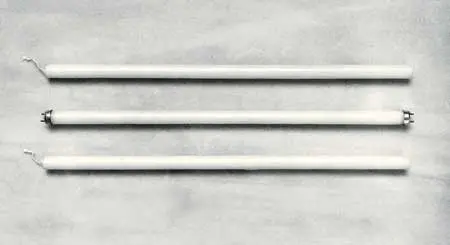
Madoz’s interventions are part of the creative autonomy required to fabricate images without the censorship of the medium’s conventional restrictions —which in addition, he has no reason to abide by. It is not irreverent to insist that in his second phase Madoz does not limit himself to finding and placing objects but also unabashedly brings about situations manipulating and pairing objects that would be almost impossible to find together. The fluorescent light tubes paralleling the candles (Untitled, 2001), and the glass that has spilled its clear liquid onto a puddle astutely drawn with a white thread (Untitled, 1987), are examples of such interventions. For Cartier-Bresson and certain Surrealists it was important to show that daily reality was Surreal even without intervening it. For others, both Surrealists and Dadaists, “reality” was not that important. It should not surprise us that the clearest photographic precedent for Madoz’s second phase should be Larmes (Man Ray, 1932), a work by Emmanuel Radnitzky. Radnitzky’s adoption of the alias Man Ray evidences his disdain for what is “real.” Man Ray placed on the cheek of an actress two glass beads that simulated tears and then photographed her “tearing” eye. Larmes crisply exemplifies one of the premises of that other undercurrent of Surrealism: things can be something more than what they are. For our postmodern temperament perhaps this insight that Surrealists and Dadaists share with symbolists, magical realists, astrophysicists, movie-makers, counter-insurgency forces, shamans, ad-agencies, etc., is more relevant than that other premise that simply alerted us that reality is often surprising.

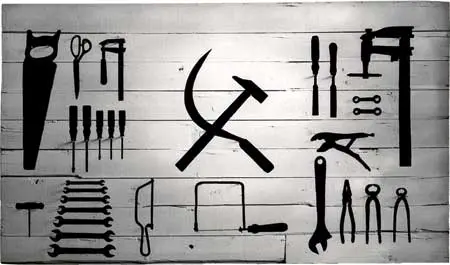
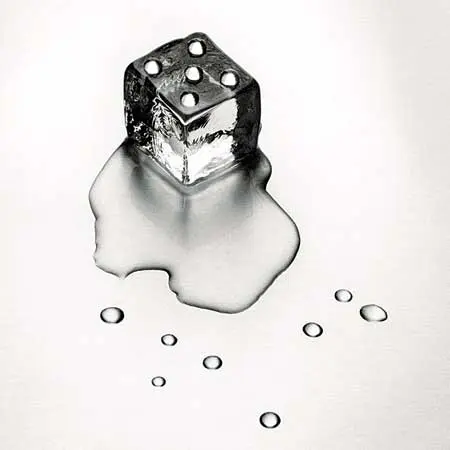
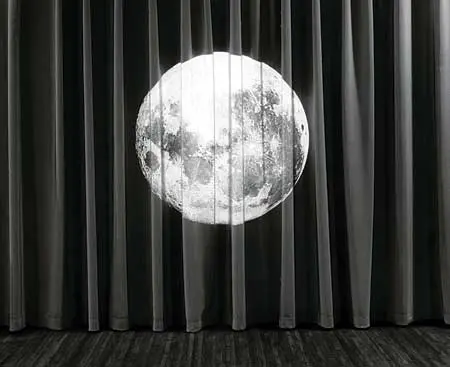
Undeniably Madoz has produced images with such a clear Surrealist lineage that they even seem to be coined in the syntax of René Magritte. Such is the case of the moon behind the curtain (Untitled, 2004), the cracked eggs and cup (Untitled, 1994), and the match whose flame is the wood’s vein (Untitled, 1994). Yet this second phase of Madoz need not deliver us to Surrealism but to our current world of deceptive appearances, virtual worlds, disinformation, ideological uncertainty, obsolete technologies, religious revival, etc. The cube die melts (Untitled, 2002) while the statuette of the Virgin Mary is about to illuminate the world with a flash (Untitled, 2003); and, someone removed the hammer, sickle, and the other tools leaving only their silhouettes (Untitled, 2000). Those silhouettes clearly allude to Magritte’s Alphabet of Revelations (1929).
Madoz has several works that subvert the use of the checkered board of the rational game of chess. They make us think that deceptively familiar games are being proposed for playing on that same board but with different rules. They are games that subvert the rules that usually define them. In one of them, there is a square on the board that is not a flat figure but a camouflaged solid (Untitled, 2004). The solid figure hides in the flat geometry of the board and stands like a wall that impedes the game. Is there behind this clinical and playful image of Madoz an allusion to the subversive use of the rational resources of the very societies that provide them? Is it a contradiction in terms to attribute to this image of a game a serious interpretation?
In his third phase, Madoz constructs centaur objects. Generally, these constructions consist of fusing two or more objects which had a previous function and existence and which after fusion become part of a novel and fertile semantic network. These are not objects without precedents as some of those strange objects by Donald Lipski might be. Madoz’s mode of construction is similar to that of mythology which concocts centaurs from humans and equines. Perhaps Picasso’s Head of a Bull (1942), made from the seat and the handlebar of a bicycle is their clearest ancestor. The difference lies in that: implicit in many of Madoz’s constructions are perspicacious psychological, social, and political comments. Of course, the virtues of Picasso’s readymade lie elsewhere. The shopping bag with a pearl necklace as handles (Untitled, 2004) depicts a certain feminine personality with a consumer addiction. The earth globe qua disco mirror sphere (Untitled, 2001) puts us under the same dancing club atmosphere in Tokyo, Moscow, Nairobi, La Paz, etc. The diamond ring as bait in an animal trap (Untitled, 2003) reminds us of one of Joaquín Sabina’s anti-romantic verses.
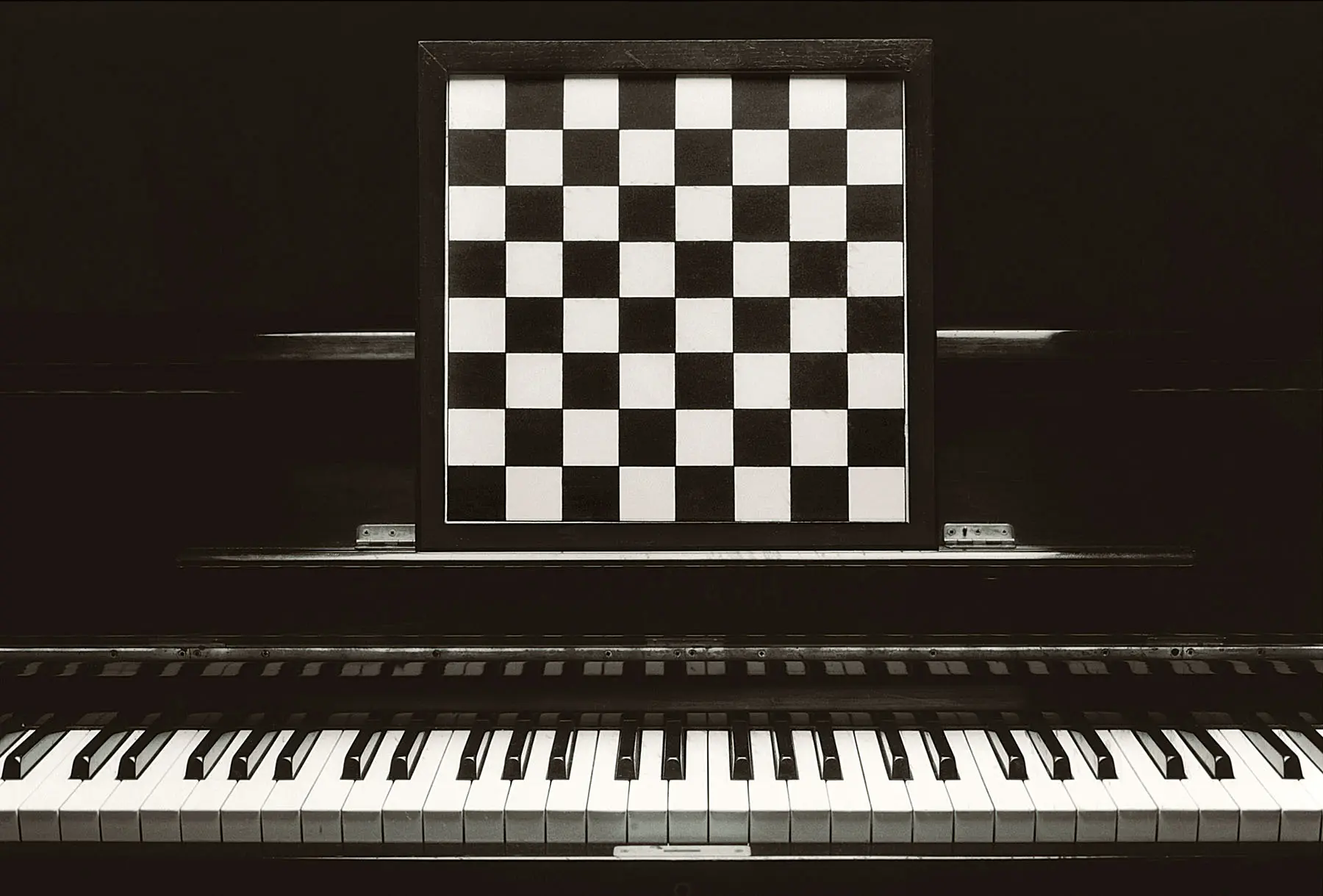
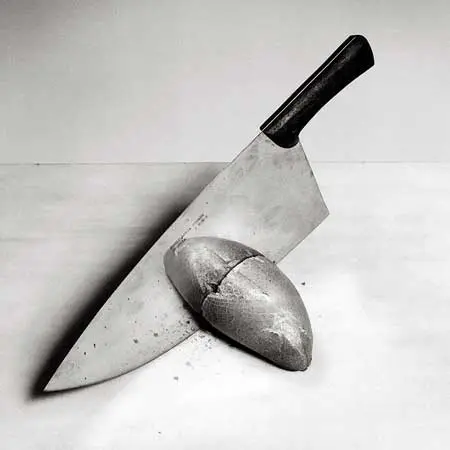
The objects constructed by Madoz have the pulchritude of the Bauhaus manufacture but they have no utilitarian purpose, only a poetic one. Although many could very well be works of art in themselves until now Madoz’s works have been only the photographic images of the objects he builds. These images are the final product of a meticulous photographic process that matches the careful construction of the objects. The photographic shots have mathematical precision. Images with water drops or puddles like one of the pieces in the liquid puzzle (Untitled, 2005) require very precise lighting in order for the shapes to be appropriately outlined. In some cases, it would seem that one-and-only-one photographic shots of the objects he constructs function as artwork. Such is the case of the multiplication of bread in the reflection on a knife’s blade (Untitled, 2001); or the chess board qua musical score above the piano’s keyboard (Untitled, 2004). The trompe l’oeil in some of these images would vanish if they were shot with different lighting or from another vantage point.
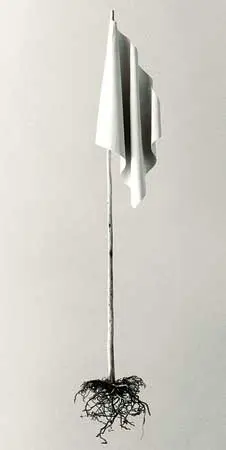
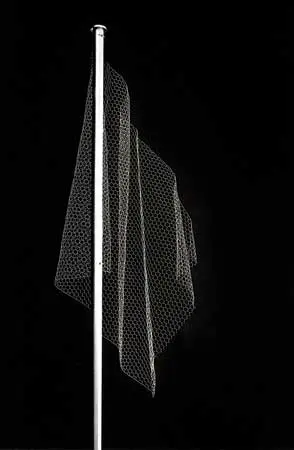
Metaphor and visual irony are the main poetic tools in Madoz’s oeuvre. But that irony does not immunize his works against serious readings. The flag made of wire mesh (Untitled, 2005) is an eloquent comment on the symbol par excellence of the nationalism that divides humanity. The white flag whose pole has been uprooted (Untitled, 2005) is a somber reflection on peace projects. Madoz generally avoids the written text as an integral part of his works, or as clues to their interpretation. The exceptions to this generalization are few and they deserve special attention. We will only mention one that serves us well: the brass knuckles in front of which Madoz has placed a B and in the back of which he has placed an M (Untitled, 2005) in order to spell BOOOOM, a mean blow. By means of irony poets often tip us off about the possibility that in our feeling, thinking, and acting humans, too, could have a different and even better existence. What is paradoxical to the point of having Surrealistic overtones is that Chema Madoz, without words and by means of his images and constructions alone, could be one of those poets.
NOTES
1. On occasions André Kertész also used the strategy of coincidence that Cartier-Bresson practiced.
2. Danto, Arthur. Encounters & Reflections: Art in the Historical Present. New York: The Noonday Press, 1991; pages 133-137. The Cartier-Bresson’s exhibit that Danto is commenting on is partially included in the book Henri Cartier-Bresson: The Early Work. New York: The Museum of Modern Art, 1987.
3. According to Dan Hofstadter, for Cartier-Bresson there were no “decisive moments” either; at least until someone else suggested the phrase to him. “In 1952, his friend Tériade, the Greek-born publisher who had earlier created the art review Verve, brought out the first comprehensive book of Cartier-Bresson photographs. Called “Images à la Sauvette” —the idiom is suggestive of speed and furtiveness—it appeared in the United States as “The Decisive Moment,” and this title, which soon became a catchphrase, did much to confuse the American public about Cartier-Bresson’s intentions.” (Hofstadter, Dan. The New Yorker, pages 59-93. October 23, 1989).
FERNANDO CASTRO R.
Artist and art critic.