
A hangar that measures 9,500 square meters and 30 meters high, which houses the installation titled The Seven Heavenly Palaces by Anselm Kiefer, has become the venue for the most recent solo show in Europe by Wilfredo Prieto.
The large dimensions of the HangarBicocca allowed, for the first time, the inclusion of several large installations, a format that Prieto has been exploring since the beginning of his career and that he has conceptualized into poetically expressive images based on scale contrasts, among other strategies.
Thus, a 60-ton crane [Untitled (Crane, 2006)] unsuccessfully tries to lift itself; and a mobile electric generator and a water tanker feed a small plant in the interior of a gallery in Mucho Ruido y Pocas Nueces (Much Ado About Nothing I, 2003). The disparity of scales in Prieto’s works, both physically and semantically, can be used as a good guide to walk through the exhibition and to contrast the different past and present operational elements of his work.
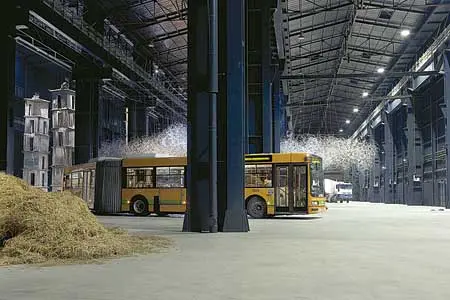
In Equilibrando la Curva (Balancing the Curve), one of the pieces specifically created for this exhibition, Prieto maintains an approach that favors visual impact based on minimally intervened raw materials and mundane objects: a bus with the emergency lights on and tires “supported” by one Euro coin in Equlibrando la Curva (Balancing the Curve, 2012); a haystack that hides a small needle in Una Aguja en un Pajar (A Needle in a Haystack, 2012); a cement truck stuck in the very cement it was pouring in Monumento (Monument, 2008). These new pieces complement earlier works of similar monumentality, like Avalancha (Avalanche, 2003-2012), with hundreds of spherical objects arranged from smaller to larger, and Nebulosa (Nebula, 2010), a tangle of barbed wire suspended from the ceiling. It is important to add the presence of three small works that bring to bear a discourse previously rehearsed in the exhibition entitled Tied to the Leg of the Table (CA2M, Madrid, 2011), where Prieto constructed enigmatic images based, once again, on elements from everyday life: Dos Zapatos y Dos Medias (Two Shoes and Two Socks, 2012), a literal representation of the title; Dos Piedras y un Espejo (Two Stones and a Mirror, 2011), a stone reflected by a mirror; Estrella Muerta (Dead Star, 2010), a burnt match. Most of the small pieces by Prieto do not reveal a direct statement, as they required a keener gaze that is on the alert for the semantic constructions presented after the images. In other instances, like this one, they can be better interpreted in their condition of ideas associated with earlier works or as explorations for works yet to be completed. Following this line of thought, we are able to connect the work Dos Zapatos y Dos Medias with Prieto’s 2008 piece Desnudo (Nude) that consisted of women’s clothing dispersed across the gallery; Estrella Muerta with his emblematic piece Escala de Valores (Scale of Values, 2001), piled plastic cups with liquid residues in them: and lastly, One Million Dollars (2002) a one-dollar bill whose image is reflected ad infinitum between two mirrors. These associations reveal an interesting aspect in Prieto’s work: a great part of the meaning of the works is in the connotations brought out by the materials and objects that he uses.
A good curatorial decision was the inclusion of Avalancha. Despite being one of the exhibition’s most ambitious pieces and the one with more presence in the catalogs and publications, it had not been exhibited since it was presented at the 8th Havana Biennial. It is a work full of propositions and symbolisms that anticipate interests latent in Prieto’s current work: the exploration of “pure” forms, and the use of diverse materials; the simple operability that stimulates an endless number of associations and interpretations; the tautological principle of the reiterated form that contains itself: the precise, accurate formalization alongside the idea; minimal intervention; the notion of the artist as an archeologist of every day; the terrestrial transformation of metaphysical matters; among others. Avalancha, which flattens most heights and reaches Anselm Kiefer’s towers, is a sort of conceptual Matryoshka in the exhibition.
For some years now, the works by Prieto reflect a certain determined apolitical posture. While his famous work Apolítico (Apolitical, 2001) would employ the term with a clear ironic tint, or even more recent works like Políticamente Correcto (Politically Correct, 2011), or Izquierda/Derecha (Left/Right, 2011) still flirted with the political, the exhibition at HangarBicocca focuses on a group of works—like Monumento and Nebulosa—that confirm Prieto’s lack of interest in the subject, while they reveal a turn towards a more cerebral phase centered on formalism.
Part of this formalism is the role played by a literality—the evolving resource in the current work by Prieto—that is present in pieces like Dos Piedras…, Dos Zapatos,,, and Una Aguja… The point of departure was Grasa, Jabón y Plátano (Grease, Soap, and Banana, 2006), a small sculpture, placed in the center of a gigantic space, whose title is the precise description of its materials in the order they are presented. Three elements allude to the fall, the slip, and by being piled up one on top of the other contributors to the tension between the image and the possibility of the fall. The literality in Prieto is manifested in two directions: from the title to the work and vice versa. The first possibility occurs when the title is a shallow description of the work, without implying any poetization of an image whose interpretation is left open, like in Dos Zapatos… Pan con Pan (Bread with Bread, 2011), Agua Bendita (Holy Water, 2009), among others. The second approach is the representation of a proverb or saying that delegates the interpretation of the image to the very phrase contained in its title like, for instance, Una Aguja en un Pajar, Una de Cal (2011), Y Otra de Arena (2011), Mucho Ruido y Pocas Nueces II (Much Ado About Nothing, 2005).
Balancing the Curve fulfills two purposes: On one hand, it identifies a moment of consolidation in Prieto’s work, and on the other, it stands out for a more experimental approach that is visible in his smaller pieces.
DIRELIA LAZO