
The Cuban-born Alexandre Arrechea began his professional career as a member of Los Carpinteros. From this association, one can see certain obvious threads in Arrechea’s works, including an interest in mining the mutually held territories between art, architecture, and design, as well as exploring innovative formal means to convey the various forms and objects that can be produced within these shared territories. Perhaps even more importantly, however, is the shared sensibility that formal concerns are not mutually exclusive with social issues, and that playfulness and wit can be subversive and meaningful.
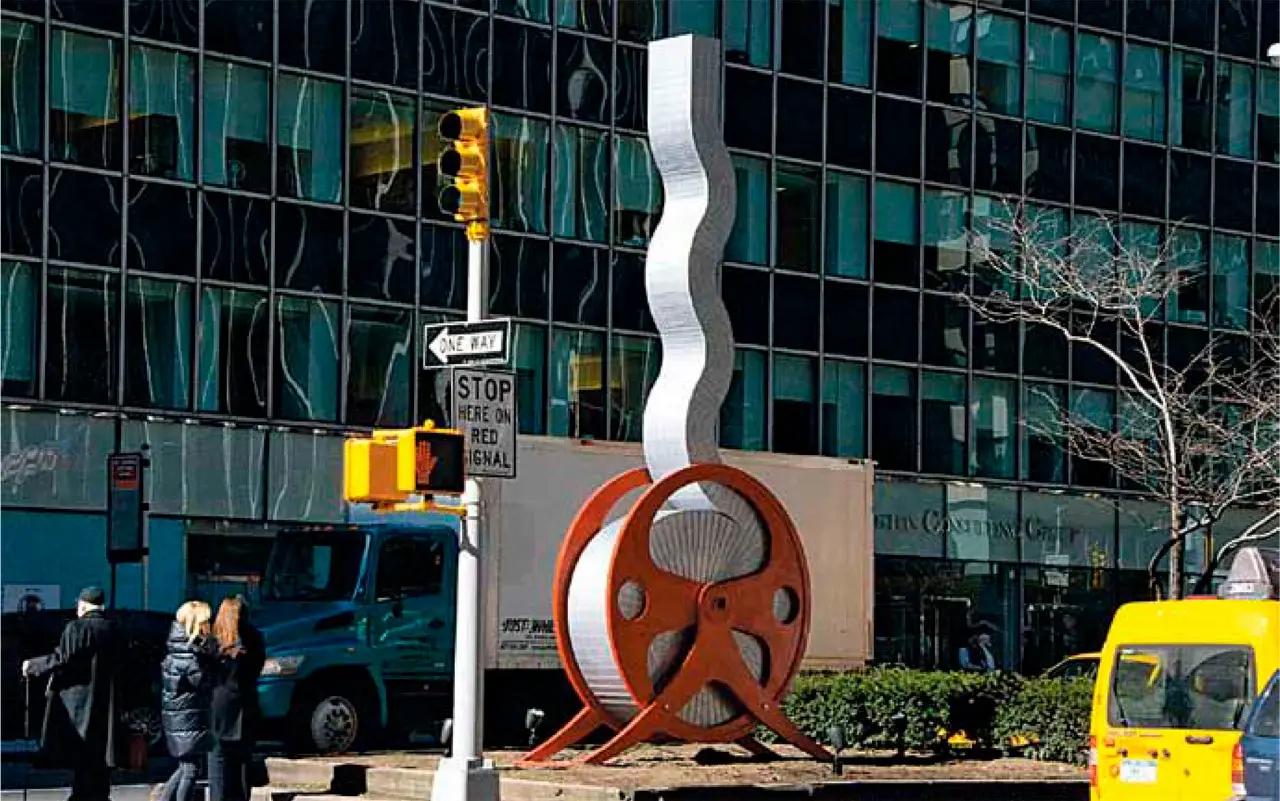
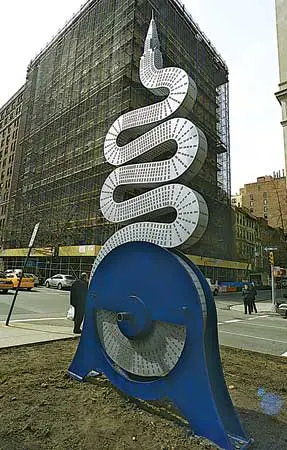
Arrechea has the opportunity to demonstrate this with his current major project in New York City, No Limits, which has been realized as a collaborative effort in conjunction with New York City’s Department of Parks & Recreation, and The Fund for the Park Avenue Sculpture Committee. Situated at either end of the medians that run along Park Avenue in midtown Manhattan is a series of large sculptural reinterpretations of landmark Manhattan iconic buildings. These large sculptures are at once lovingly reverent and laughably deconstructive. A close examination of each work reveals the meticulous attention to detail, from the time window apertures to any sculptural or molding detail work. At the same time, these buildings have been recontextualized in laughable impossible ways: the classically monolithic Seagram’s building for example now undulates upward in a serpentine fashion from support as if it were a giant fire hose. The Citigroup building is perched somewhat fancifully upon a brightly colored children’s spinning top. And with special panache the Flatiron building, that stalwart Iron Lady that helps to anchor the crazy influx where Broadway and Fifth Avenue collide and intersect one another has been hoisted along one angle onto a pole and suspended as if a lightweight flag.
All of these inventive choices are full of whimsy and have an undeniable entertainment value. As public art, they have an obvious appeal to many viewers, from casual lookers to more critical connoisseurs as well as from visiting tourists to those who know these buildings well. For all their ease of accessibility, however, they are no less thought-provoking. What can it mean for an artist and intellectual born and educated in one of the few countries existing today that has managed by and large to avoid surrendering ideologically to the hegemony of global capitalism to be engaged in a project that predicates itself upon structures that by and large embody that corporate sensibility? Virtually every structure in the show represents some major corporate or financial institution; almost of all them were built and developed as private or company projects. It is telling to see such tall and straight structures of strength and power rendered as pliant and serpentine or lightweight or at the mercy of the whims of fate like a spinning top. At the moment of global capitalism’s supposedly greatest triumph we are in the depths of a global recession while the very institutions responsible act with increasingly open malfeasance under such defenses as “Too Big To Fail,” a concept at once laughable and horrifying.
In addition to the Park Avenue works, Magnan Metz Gallery is exhibiting a fuller realization of Arrechea’s vision. Included in the gallery exhibition are dozens of smaller-scaled sculptures done in the same subjects as the larger works. Although these are referred to as “maquettes” not all of them were translated into larger versions and all of them can stand independently on their own. In these works the smaller scale allows for a slightly expansive use of materials and sense of playfulness of form—they all seem more toy-like at this size—and of course, there is a new sense of the unfamiliar to all viewers when engaging these giant icons rendered in such a different relationship to one’s body. Adding to the visual experience is a series of works on paper: bright watercolors with sharp dynamic compositions that seem to set these architectural fantasies to life; and a series of starkly abstracted lithographs that turn these new structures into powerful corporate logos for the new era.
Arrecha has been gaining a great deal of international attention in recent years. He represented his native country in its first-ever pavilion at the Venice Biennale in 2011 and has been engaging in intriguing projects around the globe. If he can maintain this keen balance between engaging humor and incisive intelligence then his should be a career worth following for quite some time to come.
JOHN ANGELINE
Art historian.