
Once again it is Puerto Rico’s honor to introduce the visual-arts world to an extraordinary artist who in a short time has established himself as a force to contend within the realm of twenty-first-century aesthetics and ethics and their provocative, daring gazes: Ángel Otero.
Otero (Santurce/San Juan, Puerto Rico, 1981; lives in New York City) has had a meteoric ascent. No Puerto Rican artist had reached such levels of international recognition since the impressive careers of Arnaldo Roche Rabell, Enoc Pérez, Allora & Calzadilla, and Melvin Martínez, to mention but a few local artists who have reached international renown and valuation.
After studying at the Universidad de Puerto Rico–Recinto de Río Piedras for five years and working as an insurance agent, Otero decided to move to Chicago. Once there, he was admitted into the prestigious School of the Art Institute, where he graduated with the admiration of his peers and professors, as well as that of art critics, for the strength and originality of his work, which challenges the canons of painting (experimenting with textures, collages, and the three-dimensional, and even combining painting with “sculpture”). Otero was invited to exhibit in various galleries and his work sold out at important art fairs such as ARCO; he received the Merit Scholarship Award of the Chicago Art Institute and the Annenberg Foundation’s prestigious (and generous) Leonore Annenberg in the Performing Arts in support of his development as an artist.
Once in New York City, the young artist followed the philosophy that defines him: a tireless worker, ready for anything that poses a challenge, trusting in his “ignorance” and in chance; Otero is not afraid to experiment. He dislikes it when his latest work is assumed to be connected with what he did before. “In the art world that becomes a double-edged sword, you become typecast, and then it is very difficult…”
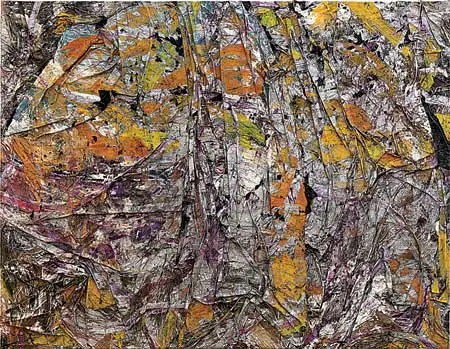
Ángel Otero: Recent Work – 2012.2013, which opened on February 28, 2013, is Otero’s first solo exhibition, and it has been a complete success. This fascinating selection of what he has been doing in the field of painting (other works belonging to the same collection will be on exhibit, under the title of Material Discovery, first in Savanna, Georgia and later in Hong Kong) comprises seven large-format works—oil paint skins collaged on canvas—very well arranged in the gallery’s ample walls. In these works, the artist again plays with textures and different three-dimensional elements, his “skins”, which are the result of a complex creative process where Otero works with several wet or dry layers of oil paint, at times resting for an entire month and then returning to it, in order to bring them to life—be it organic experiences, journeys through the universe, sensuous waves, erotic precipices. But what takes place between what the artist begins to “paint” and the final product is a game of freedom. In an interview, the artist admits that “I can control fifty percent or less of the final result, but these constraints and the uncertainty are what initiates the dialogue I aspire to create.”
Otero summarizes his technique by saying that he begins by applying layers of oil on a piece of glass. Once the paint is halfway dry, he scratches it from the glass and then applies a layer of oil to the support (where he has painted before) to create a dense texture. This creative process will produce startling waves, bursts, energies of color, unexpected folds, new dimensions, dialogues or secret games, poetry.
The artist who arrived in Chicago with Jackson Pollock as the highest representative of what happened in the New York School, and who later developed an interest in the work of Willem de Kooning and Franz Klein, and even later in Cy Twombly and France’s Nicolas Poussin (he titled a group of works Poussin Series), the artist who acknowledges that his work “plays with the history of painting, specifically the use of oil paint and how I use it in my painting… wanting to understand how the manifold possibilities of this material can be used and teased out,” has become a star, and it is a fact that what we have in front of us is a series of dazzling works of art that take abstraction to entirely new places.
MANUEL ÁLVAREZ LEZAMA