
During the months of December, January, and February we attended an exhibition that moved many followers of the art world. It was the exhibition entitled AZIMUT by Anna María Mazzei, presented at the Galería D’Museo, in the Centro de Arte Los Galpones (in Caracas, Venezuela). Here, Mazzeo synthesizes in twenty works the fruits of her most recent research and underscores the creative maturity and visual solidity of some achievements that, far from betraying the constant elements of her artistic career, here are prolonged and enriched: namely, nature and its many meanings, as well as the interaction between support and content and the behavior of intertwined visual codes.
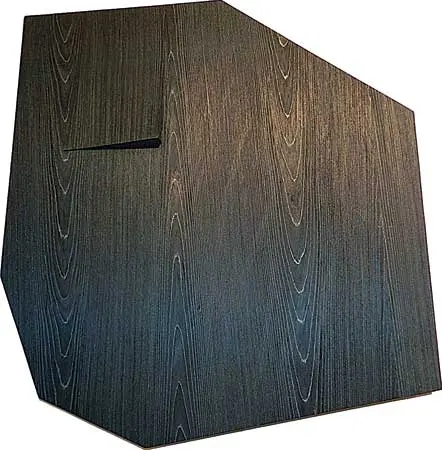
We stand before tranquil and thoughtful works, apollonian to a certain extent, but also impulsive and intuitive as well as challenging and daring. The interesting thing is that these multiple games of impacts coexist without interference or the risk of confrontation. Indeed, the planimetrical coexists with the volumetric while the organic fuses with the inorganic; the sensitive intertwines with the perceptive: all at the service of energizing pronounced ambivalences that attract the most heightened of curiosities and the most demanding of delights. Of course, here the equally important, intriguing, challenging, and surprising elements of the works develop alongside as planes are suddenly impacted by apparent incisions that turn out to be turgid volume irruptions that in some cases attempt to be discrete, while in other instances seek to demonstrate their inescapable presence. Undoubtedly, the works attain a supreme combination of the visible with the tangible. In other words, they open the possibility of visualizing the inexpressible or making the inexpressible appear with subtle self-sufficiency. It is clear that Anna María Mazzei favors overcoming dimensionality through her masterfully achieved high-resolution images. The artist undoubtedly succeeds in combining the sedimentation of a geometric code with the establishment of a sensible statute. And this is only possible based on her masterful visual technique and clear aesthetic concept. This is the manner in which each piece reveals a disciplined commitment where improvisation is not bound by the times. The resulting product always reveals an intense relationship between Mazzei and her work.
Contained within this dynamic of the implicit and explicit, there is also the contribution of translucent layers of surfaces that show the veins, streaks, and marks that characterize the wood that serves as the background. Muted colors also establish their leading role as they are combined with the other visual codes that appear in each work. These works actually appear to be part of an evolution in which each one registers an impulse supported by earlier experiences, but without relenting it specific expressive and decisive particularity. In each case, the turgidity appears or hides in different zones and with changing pressures. They act as tightly held implicit angles that demonstrate, as Ernesto Sabato has said: the artistic trade consists of not being noticed. Based precisely on that affirmation, it is important to underscore the interest that Mazzei has demonstrated in themes associated with space. Such interest is reflected in surfaces with translucent chromaticisms that interact with the pressures from the background, as they masterfully combine the physical surface with the phenomenological space. Thus, this artist conquers a vital sensation that invades that which appeared to be extreme silence. Likewise, the form of the supports adds a contribution of their own, given that in some cases they subscribe to the conventionality of the frame, while in some other instances, they are launched to the conquest of strange hexagons that expand and contract to favor that every creation reveals the reasons behind its own existence. These technical precisions are part of the aesthetics statutes, given that they add a perceptive effect to the entire visual result. Anna María never loses the purpose of her inquiries, giving plenitude to that which results from combining imagination and sensitivity.
VÍCTOR GUÉDEZ