Lisa: a historical perspective
Esteban Lisa’s (1895-1983) works are now internationally known, but during his lifetime the painter chose to keep his oeuvre out of the limelight; thus his works often do not figure in studies of the history of abstraction in which they played a part. In recent years, numerous exhibitions have allowed specialists, museum professionals, and collectors to become acquainted with this artist, who began to paint in the early 1930s. The 1999 Lisa retrospective, which was organized by the Museo Nacional de Bellas Artes in Buenos Aires two years after the initial efforts by Nelly Perazzo and Mario H. Gradowczyk, signaled a turning point in the recognition now accorded this Argentine painter with Spanish roots.
The publications that have accompanied the discovery of Lisa’s œuvre have begun to situate the artist in the historical and cultural context of Latin American abstract art. The exhibition Cold America. Geometric Abstraction in Latin America (1934-1973) admirably demonstrated the extent of this contribution.1 Other events have taken place at a range of institutions, including major venues such as the Museo Torres-García in Montevideo, the Fundación Antonio Pérez in Cuenca, the Museo de la Universidad Nacional de Tres de Febrero in Buenos Aires, the Fondation Audi in Beirut, the Museum of Latin American Art in Los Angeles (MOLAA) and reflect the kind of attention now paid to Lisa’s work.2
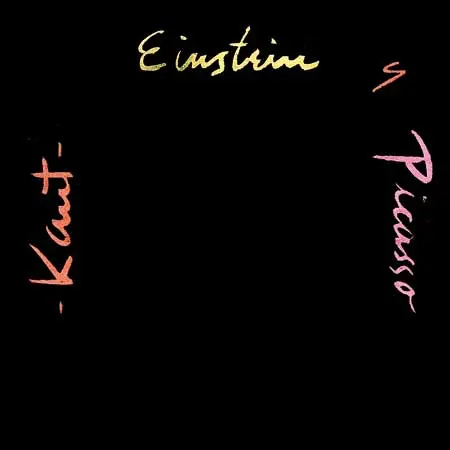
This recognition is all the more remarkable if one considers that the artist—an autodidact who worked for the Argentinian postal service—remained indifferent to the call of the avant-garde. This said he was not indifferent to the direction taken by artists such as Pablo Picasso, Piet Mondrian, and Paul Klee to renew the very concept of representation. Lisa’s œuvre evolved counter to the theoretical precepts that punctuated the development of abstract art. The artist did not sign any manifestos. But this does not mean that his work lacks a theoretical foundation. On the contrary, Lisa published an essay in 1956 that served as the basis for his teaching at an art school that he also founded.3
Lisa was not a member of the Asociacíon de Arte Constructivo, which was founded in 1935 in Montevideo by Joaquín Torres-García. Nor did he collaborate with the Instituto de Arte Moderno in Buenos Aires that opened in the 1940s. Lisa also did not join the Grupo de Artistas Modernos de la Argentina (1952)—a further reflection of how his work unfolded in secret, day by day, like an intimate journal. This is because, for Lisa, abstraction was a radical existential experience. It demanded, on one hand, the full engagement of the self in the creative act, and on the other, a type of artistic purity that rejected all forms of careerism. The artist left Spain, where he was born, for Argentina in 1910;4 there he lived on the periphery of avant-garde groups. This independence allowed him to create a protective barrier for his oeuvre, which he removed exactly twice: once in 1949, on the occasion of a collective show of works by art professors and in 1956, to accompany his essay. Numerous other pieces were discovered by Lisa’s students after the artist’s death in 1983.
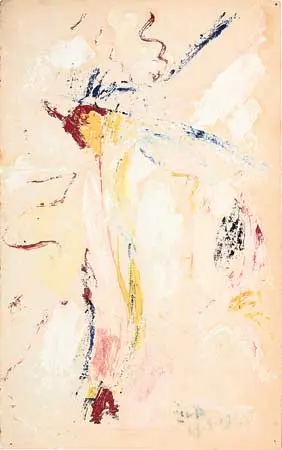
Lisa’s distanced position vis-à-vis the art world raises a number of methodological questions. What references are relevant when speaking about anœuvre that intentionally positioned itself outside the context of artistic institutions? Where in the history of abstraction can one situate Lisa›s painting, without falling into the trap of superficial comparisons? This said Lisa›s work is undeniably related to pictorial research carried out by some of his contemporaries. His work is not entirely isolated. We are reminded that Alberto Greco exhibited his Tachiste gouaches in 1957 in Buenos Aires, where an informal aesthetic had begun to appear.5 Lisa was in a position to observe ongoing developments in painting. The visual affinities between Lisa’s first works and inter-war painting trends—or again between his series Juego de líneas y colores and Abstract Expressionism—begin to emerge.
These affinities, however, cannot be traced to concrete professional exchanges. Lisa did not collaborate with any of the diverse avant-garde groups that influenced the history of abstract painting in the 20th century. How then can we describe these affinities? Firstly, as with artists from Constructivist groups that formed in most European countries, Lisa discovered a spirit of geometry in the painting surface, the modulation of tonalities in relation to forms, and the fundamental elements out of which he could develop compositions that were balanced, rigorous and clear. Secondly, for Lisa after 1945—as was the case for artists of the Cobra group—the image became something fluid, unstable and orgiastic, a poetic space like a force field, in which there symbolically manifested energy that one is tempted to call “cosmological.”
A pure plasticism
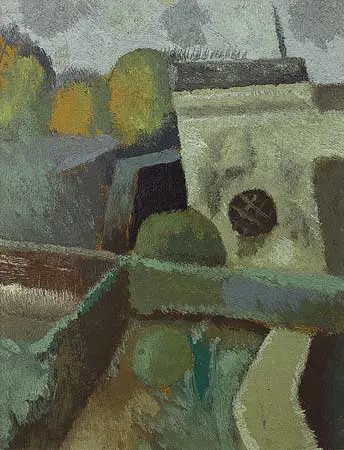
The geometric approach that characterizes the painter’s initial abstract works from the mid-1930s clearly arises from an encounter with the urban landscape. Lisa’s constructivism is therefore not a response to Cubism. This fact separates him from the majority of other pioneers of early abstraction. Lisa’s road to abstraction during this period was not due to an overlay of the cubist analytical approach to landscape—as was the case, for example, with Mondrian, one of whose works appears in the 1956 essay. Lisa’s abstraction stems from a paring down of the landscape. Reduced to a few essential lines, nature is transformed into a mosaic of evenly-colored planes. Beginning with these first works, Lisa can be considered one of the pioneers of what is called, for lack of a better term, Latin American Constructivism.
Lisa’s pictorial research is inseparable from his teaching activities at Las Cuatro Dimensiones (The Four Dimensions), the school he created in 1955.6 It appears that Lisa considered artistic education a formative factor in human development. This has nothing to do with the collectivist ambitions of the majority of schools that contributed to the development of Constructivism, like Inkhouk in the Soviet Union and the Bauhaus in Germany. Above all, Lisa was a painter. He saw the image as its own endeavor, and not as something at the service of a social project: he didn’t perceive painting as a space of formal experimentation whose goal was the reinvention of social structures.
In this respect, it is remarkable that Lisa’s works were conceived in the presence of a reserve. This reserve—the unpainted zone that surrounds the image—should not be seen as a gap or an emptiness. Rather, it is an integral component of the image’s autonomy. This autonomy imparted to the painting by the frame bears witness to the fact that Lisa’s vision of creation was clearly not utilitarian. As regards Constructivism, this is one of Lisa’s major differences, even though he adopted its visual vocabulary.
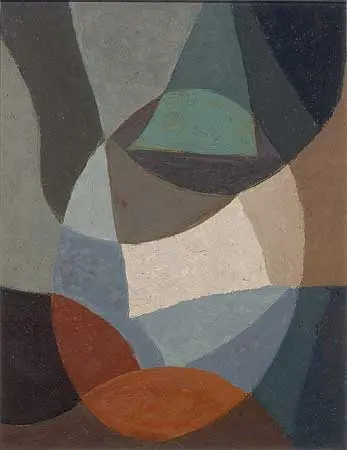
Concerning this visual vocabulary, it is important to note that Lisa’s compositions’ precise division into contingent surfaces is not the same as the pure orthogonality characteristic of Mondrian. Lisa is visually close to someone like Paul Klee, with whom he shares the same geometric approach tempered by intuition. But what is the nature of this affinity?
Lisa put into practice a number of principles that served to soften the geometric framework of his color planes—these include superimposition, contiguity, and rotation. On the one hand, the superimposition of planes appears to bear the direct influence of Klee’s paintings. The surfaces blend one beneath the other. On the other hand, the color planes are not aligned in a grid system, like Mondrian. Lisa also employs curved lines to abut the planes one against the other. Finally, Lisa created a visual dynamic using rotation. This positions the planes around each other. The artist also makes use of the circle whose shape gives rise to a rotational movement. Superimposition, contiguity, and rotation are dynamic forces that break up the inertia of a pictorial image. These planes are made up of moving elements that bring about—slowly and in silence—the flowering of the image.
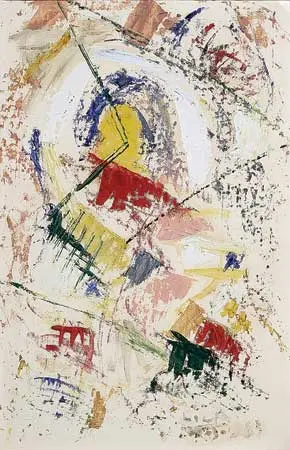
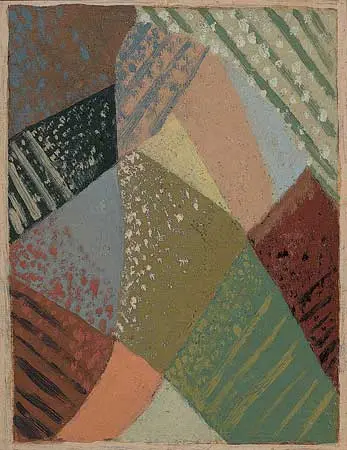
Lisa’s break with the static image led him, beginning in 1941, to energize his geometric structures by adding a network of points here, or a system of lines or marks there. These elements create an optical impression of movement. This is the beginning of Lisa’s abandonment of a strict geometric layout that, in 1953, will give rise to the two series Juego de líneas y colores and Acto Espacial.
Lisa: lyric painter
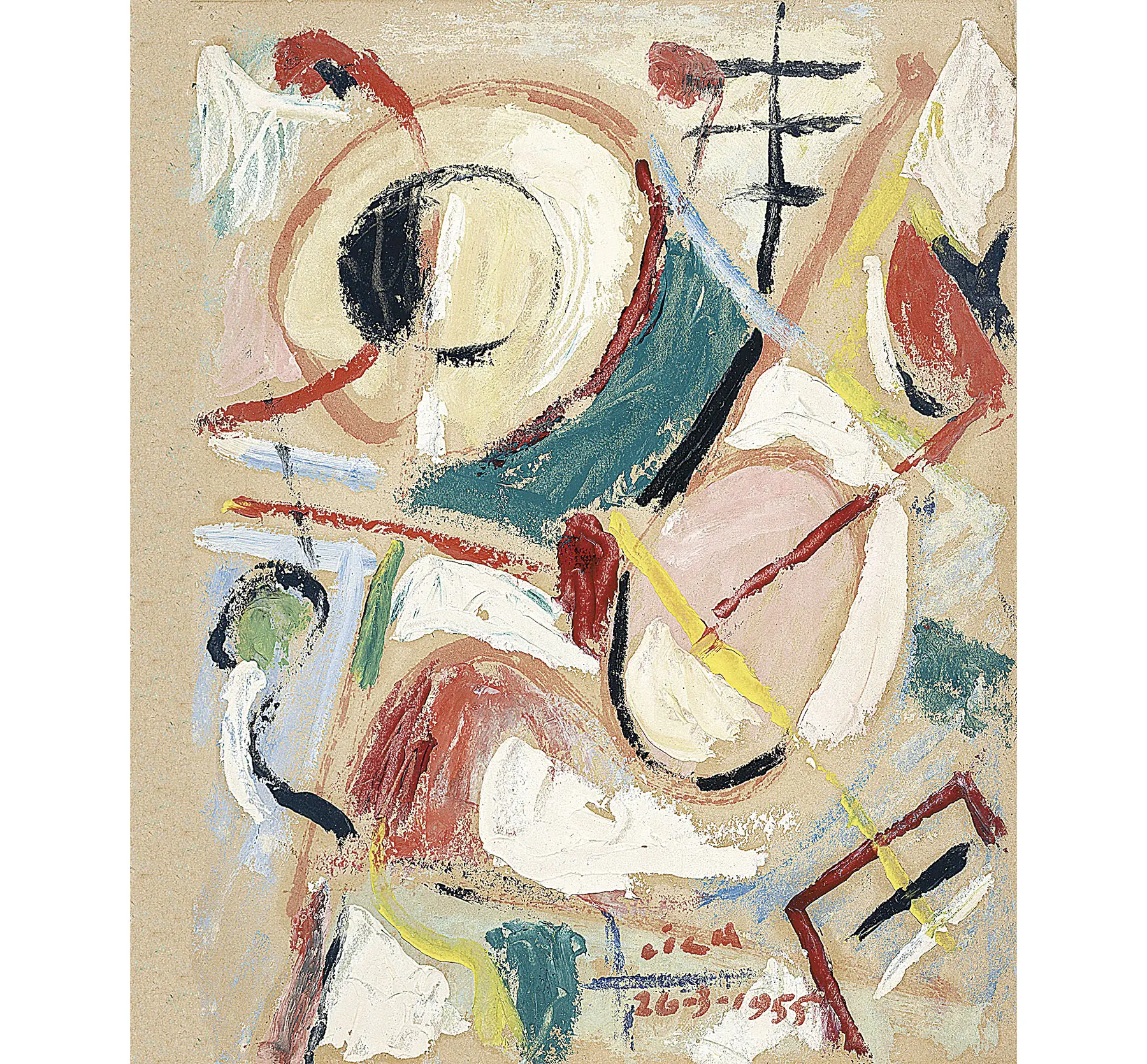
In 1955, Lisa founded the Escuela de Arte Moderno, Las Cuatro Dimensiones in Buenos Aires. A year later he published his essay Kant, Einstein, and Picasso, accompanied by three illustrations of his works (Fig.1). This essay preceded the ten-volume The Theory of Cosmovision, on which Lisa worked between 1962 and 1980. The artist consequently dedicated himself to the exploration of a new series titled Juego de líneas y colores, which would occupy him until the end of his life. This series can be divided into two main parts: an “informal” period, from 1953 to 1960, followed by a second informal phase, which was also “matierist” based. This second phase can be likened to certain works produced by artists of the Cobra group.
Before drawing this analogy, however, one must immediately note that Lisa’s Juego de líneas y colores is not Action Painting, a comparison regularly made by critics. At the risk of entering into too much detail, it perhaps suffices to say that the literalness of Action Painting’s large-scale format, the technique of “dripping”— the projecting of paint onto the canvas or paper without direct contact with the brush—the nearly choreographic involvement of the body in the act of making a picture, the absence of hierarchy in the treatment of the picture’s surface: one finds none of these characteristic elements of Abstract Expressionism in Lisa’s work.
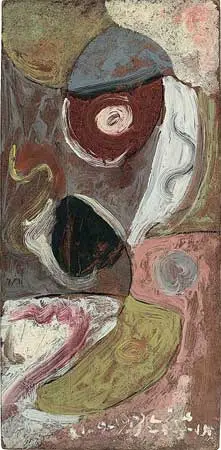
Cobra is a potential reference point for situating Lisa’s series Juego de líneas y colores. But even this requires certain caveats. Cobra was founded in 1948 and disbanded in 1951. It is understood that the Cobra group was followed by a “Cobra” approach. It is this post-Cobra painting that is closest to Lisa’s œuvre. After the mid-fifties, Cobra artists were less concerned with rebelling against the weight of social conventions and more involved with nature›s fluctuations as a way of depicting intimacy as it arises from the force of the gesture. In this, landscape played an essential role. This fusion with nature instilled in painting vital energy. The painter was no longer exterior to what he or she was observing. Both were part of the landscape, to the point of dissolving into its elements. Both were co-actors. Jorn defined this participation in 1960 as an «expenditure of energy.» It rejected all formalism that turned painting into a rigid structure. This informal approach emphasized shocks and accidents as a way to create a vital continuum composed of a hybrid of materials, chromatic shrillness, and the organic interpenetration of mass. In contrast to the austerity of geometry, the post-Cobra sensibility offered an unstable, passionate pictorial universe, whose seams give way under the pressure of interior turmoil.
Beginning in 1960, Lisa’s painting turned away from the geometric approach that had governed his first works. From then on, his paintings exploited an absence of order, asymmetry, lack of a center, a magma-like quality, and the liberation of the painting’s gestural dimension; these elements are the basis of why a comparison can be drawn between Lisa’s work and post-Cobra painting. Using techniques of disequilibrium and shock, the forms dilate and the matter is set free. In Lisa’s materialism, like that of Jorn, the painting’s very materials enter into the work. Lisa’s materialism is strictly a pictorial project.
This materialism exists under the sign of an organic tension. Without a doubt, this is the space shared by both Post-Cobra painting and Lisa’s “informal work.” How is this organic tension organized in a pictorial sense? Here, the magma of materials, the conglomeration of blots of solid color, and other painting eruptions transform the base materials into a life-infused membrane. Lisa plays here with the interpenetration of masses that interact with each other, and in so doing create an infinite continuum. The liberation of the painting gesture is considered a principle that allows for the eruption of form in the midst of the negation of structure. The theoretical basis for this approach is historically considered Jorn’s Speech to the Penguins, which appeared in Cobra’s first revue, published in 1949. The Danish painter evoked a dynamic of “irrational spontaneity,” and he ground his materials for this purpose—so that they would produce not frozen forms, but a compositional universe in motion.
Lisa strongly considered the idea of “the act” an expression of the life force. In this, we cannot but hear the echo of the existential definition that Cobra gave to art. For Lisa, the painting was a sign, a trace of lived phenomena. His œuvre became a poetic expression of an ontological project: it was about being himself through and within the painting.
One would be tempted to see in Lisa’s painting the expression of a cosmological longing; for the Cobra painters, this took the form of a return to Norse mythology. Lisa, however, did not form images but rather deformed them through a poetic process. This transformed his works into a screen on which he could give life to forces—or the fourth dimension (from which Lisa’s school took its name)—that are active in the universe. It was as if infinity sputtered on the paper’s surface, making creation a “spatial act.” It was as if the painting were the medium through which the universe was made visible. It is clear that a painting’s material was a conduit in this merged relationship that united Lisa with space. His oeuvre was the trace of something greater than him. In this, Lisa participated in the Romantic tradition—so important to Cobra—where the image is an arch that unites the earth with the universe.
NOTES
1. Cold America. Geometric Abstraction in Latin America (1934-1973), Madrid, Fundación Juan March, from 11 February to 15 May 2011.
2. Esteban Lisa 1895-1983, Montevideo, Museo Torres-García, 1998; Diálogos con Esteban Lisa. Colección Jorge Virgili, Cuenca, Fundación Antonio Pérez, from 7 March to 4 May 2008.
3. Esteban Lisa, Kant, Einstein y Picasso. Escuela de Arte Moderno Las Cuatro Dimensiones, Buenos Aires, 1956.
4. Lisa was born in Hinojosa in San Vicente, near Toledo. His immediate family moved to Argentina in 1924. Lisa returned to Spain only for a brief visit in 1981.
5. With names such as Enrique Barilari, Fernando Mazza and Luis Welles. On this subject, see the excellent contribution by Mario H. Gradowczyk, “[Re]VISION of a puzzle”, in Esteban Lisa de Arturo al Di Tella, Buenos Aires, Ruth Benzacar Galeria de Arte, from 7 August to 14 September 2002, pp. 17-18.
6. See Issac Zylberberg’s account, Esteban Lisa: mi maestro, 2008.
*All images illustrating the article are photographs by © Gonzalo de la Serna, 2013.
DENIS LAOUREUX
Professor at the Université Libre de Bruxelles.