
This is the first solo exhibition by young artist Iosu Aramburu (1986), who reaches it with the prestige of having won the acquisition prize, third edition, of the Arcos Dorados prize for Latin American painting at ArteBA 2012. Aramburu comments that he titled this show Todo lo sólido based on Marshal Berman’s book. “All That Is Solid Melts Into Air: The Experience of Modernity refers to the way in which modernity implies a constant whirlwind of transformation and that everything seems immutable but inevitably breaks down.” 1
The show is comprised of 10 large oils, 20 small acrylics (20 x 25 cm), one photograph, and one installation. Aramburu works with images of the architecture of buildings, and in one drawing titled Fantasmagoría XXI we see two buildings next to each other, 9 floors in height each, with the peculiarity that one is much larger than the other. The images are in black, which creates the feeling of unfinished work, with the acrylic ink dripping as if the image were fading, indicating that buildings also fade over time. The other acrylics, despite resembling each other in composition and theme, are all different.
In Milagros Nacionales I, oil on canvas, we see the image of a complex of 2-story buildings and, in the background, 5-story buildings. What is interesting in this image is that it has an air of Aztec pyramids. Aramburu uses cold colors to offer a negative connotation in what he shows. The buildings cover less than half of the painting, leaving the viewer with a feeling of emptiness.
In another painting, Milagros Nacionales IV, there are trees without leaves, only branches, that look almost dead. There aren’t any people, either, and the trees are in a dark blue, over gray grass. Once again, empty spaces denote loneliness.
The artist tells us that he uses buildings in his works because “I am interested in architecture as a discourse that breaks itself down. I am interested in it as a space where illusions of progress and modernity are invested, especially in Latin America. It also works as a phantasmagoria of those promises of modernity and progress that never come fully into fruition. I also use images of buildings to create a parallel with the Romantic imagination of architectural ruins as a reminder that what is fleeting is always the present.” 2
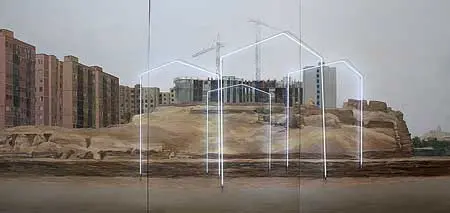
The largest work in the show is a triptych, Ser de su tiempo XVIII. At 210 x 450 cm, it is almost a mural. To his usual palette here Aramburu adds a brown hue: buildings and Inca ruins are painted in that tone, and alongside those constructions, we see two tall cranes. In front of the ruins, Aramburu placed four large neons in the shape of houses. Aramburu tells us that he uses neon because “The paintings make reference to contemporary images of pre-Hispanic ruins in Lima and the neon lights were syntheses of iconic buildings of 1950s architecture in the city.” 3 The visual contrast between the ruins and the neon creates a clash between what came before and what will come in the future.
All the buildings are made from the library or antiquarian images, or from photographs shot by Aramburu, all based on real architecture.
NOTES
1. Interview with the artist, May 2013
2. Idem.
3. Idem.
AUGUSTO CHIMPEN