
The discovery of a large number of drawings by J.J. Seinen that was rescued from a flea market by Johanna Calle and her husband Julio C. Pérez-Navarrete—an expert in vintage archives and materials—led to an encounter between two sensibilities. The drawings by Seinen reveal that the boundaries between discipline and dedicated drawer and a compulsive one whose endeavor verges on addiction can be blurred. But it is precisely that compulsion, along with the ability and delicacy of the execution—as well as the erudition that they reveal—the qualities that bestow a singular appeal to this collection.
The press release from the gallery explains that J. J. Seinen, born in The Netherlands and a banker by trade, retires and decides to move to Colombia. He brings with him his furniture, other essentials, his library, and collection of drawings he began to create from the time he was a child until around his retirement. In Bogota, he continued to draw profusely until his death. A self-taught drawer, polyglot, and book collector, he nourished his artworks with his knowledge of historical, anthropologic, fictional, and ethnographic themes. Additionally, with his travels and visits to museums, annotations in his notebooks, in which he detailed descriptions of the precise characteristics of the colors and sizes of architectural objects and museum pieces, he attained valuable and pertinent research that he would use as a central source of inspiration for his drawings.
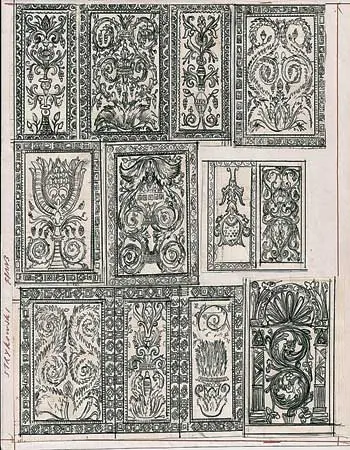
The general characteristics of the drawings suggest that they were created for his own enjoyment, without any intention of exhibiting them, in immense numbers that created imaginary and unreal worlds: a secret endeavor that reflects an aesthetic drive for drawing. Only after Seinen’s death, it was possible to learn about the artistic work he created throughout his entire life.
The treatment that these drawings received by Johanna Calle to get them ready for their exhibition at the Galería Casas Riegner, conserve the intimate and singular character of Seinen’s work; in the same manner that Calle tried to respect an unknown order, as a great part of these materials was found packed in garbage bags on their way to be recycled. This finding allowed Calle to impose her own way of conceiving the work and to avoid falling for the dictates of the Dutch banker’s frenzied work that traveled halfway across the world, as she patiently duplicated and classified every paper she could get a hold of.
Several groups of drawings were carefully organized and divided by themes, techniques, and supports. Perspectives rendered with blue ball-point pen in search of perfection, the exactitude of the drawn object, are presented before façades with arches—with a certain Mozarab air to them—that through the line are rendered without missing the smallest of details. Another group contains a series of landscapes created with black ink stains that showcase the artist’s very agile stroke and an enormous capacity for synthesis. Drawings of the frightening airplanes that caused so much damage during WWII are grouped alongside others and lines of marching soldiers with animal-like faces—similar to cartoons or drawings for children—and badges on their uniforms that tell us that they are members of the Nazi army.
In the same manner that Seinen was meticulous with his renderings, he was too in the preservation of sketchbooks, envelopes, and all types of papers used as support for his drawings. These were divided into several other categories for the exhibition. The sketchbooks immediately reminded me of Laconia, the work presented by Johanna Calle during the Luis Caballero Award in 2007, when she filled many sketchbooks with precise calligraphy that became a delicate drawing: a work that immediately moved for its infinite patience with which it was created.
On the other hand, Seinen’s dedication to classifying reminded me of the spirit of men from the 18th Century who wanted to contain and classify the entire world. Seinen did it in a very compulsive manner as if his life depended on it. He drew with the same compulsion of those artists locked in psychiatric wards that Jean Dubuffet was so interested in; some would fill the walls of their rooms with repetitive drawings, commanded by extraordinary strength and need. It was that force and need that led Dubuffet to come up with the term “Art Brut” to designate art in its purest state, uncontaminated by culture or external pressures and, instead, driven by a vital need, by a desperate search for meaning.
We do not know what was the strength and the need that drove Seinen to draw in such an insistent manner. Nor do we know why he would cut small figures, amphoras, effigies, and a multitude of objects that were carefully preserved in envelopes and sketchbooks. Perhaps some of this mystery will be revealed with the research that Johanna Calle and Julio Pérez have just begun, fueled by a finding that, accidental to a certain extent, led to the fortunate encounter of two sensibilities.
MARTA RODRÍGUEZ