
Between February 27th and May 13th, 2013, the Palais de Tokyo (Paris) paid homage to the career of Argentine artist Julio le Parc. On display were more than 100 works, including sculptures, paintings, and installations that offered an outstanding view of Le Parc’s many facets from the late 1950s through today, with monumental interventions conceived for and distributed around the 2,000 square meters of the newly expanded space.
The show Julio Le Parc is the first such large monographic of the artist’s work in Paris, and it undoubtedly constitutes an opportunity to present his vast and fruitful trajectory in France, where he has lived since the late 1950s, always insisting on reconciling art and life outside the hierarchies that bound artistic practice and beyond the conventions historically imposed by museums.
This show contrasts Le Parc’s political statements with his more playful side and crystallizes the artist’s main concern with fostering a close relationship between art and its public, who ultimately gives meaning to the proposal by engaging its participatory, reflective, creative, and analytical abilities.
Le Parc’s constant winks and surprises turn any visit to this exhibition into the antithesis of the passive, dependent behavior often expected on viewers, something that this artist has always struggled against.
Julio Le Parc won the Grand Prix in the 1966 Venice Biennale. A visionary, he was part of the select group of Latin American artists who settled in Paris around the halfway point of the twentieth century with the goal of materializing the immaterial, translating a variety of physical phenomena into art. In that context, Le Parc’s gambit was for reflection and the modulation of light, rhythm, motion, and color, articulating these phenomena in simple and effective ways and mesmerizing his viewers with notions of the intangible and the ever-shifting.
Despite his significant influence as a kinetic artist and his spectacular exercises in Op Art, Julio Le Parc is characterized by his keenness and the refined sense of humor deployed to connect with the viewer, who becomes his co-conspirator.
Even as visitors walk along the main hall of the Palais de Tokyo towards the gallery entrance, the situation is being set up. Julio Le Parc establishes an intimate connection with the audience with Desplazamiento del espectador, two site-specific installations. First conceived in 1965, they acquire spectacular proportions almost half a century later, reinstalled here. The artist breaks the ice and induces us to experience the illusion as we advance before the installation and see our own image distorted into virtual reliefs.
Immediately afterward, Le Parc brings us into a marvelous maze. His installation Célula a penetrar (1963-2005) dislocates the notion of space and confronts viewers with their own image, which fades at times as it playfully interacts with the reflection of others.
Starting in 1958, Julio Le Parc began to propose rigorous systems of visual organization that make it possible for him to methodically control waves, meanders, and geometric shapes in his compositions. From then on, the modulation of light, color, and motion was to be calibrated with the maximum possible objectivity, under a working method that is close to industrial processes.
Visitors journey through the different series that the artist controls under this system, such as: Superficies, Contorsiones, Relieves, Luces, Continuales Móviles, Desplazamiento, Modulaciones, and Alquimias, to finally enter his Sala de juegos.
At the same time, the artist avoids any chromatic temptation, selecting a range of 14 pure colors (without gradations) that are infinitely combined with anonymous shapes on an active surface. One highlight is the series Superficie color, especially the room devoted to Tema de la larga marcha (1974), where eight 2 x 2-meter paintings are assembled to suggest an iridescent trajectory.
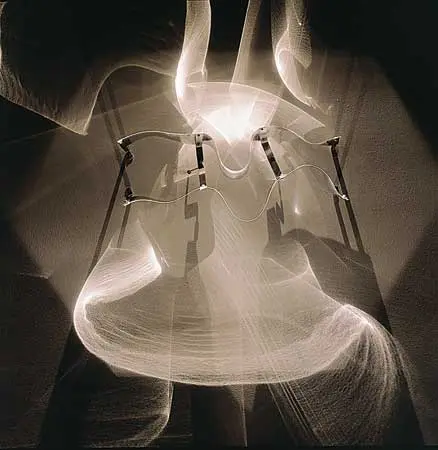
Another standout is the darkened rooms that the public can traverse, sorting through unbelievable installations where light has been elegantly modulated, contorted, and articulated by means of a variety of devices, noting and directing its spectrum, rendering it sublime. An example of this is Continual-luz-cilindro, first presented in 1962 and reinstalled on a large scale at the heart of this show.
The works selected by curator Daria de Beauvais and the artist himself surprise and unsettle viewers from the start, inviting them to gaze deeply into scintillating light atmospheres, traverse vibrant rooms, and undulate delicate mobile structures. They even invite visitors to experience a veritable catharsis by pounding and pointing to all those symbols of authoritarianism that have constrained their individuality and spontaneity in Voltee los mitos (1969), Identifique a sus enemigos (1970), or Golpean los galardonados (1971).
In parallel to the show at the Palais de Tokyo, Julio Le Parc is holding solo exhibitions in several Paris galleries, such as Galerie Denise René (which has supported his work since 1963) and Bugada & Cargnel, to mention just a few. He will also participate in Dynamo, an international group exhibition to be held mid-year at the Grand Palais.
ELISA RODRÍGUEZ CAMPO