
Until some years ago the notion of three-dimensional art referred to either work that sought a break from the traditional concept of volumetry, or those that proposed the perception of virtual figures occupying the space. However, we can affirm that many of those intentions are no longer a driving force behind the creative will of contemporary artists. Thus, to address the actions of contemporary Venezuelan art, one must refer to the work of Luis Millé, who for a period of time created “artistic forms” still close to the notion of three-dimensional works, and who now proposes in his new pieces to “deconstruct” them—to use a term that comes from architecture. If in this discipline the deconstructive states, in general terms, the abandonment of the orthogonality imposed by the classical tradition, in the field of the sculpture we can understand it as the disarticulation of the three-dimensional work into multiple and diverse components. Thus, Millé’s initial search has been reformulated toward the formation of spaces activated by shapes of a geometric nature.
In his recent exhibition at the Galería GBG, Millé, an artist who has already completed a decade as a creator of works for the space, presents a group of interesting alternatives and dynamic solutions. In order to formally and perceptually approach the exhibition, it would perhaps be good to go back in time in order to identify some variations of interest within his creative process. In that sense, the excellently executed Kirigami Vertical Amarillo, MTA 7 (Yellow Vertical Kirigami, MTA 7, 2008), constitutes a significant example. It is a piece created for a public setting, made in metal and intense color that rises between folds, cuts, and articulations to take a form that, although suggestive of three-dimensionality, in reality, is a plane unfolded in the space and oriented toward multiple directions as if it were a monumental origami.
With this background in mind, let’s review the group presented at the Galería GBG. The first set of works consists of medium-size pieces created with the same concept of disarticulation of the planes but installed on the wall. Completing the show, there is one work reminiscent of the aesthetic in MTA 7, and another formally and conceptually removed from the other explorations to propose new interpretations.
The first one, Flexocromo Tenso Suspendido (Flexocromo, tense Suspended), a piece of an intense red with some blue accents that contrast and balance the power of the dominant tone, is a work of high aesthetic quality and solid dynamism, a piece that changes as it moves across space. Despite its objectual character—conferred by the color, size, and material—in terms of form, it is the result of an exploration that breaks with the conventional notion of the temporal space, so fixed and determined. The planes that in a precise manner gave meaning and aesthetic value to MTA 7, have now freed themselves from the material connection between them to allow the gaps to participate, and from this new articulation, transform the negative space into dynamic areas or realms that stimulate the viewer’s gaze.
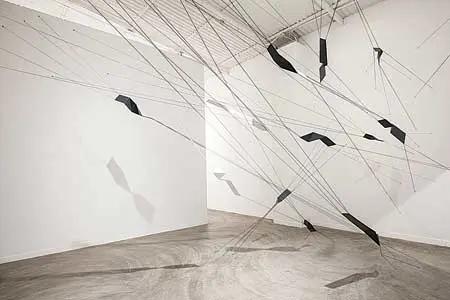
However, the intent of the exhibition presented at GBG achieves its conceptual and formal height with the 2012 piece Multiatemporal—installation-assembly with painted aluminum and elastic, variable dimensions—to the extent that the work proves to be a precise consequence of the process through which the artist has taken to investigate, experiment and achieve a specific purpose: to dismantle the notion of temporality. Despite their spatial dynamism, the components that in the earlier work somehow remained linked together, have been detached and individualized for this new realization by the artist. As if driven by an internal force, they move in various directions, following different angularities with the horizontal and vertical planes, occupying a space to which they continue to be connected through fragile and elastic lines.
Instead of observing the piece by moving around it—as often happens with three-dimensional realizations—meeting Multiatemporal puts us in a space created by the work that at times “covers us.” So somehow sheltered by the warp of subtle lines and fragile shapes, visitors “must live” the experience as the work intended it, otherwise, they would remain oblivious to what the piece suggests, proposes, and announces. There is thus a process of entries and exits, of specific routes and ways to transit them, of looks from inside and from outside; an experience that eventually results in the recognition of the “timelessness” referred to in the title. At that time, the viewer’s rationality that has remained alert before the work, stimulated by the formal elements that confer its physical presence, briefly surrenders to the subtle perception of the eternal.
FREDDY CAREÑO