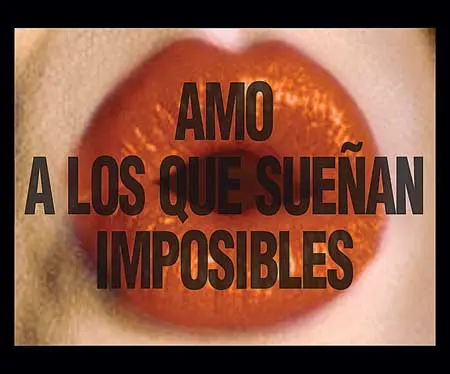
I Love Those Who Dream of the Impossible is the legend of one of the posters by Margarita Paska (Argentina, 1933), possibly inspired by one of the slogans from the May 1968 events in France: “Be realistic, demand the impossible.” An artist who continuous to dream of “the impossible,” Paksa is a painter, poet, sculptor, drawer, and pioneer in the exploration and use of new technologies in art. With more than 120 works, her well-deserved “retrospective” at the revamped Museo de Arte Moderno in Buenos Aires (MAMBA) covers the period between 1960 and 2010. The exhibition confirms Paska’s disregard for formal and conceptual aesthetic boundaries and mandates.
Possessing an inquiring mind and a keen sensitivity toward social issues, Paksa promoted artistic renovation. History transformed her work into a compelling testimony of the possibilities of audiovisual media and computers from 1964 and on, through the development of her initial projects in that field; she was also a pioneer of installations—even before they were called as such—notable for her minimalist proposals in connection to the dematerialization of objects, and an example as a proponent of conceptual art that was markedly more political in nature.
Paksa was a distinguished protagonist at the Centro de Artes Visuales del Instituto Torcuato Di Tella, led by Jorge Romero-Brest. The center proposed new ways of seeing and creating art in Argentina, as it enabled the development of two lines: an aesthetic that led to the development of Pop Art, for example, and one that linked art with politics. And Paksa is closer to the latter artistic current, with her explicit support of the struggles for social and individual freedoms.
A survey of her participation in group exhibitions such as Tribute to Vietnam (1966), in solidarity with the country from Southeast Asia, and Unwelcome Rockefeller (1969), to protest the presence of businessman Nelson Rockefeller in the country, in the middle of the dictatorship of General Juan C. Onganía, points to and evokes times of political and social unrest in Argentina and around the world. Paksa even participated in Tucumán Arde (Tucumán Burns, 1968), which brought together the experiences of artists from Buenos Aires and Rosario who were at the vanguard of political art. They promoted a series of actions—with tools from the conceptual inventory—in areas such as union headquarters that were outside artistic institutions. Tucumán was and still is one of the poorest provinces in Argentina.
In terms of exploration of old and new materials, the retrospective included her first sculpture in welded iron: Mandíbula (Jaw, 1963); plastic objects in El Rey y la Reina (The King and the Queen, 1966); a piece made with steel, acrylic, and light, titled Identidad de Dos Situaciones (Identity of Two Situations, 1967); as well as drawings of pigs with sewn mouths in Comida (Food, 1976), created during the beginning of the last military dictatorship; an inaugural video performance of her authorship titled Tiempo de Descuento, Cuenta Regresiva, La Hora Cero (Added Time, Countdown, Zero Hour,1978); and multicolor neon words in El Arte ha Muerto, Viva el Arte (Art is Dead, Long Live Art, 1979). Likewise, the artist presented visual poetry, typographic works with messages, drawings, and much more, in pieces like La Canilla (The Faucet, 1989), a water tap from which long hairs emerge like a flow of water. On the other hand, there are also digital games that include the back of Paksa’s head in a leading role, as part of the photographic image in Backlight Ultima Scena II (Backlight Last Scene II, 1998) that is also the cover of the catalog that accompanies the exhibition.
2004 was an extraordinary year for Paksa. She reedited Proyectos Sobre el Discurso de Mi (Proyects About the Discourse of Me), published by Fundación Espigas (Centro de Documentación para la Historia de las Artes Visuales en la Argentina), and won a Guggenheim Fellowship. At the Centro Cultural Recoleta, she displayed the 500 Watts, 4,635 Kilocycles, 4.5 cycles, reconstruction that was presented in the visual “Experiences” at the Instituto Di Tella, in 1967. In search of a way for the dematerialization of the artwork, Paksa created an environment with two different areas. The light area with 500 Watts... was digitally reconstructed and consists of a three-dimensional projection of the original route. For its part, a sound area reformulated the space through which viewers move. The work consisted of a walkway with photoelectric cells that are activated and make sounds when the public walked over them. The proposal of walking to modify the sound becomes a sensory experience that leads to a better conceptual understanding of the game of opposites and complements, in this case, movement and sound.
For the 1968 edition of the Visual Experiences at the Instituto Di Tella, Paksa presented the sound installation—or was it body art?—entitled Comunicaciones (Communications, 1968), also recreated for this current exhibition and a piece for which she will surely be well remembered. The artist also edited a vinyl record that plays in two (old) record players placed next to a square of sand with the imprinted shapes of two human figures. On one side of the record, it is possible to hear Santuario de un Sueño (Sanctuary of a Dream), a repetitive and detailed description of an environment. And on the side, Candente (Red-Hot) has a recording of lovemaking sounds by a couple that visitors are able to listen to but cannot see. All timely examples of some of the milestones created during an important artistic trajectory by an artist who explored art in all its forms while always exposing us to her critical thinking.
VICTORIA VERLICHAK