
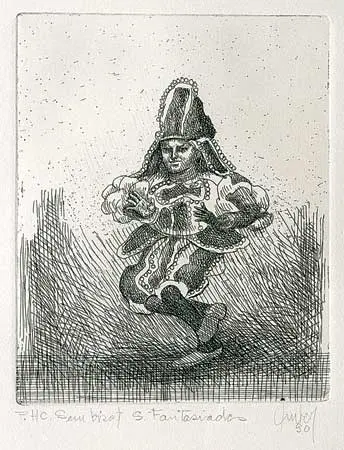
Mario Gruber is one and many: painter, sculptor, designer, muralist, stage designer, printmaker, and teacher. So many styles and techniques are part of his oeuvre that it would be impossible to frame him in a single category, even if critics have, starting in the 1960s, identified him with magical realism, something that the title of the show curated by Denise Mattar, the first to be presented in São Paulo after the artist’s death in 2011, emphasizes. In the show, however, only a small room in the exhibition space presents works from that period, with some examples from the series Disguised and Angels. The show focuses on the production of prints, especially works in metal.
All the works on display belong to the Gruber family collection, which gives viewers an opportunity to enter Gruber’s private life and observe the themes that captured his attention—everyday characters like the “Moleque Cipó” (a figure that appears under different names, but always as a poor, sad child). There are also images that record the early childhood of Gruber’s son Gregorio, who also became a visual artist. Some of Gruber’s matrices, chisels, gouges, and other tools, exhibited inside display cases, reinforce the sensation of his presence, as do the small mural texts that reproduce his reflections about the technique of engraving, with indications of how he personally related to this multifarious genre.
“Unlike painting, printmaking cannot be understood solely from its exterior and allegorical side. It acts on the knife’s edge, at the precise intersection between essence and form. Besides being a magical mirror, since it is one and many at the same time.”
Exhibited in sets of two or three, grouped by theme rather than by technique or date, in a space of dimmed lights, the works highlighted against neutral-color walls generate an intimate environment. Although Gruber used in his work a wide range of techniques, his mastery of draftsmanship is a constant. Both the woodcuts and the lithographs and metal engravings reveal the artist’s command of lines, rhythms, and compositions. It is not surprising that he made analogies between music and his own craft, comparing painting to symphonies and printmaking to chamber music. Of his paintings, the exhibition includes three oils strongly influenced by expressionism. Two monitors break the silence of the gallery, one at each end of the show, presenting respectively a documentary about the artist directed by Rubén Biáfora in the 1960s and his participation in the Provocations TV interview show, hosted by Antonio Abujamra, in 2002, which reveals Gruber as a cultivated man who was conversant with the thought of philosophers like Adorno and Walter Benjamin.
Mario Gruber Correia was born in Santos in 1927 and lived to the age of 84, sustaining a prolific production over approximately sixty years. An autodidact, he started painting in 1943. His earliest experiments in printmaking came shortly afterward, during the same decade. Having moved to São Paulo in 1946, he studied at the Escola de Belas-Artes there. The following year he won first prize in painting in the exhibition of the group 19 Painters. His first solo exhibition was held in 1948 and he began to study printmaking with Poty and to work with Di Cavalcanti. Having received a scholarship in 1949, he traveled to Paris, where he studied at the École Nationale Supérieure des Beaux-Arts with printmaker Édouard Goerg; he also worked with Cândido Portinari. Back in Brazil, in 1951, he founded in Santos the Printmaking Club, later known as the Art Club. He taught printmaking at the Museu de Arte Moderna and the Armando Álvares Penteado Foundation (FAAP) in São Paulo between 1961 and 1964. He returned to Paris and lived there between 1974 and 1978; once again returning to Brazil, he settled in Olinda, Pernambuco. He spent some time in New York in 1979, establishing a workshop there. Back in Brazil once again, he created public-space works like the Sé Metro Station and the Latin America Memorial. He continued to work intensely until his death in 2011.
As visitors leave Caixa Cultural, with its Art Deco style, located in Plaza de Sé in the heart of the city, they have the opportunity to see contemporary, flesh-and-bone versions of many of Gruber’s characters: the impoverished children, the mentally ill, the workers—the mixture of everyday types where the artist found his inspiration.
SYLVIA WERNECK