
Very often artists get together for a particular project, or to work as a group. This is the case of Mexican artists Natasha Gray (b.1969) and Plácido Domingo (b. 1958), who also happened to be friends long before collaborating. The exhibition Light Begins in Darkness is the result of this joint endeavor.
Domingo’s artistic career started in England, where he lived for several years and made an important part of his early work. On the other hand, Gray began in Mexico and later on moved to New York.
However, it was her experience during the eight years she spent in the North American desert that shaped her interest in nature.
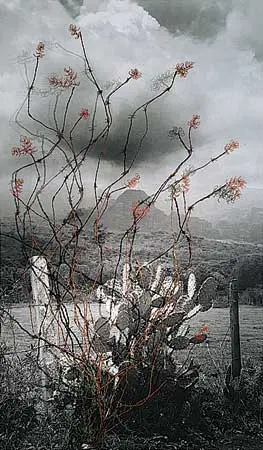
Domingo, a photographer, brings in his bucolic images. Gray, armed with the rich crafting tradition of her country, complements Domingo’s images with wire sculptural elements that she makes. The results are these “combined “pieces, in which Domingo’s photographs and Gray’smetal sculptures achieve a harmonious dialogue between the ‘flatness’ of the photograph and the unexpected third dimension of the metal additions.
Sometimes they present the pieces separated but as part of the same work, as diptychs or polyptychs. In other instances they juxtapose the wire components over the photographs, creating layers and an effect of depth. In the first group, we can mention Vida III (Life III), a piece is made up of four acrylic boxes placed in pairs. The two situated at the bottom are photographs of a cherry tree branch and a flower bud respectively. The two correspondings on the upper side are apparently interpretations of the original images. The first upper box is reproducing the cherry tree branch as close as it was possible to the original, while the one beside, instead of the bud, presents a blooming branch with leaves, contrasting with the original stark sprout.
In the second group, there is a series that depicts the changing seasons (spring, summer, autumn, and winter). In this series, the artists used the same landscape as background, and in each season different elements were added to the forefront, like the same window at different times of the year. That’s how the landscape in Amanecer en Primavera (Dawn in Spring) is complemented by a flowering tree, and Amencer en Invierno (Dawn in Winter) shows a bird on a naked branch. This landscape is Domingo’s subtle interpretation of the English countryside, enhanced by Gray’s surprising and playful sculptural elements.
Cerezo (Cherry Tree) is one of the most delicate images in this exhibition. The image portrays a flowering cherry tree on the right, while on the left a fine metallic garland mimicking the natural plant. Although it is made with wire, the theme and the fine manufacture suggest an influence of textile embroidery, a rich tradition in Mexico. The piece is finished with an acrylic box, which confers to it an almost fetishist quality.
Perhaps the boldest example of this type of ‘combined’ piece is Mirando al Cielo (Looking to the Sky), in which a Mexican landscape with a fence and a cactus acquires a new dimensionality and color. The black and white background image gets on top a flourishing ‘cacti’ made out of barbed wire, reproducing up to a certain extent the fence in the photograph. The strong image is softened by red flowers on the leaves. The shadows projected by the plant contribute to creating a corporeal effect, giving the impression of a real growing plant in its natural habitat.
The exhibition also includes an installation made from pieces that the artists created independently and in different years. Domingo is represented by a group of very experimental self-portraits reflecting his experience with drugs. In these, he seems to play with light and the effects of movement, most likely a result of his intoxicated condition at the time that the photograph was taken. In front of these is placed an installation of several gigantic metallic webs that seem like it was made by an enormous spider, which is in fact, Gray’s work. She was inspired by an experiment made in 1984 by NASA in which substances such as marijuana, Benzedrine, choral hydrate, and caffeine were administered to garden spiders. The insects were disoriented and made webs with irregular structures instead of their usual neat displays. Gray replicated some of the spider webs on an enlarged scale. Domingo saw these pieces as “a precise description of drug’s strong disorientating effect,” so the idea of presenting his portraits behind the webs is related to this kind of experience in different circumstances. In a way, this installation resumes the manner in which these two artists collaborate, showing how their interests converged, and how their perception was in tune even when they were working separately.
Nature seems to be the common thread that unites the exhibition, and what brought together these two artists. Their approach is between botanists and observers, enthralled with the perfection of it, and at the same time, using it as a springboard for creativity.
IRINA LEVYA