After years of construction and delays, the Museu de Arte do Rio de Janeiro was inaugurated last March 1st. The acronym of its initials—MAR (sea, in Portuguese)—refers to one of the city’s most salient icons, present in its representations since the sixteenth century: the ocean, and, in consequence, Rio’s relationship with other continents. Indeed, the museum is located next to the city’s port, in Plaza Maúa, a site of great cultural effervescence during the first half of the twentieth century that is now involved in a conflicted revitalization project. Deemed Porto Maravilha, the city’s urban renewal is intended to revive an adjective often added to the name of Rio—“the marvelous city”—for that specific site now blighted by oblivion, bad conservation, and a negative symbolic association among the population. Among the planned changes to beautify the city for two large-scale international events—the 2014 World Cup and the 2016 Olympics—are the construction of a second museum, the demolition of several expressways, and the relocation of certain social groups to other areas of the city. To reform means to revalue, and this verb implies another: to "bourguesify."
Visitors enter MAR through the roof. Before seeing any exhibition, we are invited to admire the view of Guanabara Bay. Visitors, crowding to take their picture, set their five-second smiles. Meanwhile, on the other side of the road, we see an empty space marked by a safety ribbon that impedes movement. At least that was the case when I visited the museum. As we approach the restricted area, our horizon is a Rio de Janeiro denuded of vegetation and with the vestiges of abandoned architecture on a promontory.
The touristic avocation and an urban renewal project that has already failed in the past continue, then, hand in hand. As people pose for photographs on the left, on the right they are not even invited to explore the space. Looking down toward the street, we suddenly encounter right in front of the image of a tenement house and a number of people hanging clothes from their clotheslines. I was left to ponder what those people’s reactions could be, those “others” faced with the recently erected alterity: a space for culture and the world that remains “out there”. The lady and her daughter who arrange their laundry will now be gazed at on a daily basis, whether they like it or not, by the fleeting inhabitants of that temple to culture. Will these families remain there in five years? How to bring into the exhibition space the complex socio-economic dynamic of a new cultural space in this region of Rio de Janeiro?
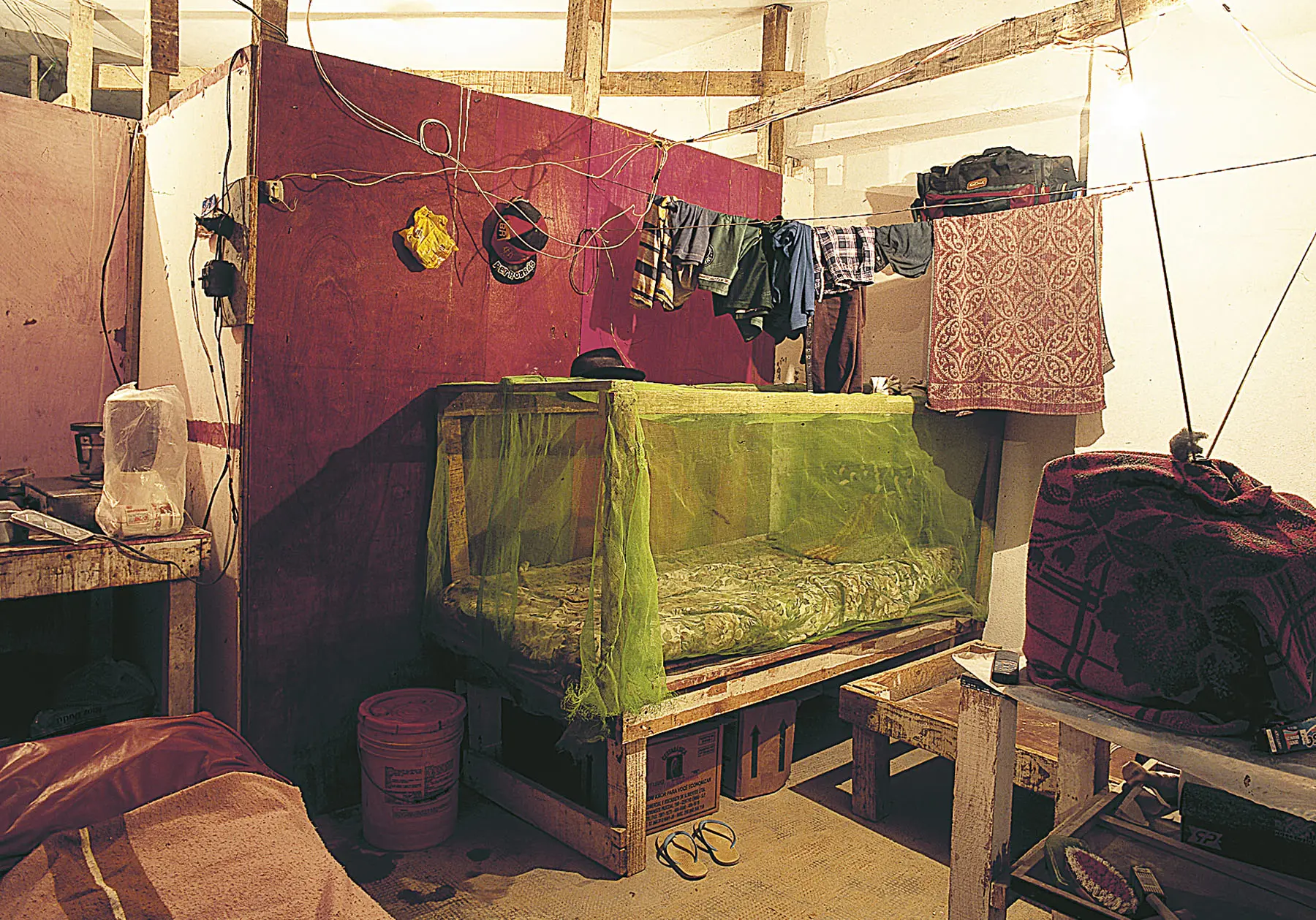
One possible answer is the exhibition that closes our journey through MAR, Shelter, and Land, presented on the first floor. The debate around processes of the reorganization of lives through new designs of the urban fabric is part of the curatorial reflection. As indicated in the last phrase of its argument, it seeks to acquire “the political and ethical awareness of the fact that, in the context of life in any society, any bullet that is shot is a bullet shot against the collective body.” Clarissa Diniz and Paulo Herkenhoff, curators and members of the institution’s management team reflect on the possibilities for contradiction and failure of a museographic project intended to democratize access to culture that can nevertheless be transformed into a site exclusively for cultural industry professionals.
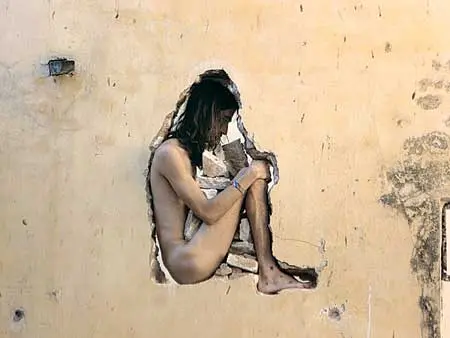
On the wall, the roster of participating artists makes explicit what we have already perceived visually: there is too much information at this level. We are not dealing with a “white cube” museum space, where each work should supposedly breathe and prepare the viewer for the next encounter. Rather than fostering a selective gaze, we are gripped by a superposition of colors, images in motion, and sounds. On the one hand, there is an interesting experiment in the curatorial language (which reminds us of Paulo Herkenhoff’s own experiments, such as Savage Counterthought at Itaú Cultural in 2011), where the joining of a variety of signatures creates a new one and transforms, perhaps, the exhibition itself into a single, large work of art. On the other hand, and in counterpoint, some of the images selected fade away on the whole.
Large-scale works and audiovisuals that, like most of those created by collectives, demand certain structural stagecraft. Yet a painting by Lucia Laguna and another one by Antonio Dias are too high above eye level and require an especially attentive look to be noticed. Adriana Varejão’s craquelure decorations appear as out of place in the curatorial reflection as the placement of an object by Raul Mourão on a portal. But, isn’t this the dynamic of a city as contrast-laden as Rio de Janeiro? To bring the specialist audience and the general public into a veritable visual confusion, isn’t it a way to make a metaphor of the museum’s future impasses as a pole for critical thought?
The selection of contemporary Brazilian artists can be questioned in relation to a curatorial proposal that expands and borders an eclectic number of names where, at times, the historic potential of the terms “shelter and “land” is dissolved. In general terms, we are left with the impression that any shape referring to a house could have been included in the show. With respect to the visual proposals of artists’ collectives, what the curatorship contributes, more than the presentation of an exhibit is a significant expansion of the concept of art for the audience.
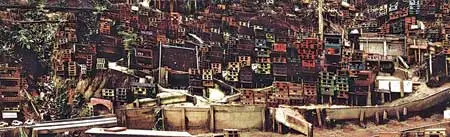
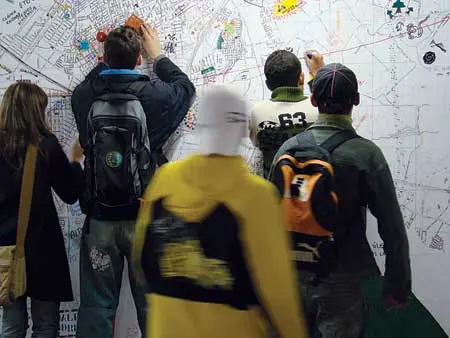
In Curitiba, the E/Ou group recreates an affective map alongside the inhabitants of a small village named Small Space. Cartography created by many hands takes shape here. The Morrito project, developed in a shantytown in Rio de Janeiro, builds a panoramic vista of its precarious shacks and shelters. In front of our eyes is a toy-like, domesticated space that quickly becomes the background by the photographs for which visitors to the museum pose. Also to note is the polemic participation (if the word is indeed appropriate) of the Opavivará! Collective. With a performance explicitly intended to criticize the displacement of the port population, the group was not authorized to present their work on opening day. Among protest of this act of censorship at MAR and explanations that it was a security-related matter related to the presence of president Dilma Rouseff at the event, what remains is a melancholy video announcing an art event that now we will never know.
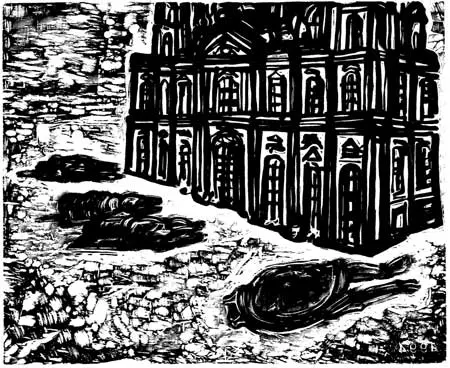
The Museu de Arte do Rio de Janeiro opens its doors between critical reflection and the tumbling-down of images. One thing cannot be denied: Shelter and Land offers a small sample of the force that this ground level can achieve. It is important never to lose sight of the location, the history of Rio de Janeiro, and contemporary art’s ability to situate great names and unknown artists next to each other. It is perhaps inevitable that “artists be ethnographers,” as Hal Foster has said. However, if they were to reflect about that safety ribbon that separated me from a decadent image of Rio, yet invited me to smile upon the apparition of a city that never was and never will be “marvelous,” art would have accomplished something, and life, who knows, may have a semblance of meaning.
RAPHAEL FONSECA