The first difficulty that confronts a critic in the exhibition titled Blanca is whether to evaluate it as a whole piece or as a set of works. To speed a hypothesis, let us assume that we opted for the former. Although there are several pieces in various formats, from oil paintings to video installations, the mounting and semantic articulation of the exhibition renders it a meta-composition, very much in the manner of installation. The global atmosphere impedes us from seeing each piece on its own. I will attempt to explain: in the main exhibition room, the windows have been covered with huge white paintings. On the floor, newspapers are spread wide and painted with light shades of oil in an attempt to blend these with the marbled texture of the gallery floor. Other oil paintings of various sizes (Piece of Gallery IV and V, respectively), were placed at the level of the floor in two corners of the room, thus flattening the square formed by the walls while emulating the hidden space behind them. In these spaces behind the paintings, two important videos entitled Trabajo Oculto I y III (Hidden Work I and III) were projected and showed the artist hiding behind a white painting. There is a general mood of concealment and camouflage between the works and the space that contains them. It is not, however, a fluid dialogue or an actual fusion, but there is rather the overwhelming sense that everything is obviously theatrical. Everything appears artificial, nothing flows naturally. As Antoine Henry-Jonquères said it is the staging of a stage.
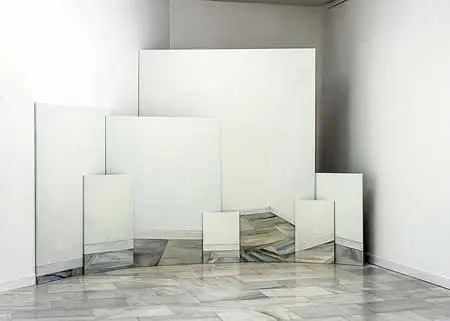
The scenography as a strategy is not new to the work of Sandra Gamarra (Lima, 1972). In LIMAC (2003-2004), the museum of contemporary art in Lima that only existed as a project, the artist was already playing with the dialectic between absence and presence, physical nonexistence, and symbolic existence, with real, surreptitious, and possible spaces. There is something in this game that is reminiscent of Mannerist architecture: veiled spaces, artifice, supporting structures that do not support anything, the preeminence of transit spaces in front of the exhibition rooms. It is, as the name implies, the maniera, an emphasis on the process rather than on the resulting form. Thus, the importance of painting in Gamarra’s work lies in what is done with it and not in itself. This is the case with the pieces included in Blanca, where the ultimate goal of its monochrome is not, for example, a visual inquiry about light, texture or color, but its employment in favor of inquiries of another order, like, in this case, the generation of a specific spatiality and the exploration of its metaphoric possibilities. Thus, the reference to the white cube as a semantically neutral place is, besides formal, overlappingly conceptual: the artist has whitened the gallery not by emptying it, but by overcrowding it with meaning and, paradoxically, such saturation has been completed without many signs through the employment of white shades of paint. I must insist that it is not about color for color’s sake, nor is the vindication of a simple presence, but rather a presence that simulates an absence.
In another room of the gallery, three paintings cover the windows while the works Blanqueo I y II (Whitewash I and II, still-lifes and textures respectively) are exhibited in front of them. Each consists of 12 small oil paintings on cotton paper. Needless to say, they are all white paintings and depict works by artists like Olafur Eliasson, Dan Graham, and James Sierra. There are fragments of narration by Ximena Briceño about the Atacama Desert on the walls of the rooms. The text also explores the synonymy of the deserted as void. Not even the void lacks content: “the sand in the desert contains traces of men and women who lived thousands of millions of years. This is the stuff we are made of.”
The simplicity is only apparent. Desert, white cube, appropriations, absences, and hidden places: once again we are faced with saturation disguised as emptiness. While the works are enunciated with minimal poetic, this is only noticeable when each of them is analyzed isolated from the others. In an overall view, Blanca does not subscribe to the equation of minimal-form and maximum-content. It is rather a horror vacui afraid to state its name.
DIANA CUELLAR LEDESMA