
In the last 15 years, her artistic concerns have localized on a question about individual experience and its relationship with public and historical discourses that narrate collective events. Already in her childhood and adolescence —living as a foreigner in Brazil and Paraguay— Jarpa evinced the awareness of history that drives her connection with Chile. Her lack of direct experience of life in Chile was countervailed by the family narrative of Chile as a place of origin.
This dislocated experience of confronting at the same time a territory that is physically unknown and discourses that are studied and learned, focused her artistic interests as a university student, upon returning to Chile, on personal experience and official discourses. A kind of questioning of collective discourses and their lived experience as historical events.
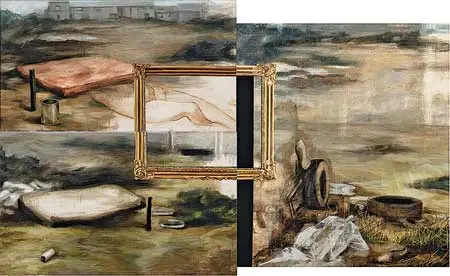
In her painting of the 1990s, Jarpa focused on empty lots in the city of Santiago. With a series devoted to these wastelands, the artist inscribed her questions about these marginal spaces at the center of the city. In a city then growing at a vertiginous pace, these locations became interstices or parentheses to housing and habitation, approached as spaces marginal to information, and explored from the standpoint of local history. Jarpa’s philosophical and pictorial was to unveil this situation, emphasized through visual-arts themes of precariousness and blight. These locations —as she points out in an interview— “became symbols of my interest in knowing what has happened here, and later I saw them as muted symptoms of what is repressed in our narrative of Chile’s recent history.”1
Alongside this, symbols such as the national flag, busts of Chilean heroes, and even the mediagua —basic social-interest housing— became icons in Jarpa’s discourse and pictorial supports for her work. Themes of public and private history in connection with official historical discourses were already present.
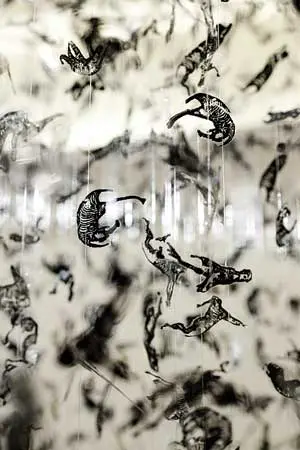
It is during this period that the artist found, in an old book, two images of hysteria-afflicted women that powerfully caught her attention, and began a phase of Freudian exploration of the condition; these images, which she calls “the Hysterical Ones,” became a recursive strategy in her art and began to establish important connections with history. They appear in Republican-era scenarios associated with the landscape of the city, interwoven with the empty lots that characterize her painting of those years. In this discovery of hysteria, there is not only a psychoanalytic interest but also an interest in the history of hysteria itself, as Jarpa learned about the illness’ origin in La Salpêtrière Hospital under Jean-Martin Charcot. Starting there, Jarpa’s work braids together these hysteria-related matters, using images of afflicted women in different ways and starting a connection with relevant events in the history of Chile.
Jarpa’s incessant investigation around history and hysteria suggested a new work based on the publication, in 1998, of the newly declassified CIA archives about Chile in the period between 1968 and 1991, where notions of history/hysteria refer to the material censorship and the chaos of information triggered by the unveiling of such previously silenced information.2
Opening Pandora’s Box3
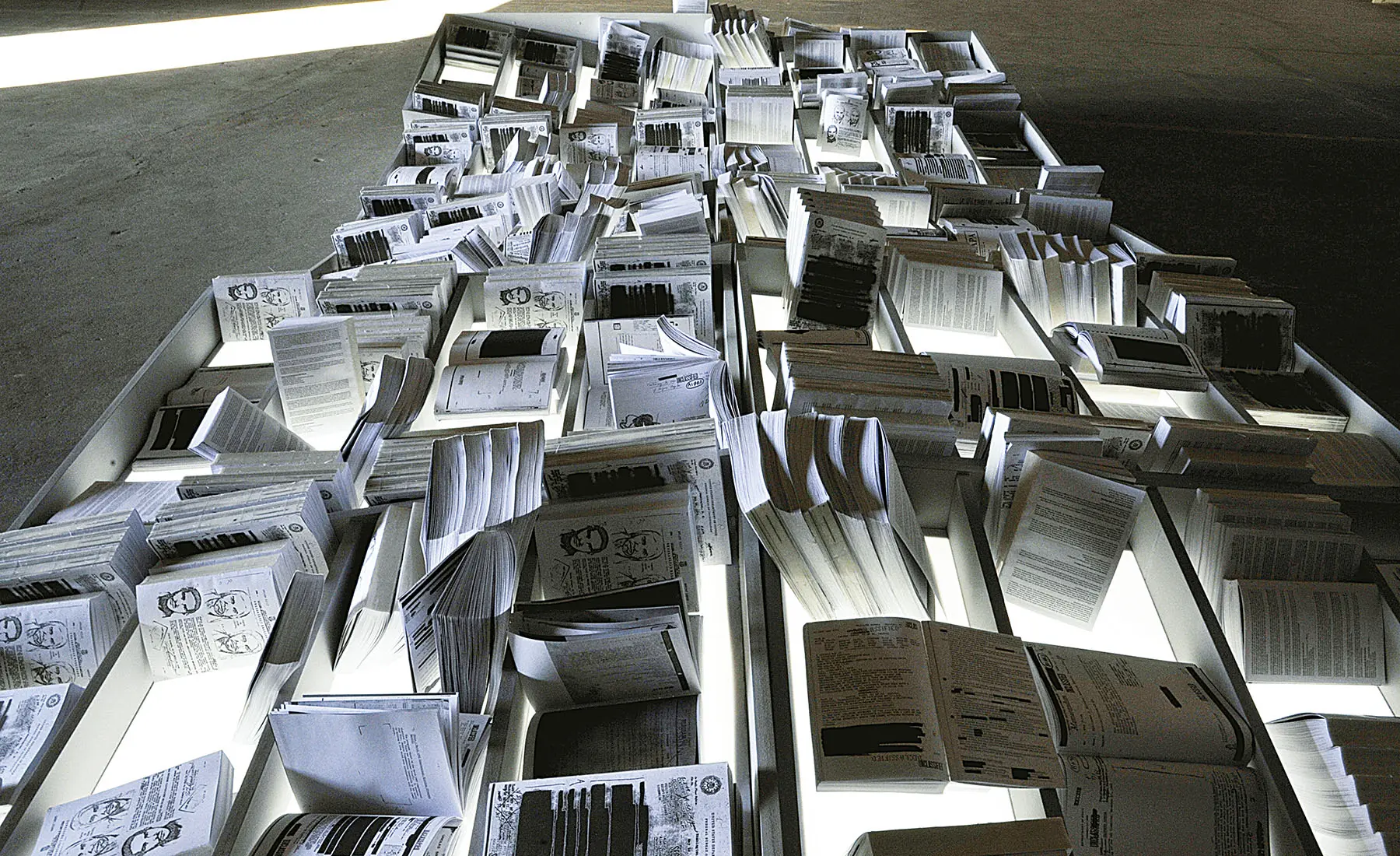
This recent interest in focusing on the use of the archive as the material for her work, specifically the declassified CIA archives, is in this artist not only a historical approach but also a visual one. The documents, their legibility impeded by black-blotch redactions across each page, carry in them a hidden history of Chile from the times of the military dictatorship and appear as a visual of that silenced, censored history.
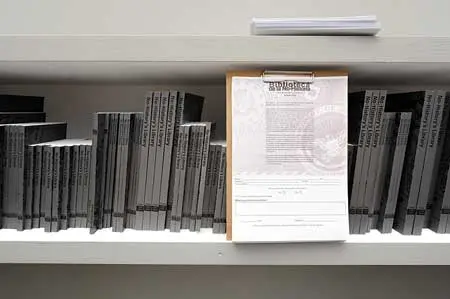
One of Jarpa’s earliest strategies for the visibility of these archives has been La Biblioteca de la No-Historia (2010-2012). An initial version of this work displayed the library in three locations of Librería Ulises, a commercial bookstore in Santiago. There, an advertisement offered, free of charge, a book about “Chile’s untold history,”4 after answering the question: What will you do with this book? For Jarpa, this was an essential matter, one that completed the work of art: a hidden history was being unveiled and put in circulation, so, how did this impact the rewriting of the country’s history? Would there be a space to rethink what took place and to interrogate the course of events already made official?
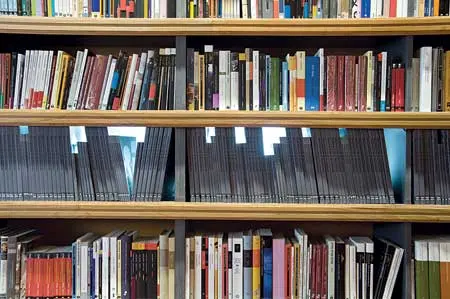
If we approach the artist’s strategy of unveiling those declassified archives, we can mention other artists whose operations have displayed an interest in similar ideas. Britain’s Rachel Whiteread has developed a Holocaust memorial project in Vienna (2000) where, through a sculptural volume placed in a public square, she has created an impenetrable room with walls that emulate the shelves of a library. This library, entirely covered by hundreds of identical books, does not expose the spines but the opposite side, the pages, whose content is hidden from our view. Also, this book room has doors that are also inaccessible; the emptiness and repetition of the books seek to commemorate the loss of 65,000 lives in the Holocaust and the silent way in which Austria was part of that tragedy. The books symbolize the histories that were cut off abruptly and were hidden under the horror of persecution.
Another artist who investigated conspiracies and political connections in his oeuvre was Mark Lombardi, from the United States, whose cartographies brought forth the links between the power spheres around the US government and those in other countries, especially the Middle East. Using conceptual relationship maps, Lombardi puts on display information researched through the internet and through personal communications with agents involved in the process. This kind of work of art destabilizes public policies, in that it reveals information that governments deem classified. Lombardi, who died in 2000, revealed the uses and abuses of power both political and economic, with a powerful impact that generated interest in his work.
These intentions of visibility that artists use in their works are ways to reclaim the spaces for expression that art makes possible and that politics attempts to hide.
The Latin American Situation
La No-Historia developed from Jarpa’s participation in the 8th Mercosur Biennial (2011). This work salvages declassified archives not only of Chile’s memory, but also of the countries of the Southern Cone: Argentina, Brazil, Paraguay, and Uruguay. With this, Jarpa blurs the official national boundaries often imposed by historical discourse. Here, history is intertwined, as events occur it becomes continental; someone is sought in Chile, flees to Argentina, and is detained in Brazil. This attempt to reconstruct history is found in books arranged on a bookshelf knocked down to the floor and retro-lighted. From that moment, Jarpa’s career took off and its international circulation intensified; that very journey from country to country to set up exhibitions drives the artist to open up her focus to matters of hidden histories beyond her country of origin, around the whole world.
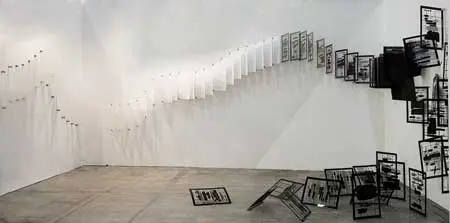
Minimal Secret (2012) was presented as a Solo Project at ARCO, the Madrid Art Fair, in 2012. It was installed as a series of floating sheets, where the ink on each page of the archive seemed to become solid and was removed from the page to leave the blank paper as a transparent space that allowed light to pass through and produce a distance augmented reflection on the wall. These semitransparent volumes containing true history, at once hidden and revealed, float in the exhibition space, presented for observation with the intent of generating new writing, a possibility of having them appear to rewrite the historical narrative that is obscured by official discourse.

La Biblioteca de la No-Historia continued to circulate, and new versions and adaptations of it developed in different contexts and countries: Kunstmuseum, Bern, Switzerland (2011); 12th Istanbul Biennial, Turkey (2011); Printemps de Septembre, Toulouse, France (2012). In all of them, copies of the printed books were given away with the same condition for viewers to give their feedback as they took them, but the content was no longer focused on Chile but combined Jarpa’s new investigation in the Southern Cone archives.
The material gathered so far from these answers by international audiences has roused new interests in Jarpa. There is something that connects the censorship of redacted texts and the impossibility of even understanding some of the languages in which she has received answers. There is a distancing and also a power strategy associated with the Babel tower where, as they are expressed in a multitude of languages, certain ideas are understood and others are not, provoking the veiling of communication that seems to present an inherent barrier to the circulation of information. Even so, through this experience Jarpa has been able to verify that the history of the local, contained in those Chilean and Latin American archives, can be permeated with structures of history and of power from other continents; codes such as censorship and the official discourse are universally connected, generating interest and awareness in viewers regarding this veiling, now unveiled.
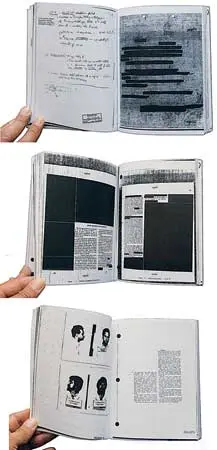
It is precise with the work presented in the show titled La Historia es mía!, curated by Paul Ardenne in Toulouse, France, where Jarpa carries out a conceptual operation that differs from her usual one. This time, the artist includes the prior experience of interaction with the viewer, with the cards collected over the last two years in response to the question for the use receivers would give the book; here, the books are made using those responses as well as the declassified archives. This generates an intention to expose the role played by the possessors of such information, the way in which their lives will be impacted, and what is, finally, their vision of the world we inhabit. In the words of the artist, “This has to do with gauging our scale as citizens confronted with the historical information that circulates or remains hidden; the answers I have received have to do with valuing that subjective relationship we can have with history.”
Today, Voluspa Jarpa works on her latest project, Litempo, which includes archives from a variety of agencies shedding light on a US-led operation in Mexico. This work is “a metaphor for the machinations of Latin American elites and US interests that operate in secret and impunity.”5 Jarpa’s desire to render the invisible visible by means of art remains strong, growing as an assertion of the right to information against the censorship wielded by power.
Everyday life is filled with such acts of invisibilization and we often focus on that which we want to see. In couple relationships, we don’t see the errors that are made; in cases of domestic abuse, violent or unjust acts are justified because the family ties between parents and children or between spouses are stronger; in cases of rape, because of the fear of consequences.
In terms of history, especially in countries with a low level of cultural development, the population tends to believe and absorb what is offered, often not questioning it, much less the history of a country, a continent, or the world as a whole. Jarpa’s work wants to induce its viewers to reflect on these matters, not intending to become a form of political activism but from the standpoint of the very definition of being an artist and of the visuality that art makes possible.
The materials Jarpa uses in her work are available to all at the CIA’s official web page; these pages of declassified documents have been open to the public since 1966 thanks to the Fifth Amendment to the Constitution and the Freedom of Information Act, the law that guarantees access to information from the US federal government.
We must wonder, then, how much laziness or disinterest is there for citizens not to study this information? At the same time, we see the emergence of the artist’s main strategy: she transforms it into books, a more familiar, closer way of accessing information that also makes evident the thematic connections between the activities (cases/operations) carried out for over more than twenty years in the case of Chile. Although I have said that Jarpa is not a political activist, she does agree with Philip Agee’s statement, in a 1995 interview with Alternative Views, that one of the most aberrant things he can think of is “the subversion and overthrow of democratically elected governments and their replacement with highly repressive military dictatorships that institutionalize torture and the disappearance of persons.”6
Jarpa’s ability to research, reflect, and be supported by her own conviction is undoubtedly to be admired, recognizing the profundity and truth of her assertion that the history of Latin America needs to be rewritten with many corrections.
But the most impressive aspect, besides her actual oeuvre, is Jarpa’s integrity as a citizen, professor, and artist. She exerts great influence on her university students, youths being educated as artists, to whom she imparts a strong critical vision of their national and Latin American reality.
NOTES
1. Interview with the author, July 2011, published in http://bienalmercosul.siteprofissional.com/blog/entrevista-voluspa-jarpa/
2. Interview with the artist, May 2012, published independently, Historia / Histeria, Chile, 2012.
3. This subtitle refers to a comment cited in the artist’s graduation thesis. During negotiation to convince President Clinton to declassify the archives, significant opinions emerged: “To prosecute Pinochet, said a former intelligence functionary to The New York Times, was ‘opening Pandora’s box of history.” Also, Jarpa titled one of her works La caja de Pandora in 2012.
4. Inscribed in the book displays inside Librería Ulises.
5. A statement was written by the artist and sent to the author via email in March 2013.
6. Philip Agee, was interviewed in the Alternative Views program in 1995. Site visited on March 1, 213. http://www.youtube.com/watch?v=nvZQa0hkfgw
ALEXIA TALA
Artistic Director of Plataforma Atacama-Arte y Lugar.