The memory of the Holocaust in the collective social body is perhaps one of the most problematic issues in the visual arts to represent because of its inherent aesthetic and moral dilemmas. Adorno’s phrase, “to write poetry after Auschwitz is barbaric,” marked the beginning of the dilemma and, since then, the “representation of the unrepresentable” has become the subject of study for both intellectuals and artists.
Born in Mexico and a resident of the city of Los Angeles for over a decade, Yishai Jusidman (49) belongs to a generation not directly connected to the Holocaust. Contrary to what one might think about the abundance of its representation, the artist has described his geographic and generational context as fearful or simply disinterested in the issue. In his latest series of paintings titled Prussian Blue—Memory After Representation, Jusidman intends to intervene in that silence, and therefore assimilate his place in US Society.
Inspired by Primo Levi’s writing and the film work of Claude Lanzmann, Jusidman evokes memories without eliciting individual suffering and the abstract representation of pain. Based on a straightforward language that eludes sentimentality, the artist creates in the viewer’s experience a reflection on the collective trauma, on the memory of everyone. This experience is made possible by the connotative correlation between the materiality of paint and the image represented, an essential operation in the author’s work who, beginning with his series The Astronomer in 1989, has developed critical and purposeful work against specific problems of contemporary painting practice.
Curated by Gabriela Rangel, the exhibition consists of twelve realistic acrylic paintings based on photographs about the concentration camps that have circulated since the Nuremberg Trials. Ten of them are both vertical and horizontal medium-sized paintings that depict gas chambers, while the other two large square ones; represent the inside of architectural space and the other a backlit tree. In addition, the artist has installed a desk with visual catalogs and literary documents about the representation of memory.
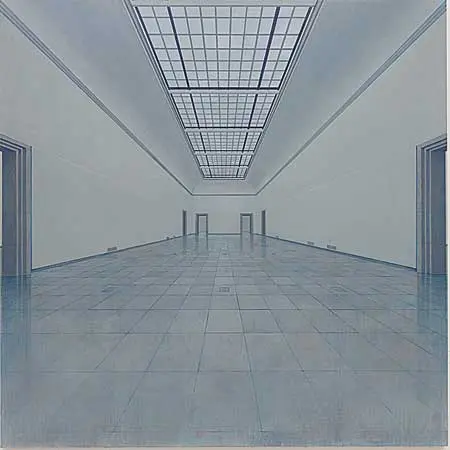
On the left side of the first room of the gallery, we find the catalogs, on the right, there is the curatorial text and in front one of the large paintings. Titled Haus Der Kunst, the image represents an art gallery opened in Munich in 1937 under the Nazi regime to exhibit The Great German Art. However, there are no paintings there on the walls for visitors to observe them, but an empty architectural space-dyed blue. Silence. In Prussian Blue-Memory After Representation the paintings, which are ontologically silent, do nothing but reward a silence that is so straightforward that it becomes eloquent.
By representing a gallery in the first image, we understand that the series is about the relationship between art, trauma, and memory. Such a relationship in this instance operates from painting, a medium that by its specificities can “evoke feelings and not just state them.” So we enter the second and third rooms, and we observed the paintings of gas chambers. Titled according to the concentration camp to which they belonged (Auschwitz, Dachau, Majdanek, and Stutthof), and the year the images were created (from 2010-2012), most of the time the works depict damp indoor spaces with vents and drains constructed with concrete or tile. Other times, as in Auschwitz, 2010, and 2011, we observe mysterious spaces determined by rigid and rough doors that define the vertical format of the composition. Finally, in works like in Stutthof, 2011, the brick architecture in a snowed landscape represents the marks of history outside a gas chamber.
The chromatic space in these paintings is also monochrome. The series by Jusidman is about a universe that is always blue. With this, the artist alludes to the Prussian blue marks that were found in the brick walls of the gas chambers as a result of the use of the poisonous chemical Zyklon B. In turn, to give the feeling of a curtain of steam Jusidman introduces silicon dioxide powder in the paint, as it was that the substance used in the pellets introduced into the gas chambers. The third materials are the flesh tones conventionally used for making skin tones. Thus, the pain and confusion in Jusidman’s paintings exist through their pictorial presence and what they represent. The viewer then relates to the series from an “eloquent silence,” reflecting on the trauma in the collective social body and the aesthetic power of painting.
FLORENCIA SAN MARTÍN