The Argentinian painter Guillermo Kuitca has returned to Spain. His work was first presented in this country at ARCO in 1987 (which he attended in person), at the stand of the El Retiro gallery from Buenos Aires. Now it was on show between the months of February and May in the exhibition rooms that the Valencian Institute of Modern Art (IVAM) has established in El Carmen, a handsome Renaissance convent located in the historical district of the city of Valencia.
A number of differences were evident between the first show and this new exhibit. In 1987, Kuitca was only 27 years old and was totally unknown. I was the only writer to draw attention to his work, in an article that I wrote for the Madrid weekly Tiempo and in a review of the ARCO fair which appeared in Arte en Colombia.

Few people paid much attention to his pictures at that time, even though it was clear from the work that he had managed to set himself fair and square in the current which was still the mainstream in those years: the return to painting, the transvanguard and neo-expression. Now Kuitca has returned to Spain with experience and, to some extent, with fame. During the years since his first show, he has followed an international trajectory which began with a one-man show in 1989 at the Annina Nosei Gallery in New York, a second one at the Barbara Farber Gallery in Amsterdam in 1990, which was also presented in the same year at the Kunsthalle in Basel, followed by another in the winter of 1991 at the MoMA in New York, and by his participation at the 1992 Kassel Documenta, his most important collective venue to date, if we exclude the controversial exhibition on twentieth-century Latin American art organized by Waldo Rasmussen at the MoMA.
But what has happened to him and his work in these six short years? First of all, he has remained faithful to himself and to his decisive theatrical roots. Kuitca was a precocious dramaturgist who before the age of twenty was already directing his own theater company; in 1982 he staged a work titled No-one forgets anything, followed in 1984 by Sweet Sea, which dealt with the theme of European emigration to Argentina at the turn of the century, and of which his ancestors formed part. The titles of these pieces are important since they are the same as those of two series of pictures that Kuitca painted in these years.
Previous theatrical training was, without doubt, one of the best bases that a young painter could have had at the beginning of the 1980s when international art was experiencing a return to painting. To admire or imitate this return was easy, although it was much more difficult to understand and apply it. What did this return to painting, to the pleasure of painting as advocated by Marcelyn Pleynet in a truly programmatic essay, really mean? For a historian of “non-event” history, accustomed to the reconstruction of long cyclical periods, it probably means nothing.
Painting, like the dinosaur of the celebrated story by Augusto Monterroso, was still there, propped up by an ancient tradition given life throughout these years by such painters as Francis Bacon, Cy Twombly, Guttuso, or Botero. Painting had not disappeared despite the vehement announcements of its death made by the promoters of conceptual art, support surface, or happenings. What was therefore the point of announcing its return? Was it merely a boutade, identical, but in a contrary way, to the boutade announcing its demise? Not exactly. Painting has become as mortal as those who actually paint or look at paintings. It is “a child of its times”, as the mystical Wassily Kandinsky once pointed out. In the 1970s and 1980s, the time of men, which is a historical time, experienced a break that gave rise to a cycle in which painting came into its own once again. The painting of representation. In the 1960s and 1970s, situationism and all the other contemporary movements, in addition to following the Fluxus proposal of eliminating the difference between art and life, wanted to go even further and eliminate the difference between those who govern and those who are governed, the backbone of political representation and, in the final analysis, of the State. They tried and, of course, failed. If they had succeeded, then painting would have lost its place.

So the problem of the return to painting was not, despite the sensual arguments of Marcelyn Pleynet, a purely aesthetic phenomenon. It was also a historical problem that affected all our social life in such a way that when we now try to remember the situation before the volte-face, it is one which appears remote and even incomprehensible.
But let us return to Kuitca and his theater. His early attachment to the stage enabled him, in a way that is rare amongst his contemporaries in Latin America, to capture the full weight of this return to painting which, moreover, was not a return to its essence (in this case it would have been a return to abstract painting), but to painting as a portrayal of portrayal. Or, in terms that are less symptomatically baroque, to painting as theater. Theater which in Kuitca's paintings appeared to be poor and desolate —although the desolation lacked the metaphysical aridity of the early De Chirico— fragmented or rather discrete up to the limits of the internal incongruence.
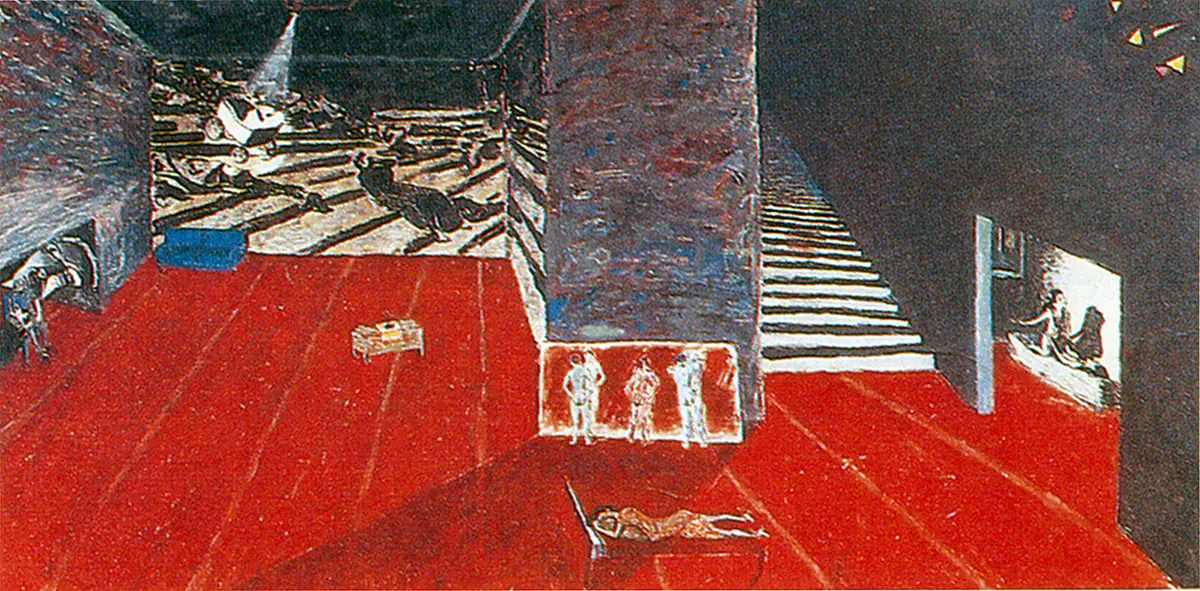
All these characteristics are evident in Sweet Sea, one of the paintings from the series mentioned above with the same title, which was painted in acrylic on paper mounted on canvas in 1984, measuring 2 meters by 4 meters, which presents in the same disperse and incongruent setting a couple copulating on a bed, a naked woman lying on her back in a camp bed, a man with a mask sitting on a chair with a woman at his feet, her head on his abdomen and an enormous fragment of the celebrated sequence of the killing on the steps of Odessa from Eisenstein's Potemkin.
The composition of this picture recalls the painting of Francesco Clemente; its concept of space is reminiscent of that of Enzo Cucchi, and the human figures have much in common with the deliberate infantilism of Tattafiori. But the picture goes beyond these influences to offer a panoramic view of the heart of an epoch that is both theatrical and sinister and which began to emerge during those years. Kuitca was able to achieve this because of the irresponsible and childlike innocence that he still retains today, at the age of 32, and because of his theatrical training. But he was also indebted to his native city of Buenos Aires, a dramatic and psychoanalytical city which is particularly sensitive to those closings (and opening up) of space which gave Jacques Derrida the material for one of his most fruitful essays.
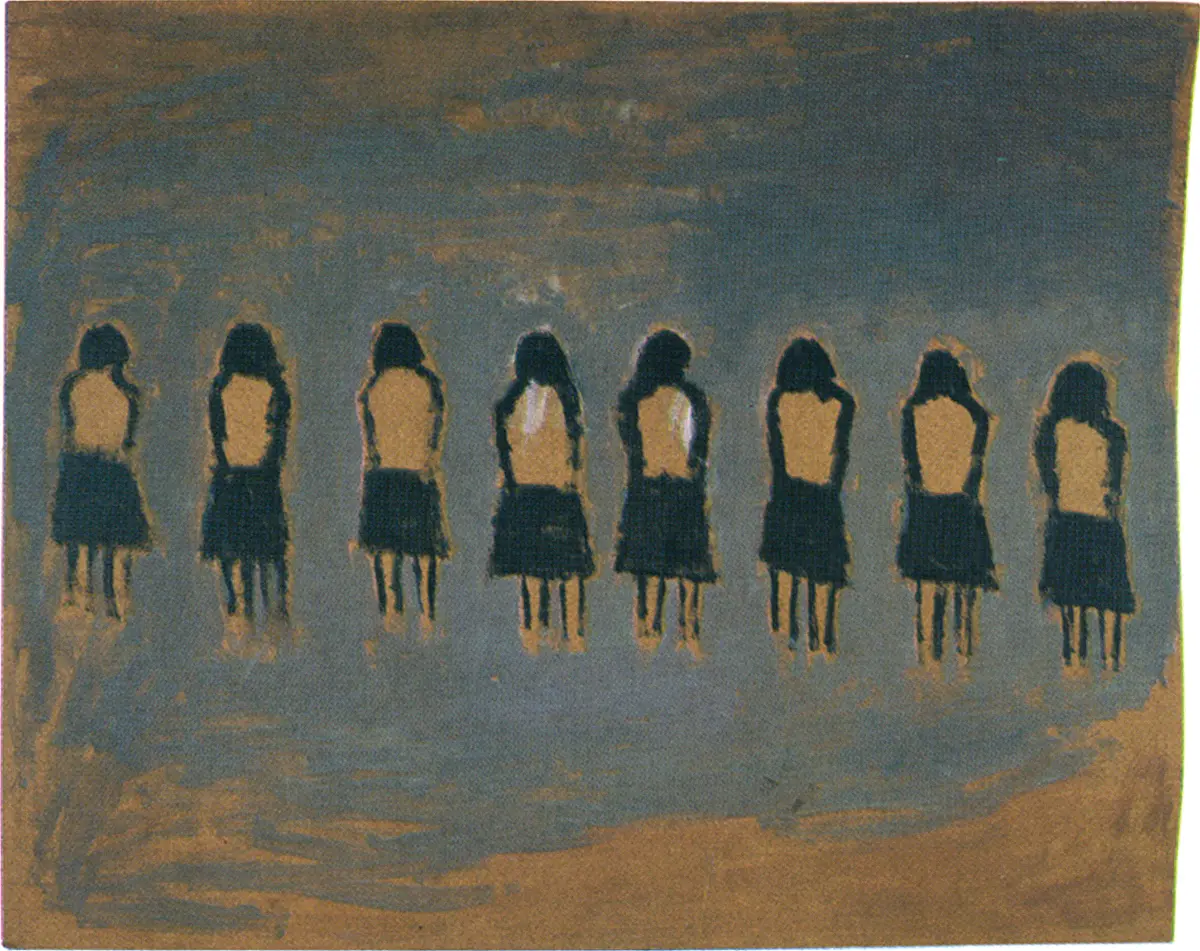
Thus Kuitca, in the anthological show organized by the Museum of Modern Art of Valencia, which will travel on to the Stedelijk Museum in Amsterdam, to Monterrey and Mexico City before concluding its itinerary in the Pompidou Center in Paris, remains faithful to his theatrical origins. What is interesting in this show is that it highlights his entire trajectory, the paths he has followed, the crossroads he has faced, the turns he has taken, and the halts that he has made. For example, it provides some early material for his obsession with beds, such as one of the paintings from the No-one Forgets Anything series, painted in 1982, in which a bed and a human figure scrawled in white share the same desolate space, separated only by the line of some impossible horizon.
The show also presents pictures documenting Kuitca’s early attempt at the purely scenographic level of theatrical work. Scenography is always theatrical, but the theater is not always scenographic. Kuitca examines this difference when he successfully seeks out another scene in the typical apartment of the urban middle class, which was perhaps his own, which he has since painted many times and in many ways. The profound meaning of this theme for Kuitca has been interpreted as the claustrophobic setting of his early childhood or the absorbing influence of the mother figure, where incest constantly threatens. These interpretations (which perhaps are nothing more than interpretations of a specific role) do not really convince me. I prefer to emphasize that Kuitca keeps his distance both from the desolate scenes and from his claustrophobic apartment layouts. He is an artist who never gives way in his themes —which, in his case, are obviously melancholic or sinister— to romantic excesses or to expressionist confusion. And this is not simply because he himself remains apart, opting for a kind of light displacement. The same is also true of his works in which there is always a hint of something catastrophic and intolerable which at the same time is uncompleted and unceasing, suspended or held in suspense, like a kind of threat that never seems to materialize fully.
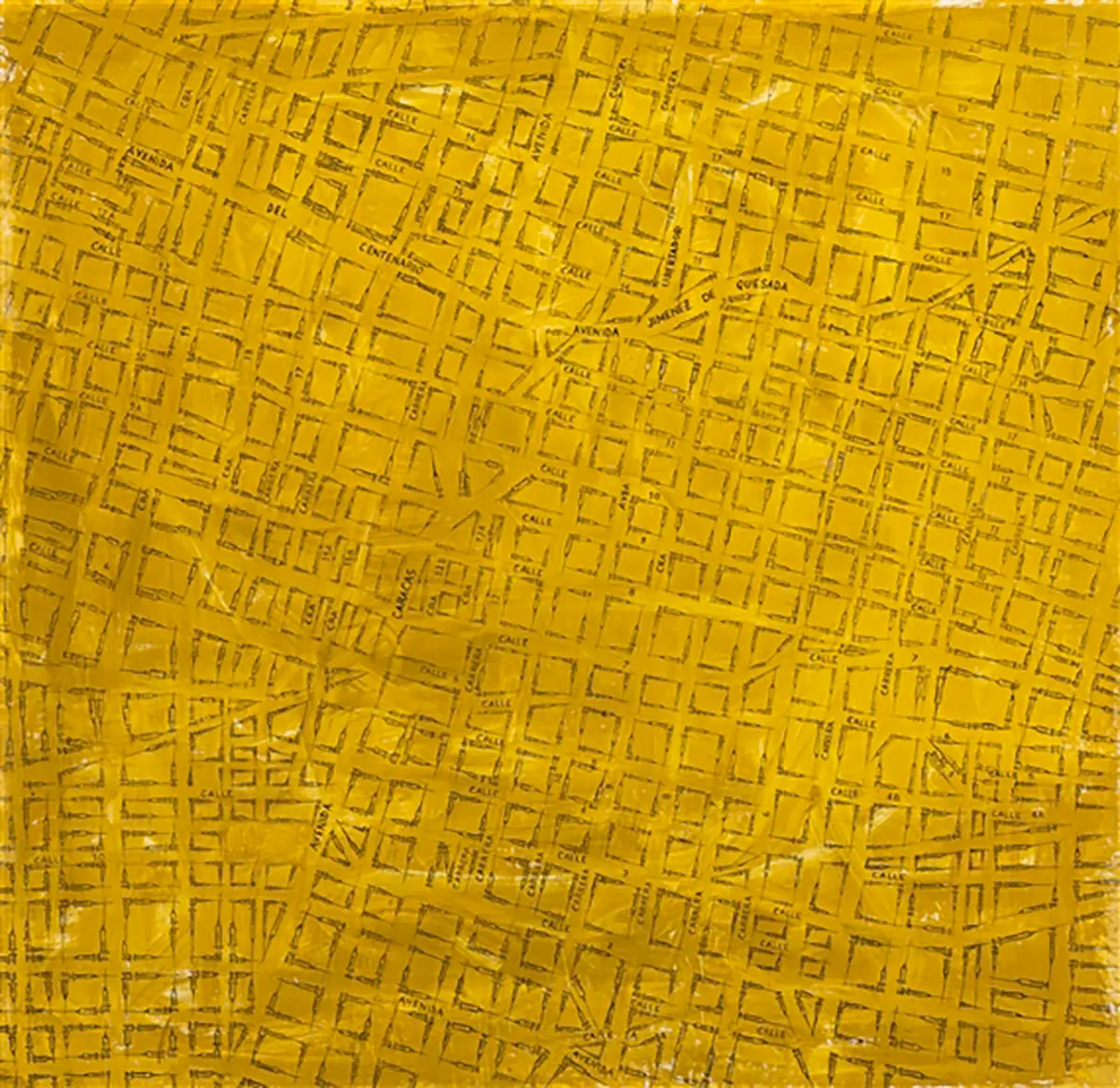
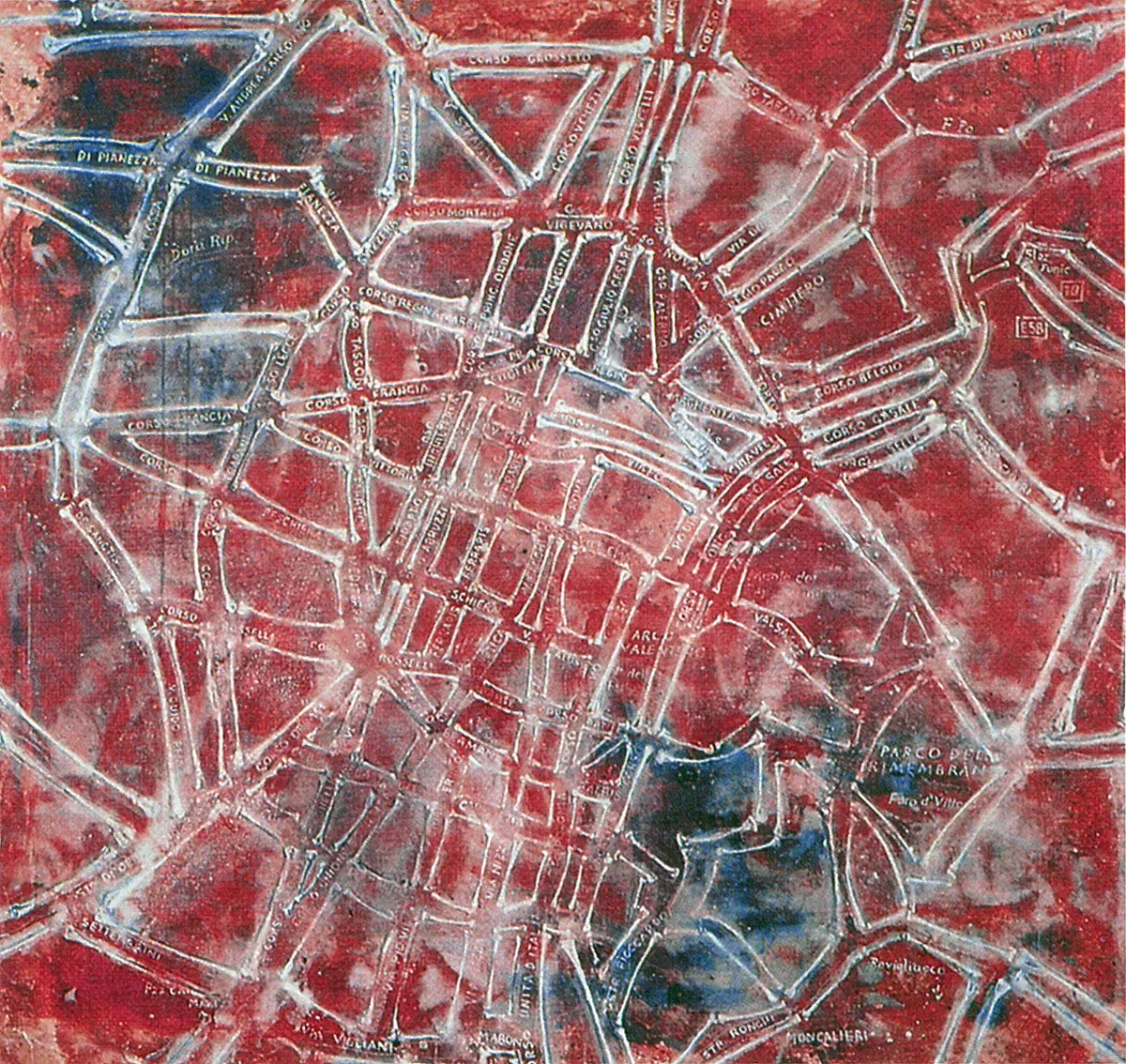
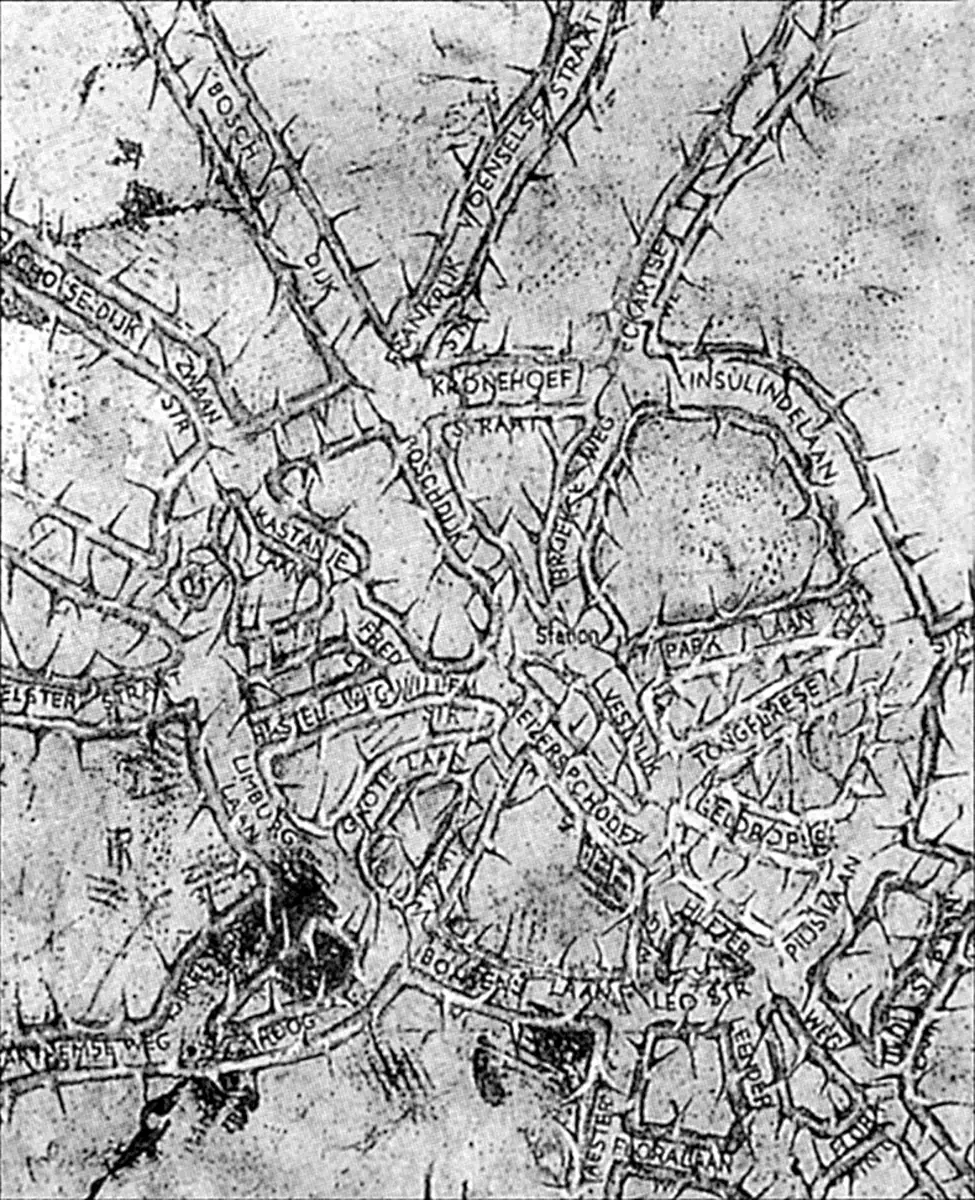
I said earlier that theater is more than just scenography, and I would like to add that representation is more than just theater. Each of these terms includes the other without exhausting its meaning, as Kuitca seems to have realized when, after the painted beds, the scenes, and layouts of apartments, he began in 1987 to paint plans of cities and maps. The Valencia show includes many of these works, some of which have purely informative titles, such as Turin, painted in 1991, which in fact shows a map of that Italian city in which the outlines of the buildings suggest chicken bones or perhaps human beings. Other works, on the other hand, have titles that are metaphorical, such as Mainline Grid, a map of the center of Bogotá with hypodermic needles forming the limits of the city blocks.
Something similar occurs with the names of his maps, the pictorial handling of the plans and maps, and the washed-out, watery colors swamping the ideal and ideally homogeneous space which is indispensable to topographical surveying and the tracing of maps. Here I see a gesture of solidarity with the artistic gesture in the paintings of theatrical scenes managed to embroil the overwhelming spatial uniformity of the pictures painted by De Chirico in his early and most well-known period.
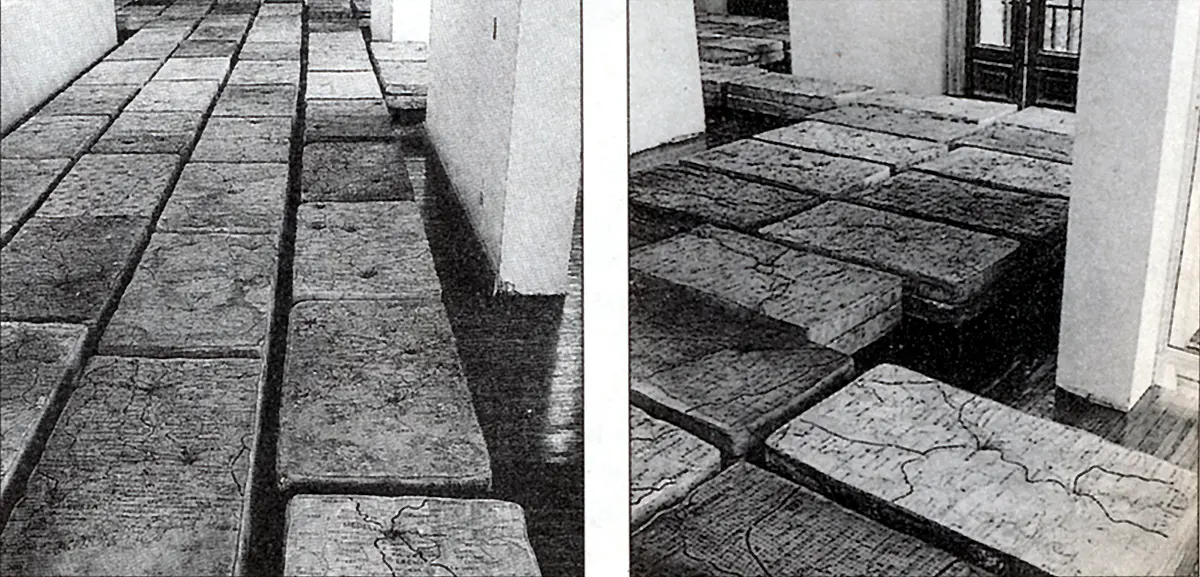
One final note. Over the last two years, Kuitca has taken to painting his maps and plans on mattresses which he subsequently arranges as parts of an installation. This was the case, for example, in the Kassel Documenta and can also be seen in the Valencia show. Why does he do this? Perhaps there is no single answer to this question. I believe it is a sign of the imminent exhaustion of the possibilities of representation: the beds that before were represented are now presented. Or, if we turn our backs on any kind of optimism, Kuitca’s gesture can be seen as a symptom of the secret diseases that are undermining the restoration of representation.
CARLOS JIMÉNEZ
Poet and Art Critic. Collaborator with the weekly magazine Tiempo and the newspaper El Mundo (Madrid).