
For the past three years, Alicia Viteri devoted herself to carefully covering liquor bottles with raw linen fabric and bringing to life on them, using modeling clay and layers of paint, seventy-five different characters. The identity of these characters was defined by means of luxurious clothes and ornaments also created by the artist, and their actions were shaped by the assemblage of fragments of speakers, pieces of an old photographic camera, scissors, or any other object not in use. These 75 characters were part of Viteri’s installation Los Terrícolas.
I have always thought that Alicia Viteri’s work retains a filiation with caricature, and the terms in which this genre is defined by Wikipedia allow me to assert the connection. “A caricature (from the Italian caricare: to charge or load) is a portrait that distorts or exaggerates the physical appearance of a person or several, on occasion a portrait of recognizable society, in order to create an easily identifiable, generally humorous semblance (…) Its usual technique is based on identifying the most salient features of its subjects, exaggerating or simplifying them to generate hilarity or represent a moral defect through deformation.”
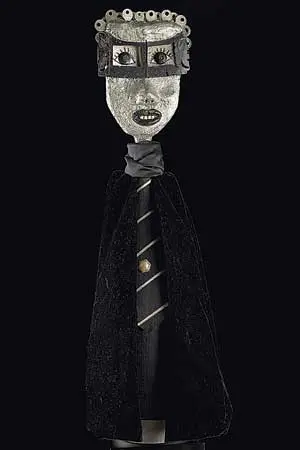
The two-faced characters in Viteri’s installation were intended as the “portrait of society’s moral condition,” shining light, by means of an ironic “deformation” achieved through the installation’s assemblage, on the two faces that characterize all individuals. Occasionally, Viteri took a specific person as her starting point, other times her characters are more generic, they always have exaggerated features in order to make their human condition visible.
The first impression I had as I entered the installation, despite its being so minimalistic and sober, was of finding myself in front of a baroque altarpiece of sorts with static figures carefully set in place. Inside a dimmed, black-walled gallery, arranged on a table that was also black and placed under precisely-aimed lights, Los Terrícolas formed lines towards the back of the room. Upfront were characters dressed in black and white; behind them, we could see red, green, white dresses in a multicolored parade. Their assembly was impressive and, as in baroque art, it had a theatrical element: the figures were poised to launch into some kind of motion, into some kind of speech, which made me think: “the show is about to begin.” Towards the back, three bronze figures, an enlarged replica of the head of one of these characters, jealously guarded (or perhaps watched over) the motionless actors.
Indeed, the show began as I started to move on the catwalk (which is how Alicia Viteri conceived her installation). As I came closer to each one of the figures, they in their silence started to talk through the details of their faces, some times grotesque, some times threatening, some times tender. Businessmen, military officers, divas, priests, young and old women, sad and joyful people, in sum the entire “human fauna,” was represented there, and each one of them gave more than one reason to laugh and remember a public figure. As the journey ended with a self-portrait by the artist, a new one began presenting the second face of Los terrícolas.
The dual condition of these characters, their sumptuous attire, and their allusion to theatricality, brought to my mind sociologist Richard Sennet’s description of complex human behaviors that began with modern society when cities expanded and became a site for the encounter of a multitude of strangers. 1 Sennet analyzes how that multitudinous encounter generated a way of being and showing oneself in society. Individuals began to experience a split between their inner being and their public behavior. Walking in the street became a kind of challenge: How to display oneself to others? How to project an appropriate image? How to dress? How to smile? A certain theatricality overtook all gestures and modes of social behavior. Watching Los Terrícolas, we could even say that the path was cleared for the two-faced nature of these characters, adopted at times for reasons of fear or insecurity, or motivated by contemptible interests.
What is true is that, whatever the reason, we human beings do possess that dual visage captured by Alicia Viteri with such irony and a fine sense of humor, through her peculiar exaggeration of features and expressions. Viteri has attempted to unveil once again (she did it before with her series of insects, El Mural, and her series El Príncipe Próspero) a facet of society: the double morality of the Earth’s inhabitants.
NOTE
1. Richard Sennet. The Fall of Public Man. New York: Knopf, 1977.
MARTA RODRÍGUEZ