
Carlos Estévez (b. 1969) belongs to a generation of artists that started working and exhibiting in a very intense period and at a very particular place: the decade of the nineties in Havana, Cuba. Like many of his peers, he studied at the San Alejandro Academy and later at the Superior Institute of Art (ISA). One of the benefits of doing this, particularly during those years (the 70s and 80s), was that many of his professors were precisely the artists who were the protagonists of the art scene of that time. Among those was the late Juan Francisco Elso (1956-1988), who was his professor and whose influence reached many artists of Estévez’s generation. Elso’s anthropologic approach to art made a remarkable impact on the visual arts in this period. In Estévez’s case that influence, especially conceptually, was present in the early works.
Estévez, like any other artist who has been consistently working for a couple of decades, has a solid body of work in which we can easily recognize different stages and certain themes that would be recurrent throughout his career. These can be easily traced to the changes reflected in his work, which corresponds directly to his own development as an artist and as a human being.
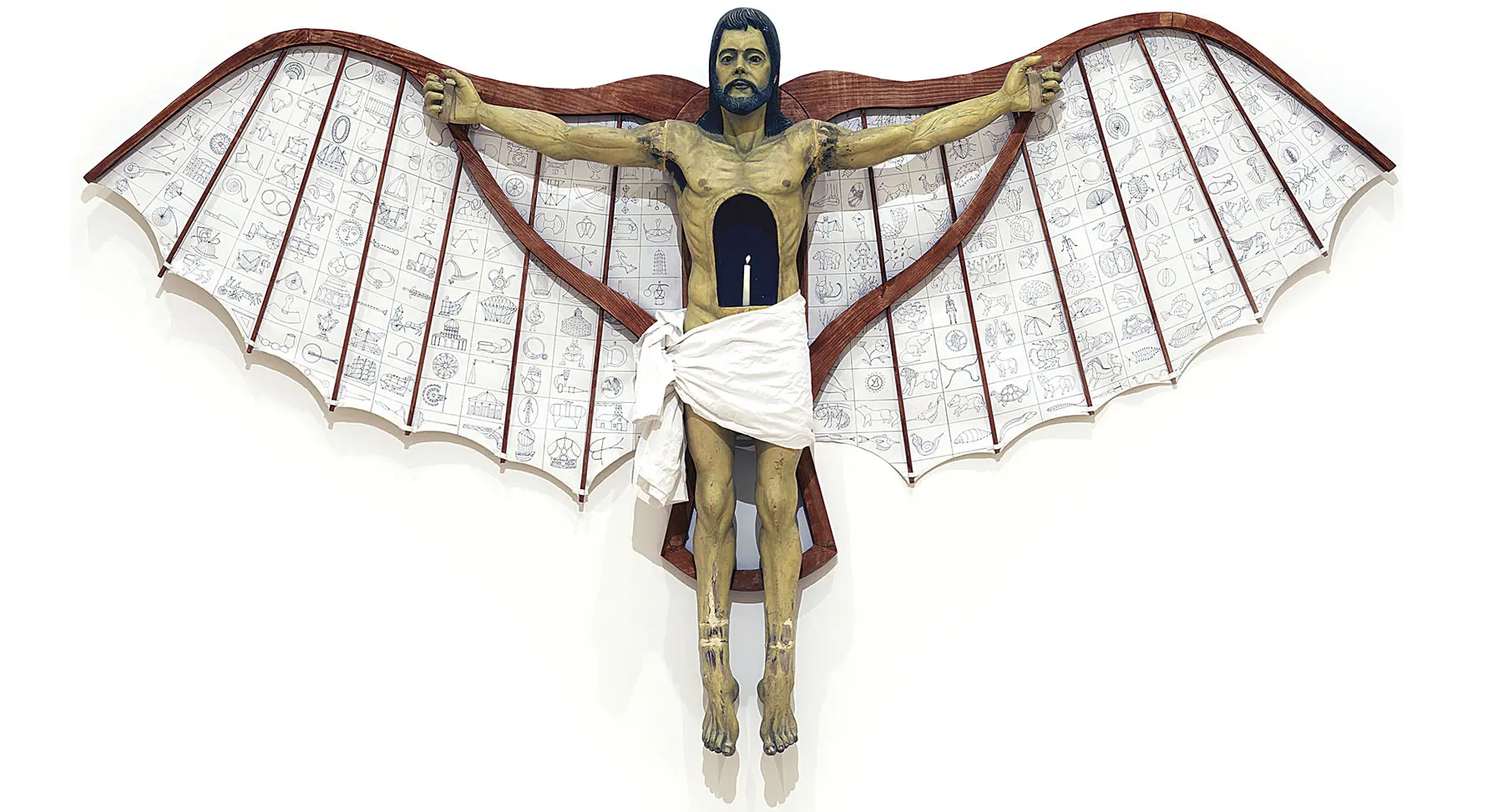
The first period can be defined starting from his first solo exhibition in 1992 at the Centro de Desarrollo de las Artes Visuales in Havana, which also served as his graduating thesis from ISA. The works included were more related to a general philosophical quest, with a man as the center of the universe. The main piece of this show, and which also gave the title to it, was A Través del Universo (Across the Universe). This life-size sculpture is a Christ-like figure with extended wings, inspired by the Baroque tradition of polychrome wood life-size saints. The hollow chest has a cavity where a real candle should be burning when on exhibition, an analogy to the interior light of every human being. The wings, which overall represent knowledge, are covered with ink drawings similar to hieroglyphs; the left-wing registers man’s creations (machines, buildings, inventions), while the right one reflects nature’s making (animals and plants). A Través del Universo summarizes Estévez’s work from this period, encapsulating his vision and cosmogony.
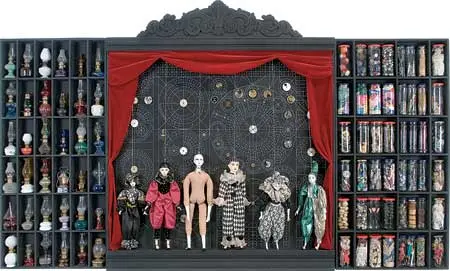
In 1995 we can see another phase in his oeuvre. The excision can be traced to the First Cuban Contemporary Art Salon when he presented La Verdadera Historia Universal (The True History of the World) and won the first prize. The piece, later acquired by the National Museum of Fine Arts in Havana, consisted of a little theatre scenario with wood dolls made after worldwide important characters, including prominent ones from Cuba’s history and politics. The dolls were under the scenario and anybody could change the protagonists of the play according to their preferences or viewpoints. This is a provoking vision of how history has been manipulated and revised through centuries, and a direct commentary on the way that it was being taught and presented in Cuba, completely fragmented and adulterated. In this piece, he translated to sculpture his notion of the world as a theatre, an idea that he would later explore and revisit from another stance in Theatrum Mundi (2008). In this latter piece, he presented the same thesis of the world as a gigantic theatre, but instead of the political perspective, it was more oriented towards a philosophical interpretation of the universe and the lack of control in front of destiny in general.
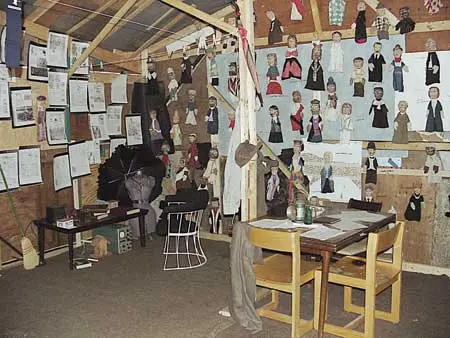
Another departure point in his oeuvre was the installation Where the Demiurge Dreams, from 2002, exhibited at the Massachusetts College of Art in Boston. The piece in question was a full-scale hut, partially replicating the place that the artist used as a studio in Havana, and to some extent creating an ideal space where most of his inspiration sources of the moment were cited. Inside the hut, he placed real furniture and things that belonged to him. The walls were completely covered by images and objects in a horroris vacuum fashion. One of the walls served as support to a group of hand puppets made after people such as Federico Fellini, Sebastian Bach, Charles Chaplin, Nicolas Copernicus, Mother Theresa, just to name a few. Other walls would show multiple botanical and fauna images, drawings, and reproductions. In this installation, he included many of the symbols that he would later use, such as animals. Conceptually this piece transpired essential philosophical questions such as his role as a human being in the universe, something that would ponder in his head and resonate in his work for years to come.
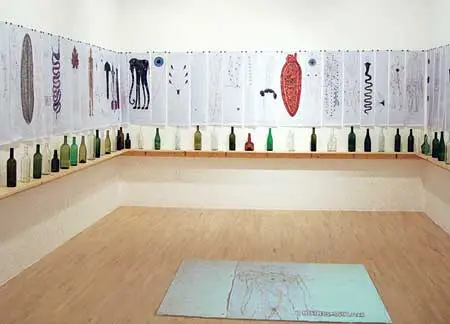
An earlier piece, Bottles to the Sea (2000), was a premonitory work. This installation announced his departure from Cuba in a poetic way. He made one hundred drawings that look like old manuscripts and individually encased them in glass bottles. In these drawings, he used symbols and elements that encompassed his philosophical and human perspectives, especially his winged hybrid characters that became a sort of trademark. The idea behind this project is to throw a bottle into the sea in different cities and later locate who finds them. This work is talking about fate and destiny, and again about the lack of control over it. This statement is reflected in the fact that he couldn’t decide where each bottle would end up, or even if somebody would actually find it. That’s impossible to predict, kind of what happens with life: we only know the departure point, arrival is a mystery until we get there.
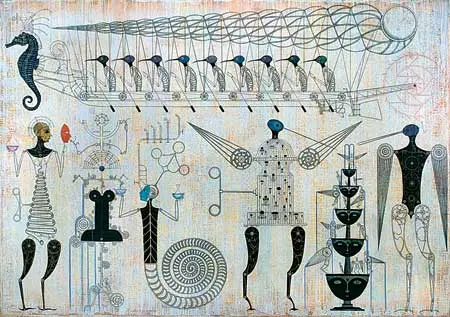
This is not his only piece that has touched, directly or tangentially, the theme of migration. In 2009 he made El Misterio de la Migraciones (The Mystery of Migrations), a painting that served as inspiration for an exhibition title. The complex scene was populated by mythical creatures, and showed diverse planes, but was mainly solved in two focal areas: the upper and the lower. On the upper side, he placed a seahorse leading a boat with rowers that looks like human beings with bird heads. The uniformity of the rowers is an allusion to the even situation: everybody is trying to get to the same destination. The lower part of the piece is far more complex: there is a mechanism of relationships established between all the represented characters, all linked in one way or another. We can see again his bird-headed beings, biped-hybrid creatures whose bodies are birdcages or chemical tubes. Once more, the idea of transformation is reflected in the imagery. There are not simply human beings anymore, the whole process of assimilation has made a profound impact, and therefore the change is inevitable. Estevez is talking about the foreseeable transformation that people experiment as time passes, and as they go through traumatic and life-change events such as migration.
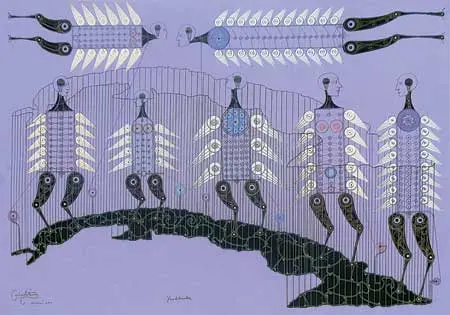
Up to this point in time Estévez never talked about migration in a political way, but mostly as a result of an inner necessity and a direct consequence of each person’s path. However, in 2011 he made Yard Birds, in which for the first time he explicitly shows the island of Cuba with his hybrid-winged creatures standing on it, ready to fly away.
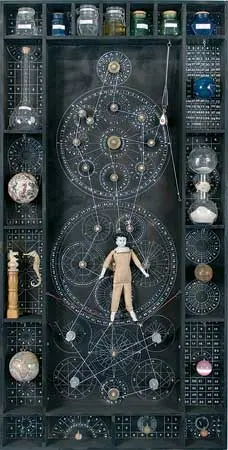
One of Estevez’s most revealing series was his ‘boxes’, undoubtedly influenced by Joseph Cornell’s iconic assemblages. Exhibited at Pan American Art Projects in 2008 under the title Hermetic Garden, it comprised several pieces on which he had been working from 2005 as an ongoing project. Each box was created as a separate universe representing a different theme. One of the earliest boxes was Domestic Planetarium, an intricate-looking assemblage showing many spheres connected to each other by a thread. The central sphere had attached a doll whose limbs were also joined to the mechanism. The piece alludes to the delicate balance that allows peace at home, and the importance of this harmony for any human being.
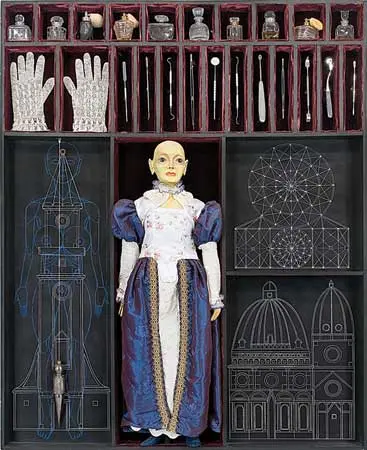
Feminologia Práctica (Practical Feminology), today part of the Frost Museum’s collection, was another box exhibited with the group. It contains emblematic objects of femininity such as lace gloves and perfume bottles but also included surgical instruments. He is bringing together the duality of pain and pleasure that could be associated with women. Estévez created the term Feminology to talk about women and their intimate world, in his view a complete and more complicated cosmos.
The theme of women and the apparent importance of beauty has been a recurrent one in his work. There is a canvas he made in 2009, Eternal Return, that enunciates his views about beauty and time. Estévez’s representation of women is not based on the traditional beauty attributes; indeed he consciously avoids them, elements such as hair or jewels are purposely left out. His ‘women’ are intentionally bold; he wants to concentrate his attention on their emotional and spiritual distinctiveness. In Eternal Return we see a woman staring at us, dressed in a red gown, from neck to toe. There are scissors nipping at every corner of the dress while the woman is very still like there is nothing she can do to stop them. This is Estévez’s view of the passing of time and the inexorability of it, and how the traces would be visible on her face and body.
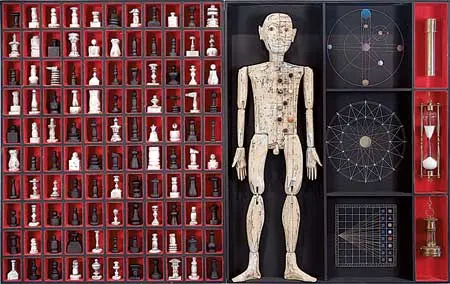
A third piece within the theme of inevitability is El Juego de la Eternidad Ilusoria (The Game of Illusory Eternity) (2008), based on Albert Camus’ idea of life as an absurd. The piece is a chess game in which the contenders are invisible. It is a metaphor of life seen as a strategic game, the way each person designs his own tactic to survive. He included elements that imply time such as a sand clock. Other symbols are more related to spiritual guidance, like the lantern for inner light and a miniature telescope, all tools to help in seeing what lays ahead.
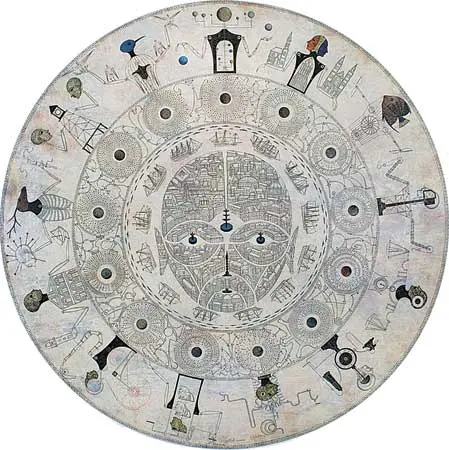
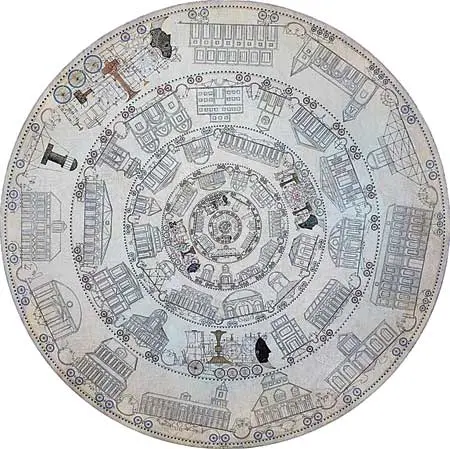
The following year, 2009, Estévez made two major works: Last Supper and Round Trip, without question two of the most important within his oeuvre. He created these impressive pieces in an unusual circular format. Last Supper is made after the famous biblical passage, and in a similar manner to King Arthur’s Round Table Estévez is presenting his view of the Twelve Apostles and God. He chose to represent the apostles as characters defined by symbolic elements, based on their particular attributes. To represent God, he chose to portray it as a hollow human body with a head surrounded by several smaller satellite heads, as if to show His ubiquitous power. Estévez decided to present us with a universal idea of God, therefore pleading for an integrative view of religion instead of a definitive representation of God following any of the main religious tendencies. This is a new approach to the subject, and looking back to A través del Universo we can see how he is bringing into a similar theme a broader vision.
Round Trip is his interpretation of life’s concatenated facts, the cause-effect factor. Estévez is talking about the idea of a cycle, and how it is developed throughout somebody’s life as a repetition of the universal law. He is following the alchemic idea of macrocosm and microcosm, which describes every human being as a macrocosm itself at the same time that it is a microcosm, part of the universe. In this piece there is a constant flow of trains, coming and leaving. Perhaps he is paraphrasing the popular saying of ‘taking the last train’ and sees life as a succession of trips and journeys.
In 2010 he presented his solo exhibition Oblivion, again at Pan American Art Projects. This time Estévez did three imposing canvases, the biggest up to that date, as the exhibition’s anchors. In those pieces, he continued exploring the existential side of life, not in a pessimistic way but by presenting the many possible alternatives that could be faced.
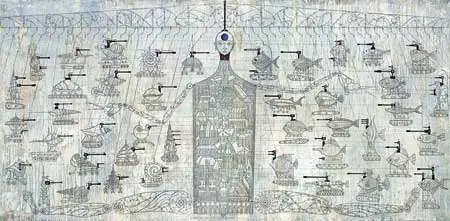
The first one, Permanent battles of the Transitory Existence illustrate the daily emotional and spiritual ‘battle’ we go through, mostly against ourselves. A central figure is a man showing his torso made up of a city; his head has attached a revolving carousel with pending armed fishes and shells besieging him. In alchemy, cities represent the inner self, the most intimate thoughts, and personality. So apparently here we have the image of this man, but what we are seeing really is how he sees himself, in the middle of his battle against the world, but mostly against himself. Estévez is representing a generic man, which could easily be any of us. In his viewpoint first, we need to know and understand ourselves, and then can we try to understand the universe. Once more he is reinforcing the idea of our place in the totality that represents the world, a sort of butterfly effect.
There is a more intimate part of his work that consists of drawings. Part of these is a recent series that he started in 2009 titled Ambar Project. This is a series of small-scale color drawings, almost miniatures, in which he individually explores subjects that he would usually combine in large format pieces. Made on Hanji paper, a hand-made Korean paper, the drawings are like single pages of a diary.
One of the most important principles in Estévez’s work is related to transmutation, the central idea of alchemy, but instead of transmuting metals into gold Estevez is interested in human change and inner transformation. He comments on what happens to people throughout their lives in a philosophical way. He is also exploring the place of human beings in the universe as part of a system and their individual cosmos, the wheels that move it all and allow them to function. This is another idea he has taken from the principles of alchemy: the existence of a microcosm and a macrocosm. Estévez sees men as individual entities in their own microcosm, and then as part of the universe, which he sees as a macrocosm.
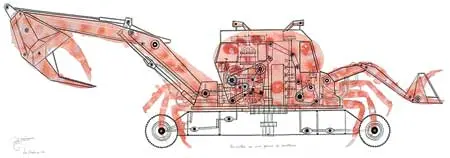
He has distinguished himself for his iconography, which includes hybrid creatures, half-human, and half animals. His characters have human bodies and birds’ heads, or vice versa, birdcages as bodies and human heads. He has created exquisite metaphors of parallels between the animal world and mechanics. In his eyes, all has been done before by nature, in the incredible and complex natural world. We can see it in Meditar es una forma de construir (Meditating is a way of Building), a drawing from 1999, in which a crab is mapped out internally as a digger machine; or in Mecánica Natural (Natural Mechanic), from 1997, when a hen becomes a sewing machine.
Over the years Estévez’s work has evolved and matured, developing complex imagery. His cosmogony has been nourished by a broad spectrum of sources: from medieval literature, illuminated manuscripts, antique philosophy treatises, and esoteric books, among others. If we had to define Estévez’s work we could say that it is about his constant questioning of life and the surrounding world; it is his inquisitive overview of humankind and of his place in the world.
IRINA LEYVA PÉREZ
Curator and art critic. Curator of Pan American Art Projects, Miami.