Carlos Amorales (Mexico, 1970) archives, recuperate and actuates. He appropriates what is his own with the intelligent momentum of someone who follows his intuitions and turns them into a graphic display of (im)probable (un)knowledge, not subject to verification, further pondering not needed. Amorales has been putting together a collection of images that comprise his “liquid archive” for over a decade. Its very name unmakes the concept-as-function of the archive, understood as the site and meaning of safeguard, denomination, warehousing, and ordered inter-relation. The “liquidity” convoked by Amorales in his gathering of images seeks, then, to re(s)olve the semantic capacity of its holdings beyond their formal boundaries and, certainly, the boundaries of their meaning.
Carlos Amorales’ recent solo exhibition at Museo Tamayo—curated by Magnolia de la Garza—includes works whose language and reverberations become consistent with the tone, fear, and trembling (Kierkegaard) of some of the art held in the museum; the curator recovers, via a “linguistic-formal” connection, works by Goeritz, Tàpies, and Torres-García, establishing plots that unfold towards the domain of contemporary artistic production. The displaced equilibrium takes place between the (in)visible threads, as in a tightrope, convoking the imaginary and imagined memory Amorales has learned and apprehended from the work of other great artists, such as Alexander Calder (at whose foundation Amorales was an artist-in-residence a few years back).
In this exhibition, the work that directly appeals to the body and the gaze with its visual and auditory presence is one that irradiates the reverberations of dozens of gold-colored cymbals whose restrained timbres seem to await and/or exploit the passing contact, bodily or auratic, of the visitor’s body. Its name, an invitation both to act and to listen, is: Veremos cómo todo reverbera (2012).
As we approach the center of the gallery, the “body-public”—now set to become part of the artwork—is given a drumstick like those used to play percussion instruments. The golden, suspended “circular flying saucers” sway on a vertical axis with a certain degree of uniformity on a seemingly harmless radius, if all that is left from them is the vibrating memory of the most recent contact. But then the hand that hits the rim of one of the sets of a couple of cymbals, configured like a Calder mobile, belongs to another body, it is immediately evident—from the tip of the fingers all the way into one’s heart—that the tension generated by the sound waves we hear, emerged from the force of the strike, penetrates us at once; it is impossible to stop or evade it, it overtakes us from the inside and keeps the time of our condition.
The body now entirely exposed to the sound vibrations of this interactive installation by Carlos Amorales, turns us, for a few seconds, into reverberating bodies. Let this be a fortunate way to recognize ourselves as the “vibrating bodies” about which the Brazilian theoretician Suely Rolnik has written-in-body with such sonorous lucidity.
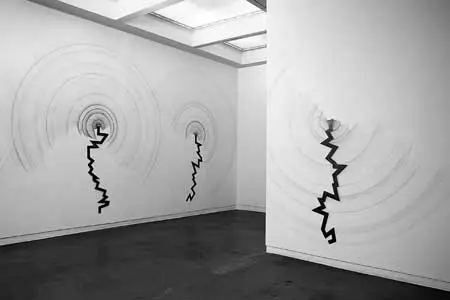
Carrying thusly corporeal, semantic, and symbolic linkages, Amorales extends between this work and the rest of the exhibition—for example: his cracked-metal sculpture Terremoto vertical (2010); his (de)coded video Amsterdam (2013); and those graffitied drawings in circles of broken tension that are so difficult to disengage from—tracings that are received as sound registers evident in one of the possible hearing-for configurations by JL Nancy.
Rooted in a profound interest in language-for-form, Amorales transforms history into tracings that also make their effects vibrate on paper and towards space Recovering the memory of a communitarian social consciousness—emerged from the many small and immeasurable tragedies caused by the Mexico City earthquake in 1985—the artist presents a series of graphite drawings whose delicate power is able to contain the deafening roar that still resonates for those who lived through and survived the horrific, duplicated event. In Amorales’ large-format drawings, rips that are like lightning strikes extend from the center to the edge of the paper—a great chasm in each surface; around it, the radius of the usually invisible waves that carry sound—like water does when a rock is thrown into it to create an expansive concentration of narrow vibrating circles—has been drawn in concentric tracings that make it possible for us to hear/glimpse/remember what the devastating morning of September 19th marked as a wound on the body of the city and its inhabitants; only to again inscribe the calligraphy of its fate on the evening of September 20th.
Recovering the gesture of this history in an “inhabitable” range for the “body-proper” (following the concept proposed by JF Billeter), Carlos Amorales recovers and re-situates the directed times of those indelible inscriptions; he does this grounded on the certainty of his own history-in-survival. Inviting us to remember that survival is a daily condition that we face—with greater or lesser awareness—but after visiting these galleries we know that there are other ways to receive and reinstate its harmonies.
MARCELA QUIROZ