
Renowned Trinidadian artist Christopher Cozier held his first solo exhibition in New York at David Krut Projects, a South African gallery with a venue in Chelsea. Cozier exhibited drawings and prints, as well as initiated an online project inviting participants to create variations on a template whose design is a recurrent feature in Cozier’s work. The pattern derives from the modernist architecture of the Caribbean, featuring open brickwork in a geometric configuration, which allows spaces to be well ventilated while remaining enclosed and secure. For Cozier, this particular motif symbolizes the hope and failure of the post-independence project in the West Indies.
The centerpiece of the exhibition was the large square drawing Now Showing II (2012) perforated with the brickwork pattern, subdivided into a grid-like format, and populated with images that recur in Cozier’s work, including a loaf of white bread with wheels, a base with the words “Made in China” over which are visible the legs of a businessman, the artist’s profile, two bare feet, and a leafy tree with a significant portion of its trunk cut off. The numbers “12.30” are prominently displayed in red ink, and they refer to the daily matinee film in Port of Spain, as well as to a poem by Nobel Laureate Derek Walcott titled The Spoiler’s Return, which reads, “all Port of Spain is a twelve-thirty show,/ some playing Kojak, some Fidel Castro,/ some Rastamen, but, with or without locks,/ to Spoiler is the same old khaki socks,/ all Frederick Street stinking like a closed drain,/ Hell is a city much like Port of Spain.” For Cozier as well, far from being a tropical paradise, Trinidad’s capital is an oppressive space with an erased past and an uncertain future. Red ink drips like blood from below the “12.30” caption. The tree that recurs in his drawings replicates the one that stands outside Port of Spain’s morgue, recognizable to anyone who has had to identify a dead relative. The bare feet blur past and present, recalling Trinidad’s history of enslavement and indentured servitude and signaling the country’s ongoing problems with poverty. The marks on the page also evoke violence, for Cozier employs a gestural stroke that obliterates parts of the images but also serves to bring the disparate elements together.
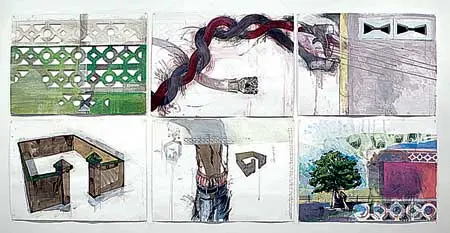
Cozier’s impressive skills as a draftsman are discernible in all of the works in the exhibition. From the postcard-sized drawings of his best-known series Tropical Nights, typically exhibited in a large grid, he has transitioned to working on bigger expanses of paper with more minimal groupings. Laocoon (2012) is a stark triptych of larger drawings that features the open brickwork patterns cut out of the paper in an entirely abstract composition in greens and grays on the left, two tubular forms twisting in a double helix accompanied by a hose with a mysterious serpent’s head in the middle, and a wall with two ventilation bricks next to which float a pair of feet, one fitted with a boot and the other bare, on the right. This project is particularly exciting to witness, as it signals new directions for Cozier. The images are more minimal, and they introduce interesting novel elements that flirt with pure abstraction. Whereas geometry in the art of nearby Venezuela had signaled the dream of modernity, in Laocoon’s green wall, it becomes oppressive, evoking monotony and entrapment. The middle drawing, with the spiraling tubes, gives the piece its name. Laocoön, a Trojan priest who warned his countrymen against accepting the wooden horse and was killed by two sea serpents along with his twin sons, is the subject of a celebrated sculpture from classical antiquity. In Cozier’s piece, these tubes resemble gasoline hoses and signify the oil industry in Trinidad, and the form of the serpent’s head derives from a drill bit. Like the Trojan priest, Cozier here warns of the dangers of oil dependency, especially in the context of the third drawing, as the feet, described with washes of red resembling blood, are positioned as a continuation of the hoses. Petroleum is Trinidad’s most important resource, but in Cozier’s view, it is a curse rather than a gift, resulting in violence and death. Another reference to the oil industry occurs in Development Patterns III (2012), a wonderfully complex drawing on cut paper where old colonial maps meet oil towers, palm trees, and the open brickwork. The exhibition is rounded out by a smaller series of drawings depicting walls around an empty lot, a recurring trope for Cozier that relates to Port of Spain’s vanishing historic architecture and the loss of collective memory, as well as various prints referencing colonial history, from the geopolitical to the domestic spheres.
In addition to his art, Cozier is an important critic and curator. He is a generous mentor to younger artists, and his web-based project evinces his collaborative spirit. Though his exhibition has closed, the online portal http://dpatterns2013.wordpress.com/category/dpatterns/ contains a variety of work by other artists, from the performative to the playful, demonstrating Cozier’s wide-reaching influence.
TATIANA FLORES