Hell is the title of the exhibition by artist Claudia del Río (Rosario, Argentina, 1957) at the Galería Nora Fisch. Under the curatorship of Inés Katzenstein, a selection of works created between 1996 to today by del Río shed light on some of the most important issues covered in her work. When we analyze her artistic trajectory and the works in this exhibition, the first thing we must mention is the important role of drawing as a dynamic practice and tool present throughout her entire production. During the 2002 Argentinean economic crisis, del Río created El Club del Dibujo (The Drawing Club), a self-managed artistic group project that to this day continues to develop participative activities centered on the exploration of drawing techniques with a strong emphasis on educational orientation.
Upon entering the gallery, on an elongated white table placed at the center of the room, viewers can observe three piles of white rectangular fabric pieces—silks, canvases, and cotton cloth—in which the artist embroidered different sentences. Through the years Claudia del Río collected headlines from the crime section pages of a periodical from Rosario that she eventually transcribed to the fabric remnants. The events that del Río chose to engrave allude to violence—murders, rapes, kidnappings, fights, abuses—that she condenses in shocking phrases with a high content of gore and tragedy. Nonetheless, without the presence of any context or narrative, the phrases sound too rarified, implausible, or insane to be true. It is interesting to note how the violence and the terrible nature of these sentences lose any density without context and, instead, how we come to regard them as unthinkable in the content of any periodical but more acceptable in works of fiction.
Periodicals pile up fleetingly day after day. Just as dramatic news and cover stories appear to be forgotten and buried under tomorrow’s news, in the same manner in Claudia del Río’s work the gruesome headlines accumulate on the table and the most recent one covers the one that was there earlier. It is necessary that viewers are willing to read the embroideries one by one.
But unlike the periodicals that are discarded or reused to keep eggs, here the event remains based on the poetic record. The work allows us to link together certain aspects of our world and to pause and immerse ourselves in deeper reflection. Del Río relies on the documental record of specific incidents to transcend the universal realm and to offer us the image of a brutal world that contrasts the manner in which she preserved these events. Somehow, the practice of embroidery masks the content with a friendly and delicate presentation that is associated with the feminine and that requires time, patience, and skill.
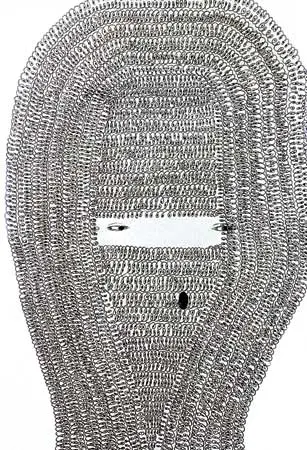
Women are presented in her work as a recurrent problematic connected to violence. We can observe this in her drawings—placed before the embroidered headlines—of heads that are reminiscent of burkas, a full-body cloak used by some Muslim women that cover the entire body and only allows for the eyes to be visible.
With each dense texture, the veil works as an armor that imprisons the face of the woman. In some instances, the cloak even covers the eyes with a mesh that only lets us guess phantasmagorical forms.
On the lattice of these heads, a small black oval rips the fabric to reveal a scream, a veiled gesture. This oval form is connected to the ingenious drawings of armored young girls in which the scream is no longer visible, but rather materialized in the form of jaws that emerge from the mouths of girls with faces that lack eyes and noses.
These drawings are not the only works that shed light on the vulnerable and interrupted world of children; it is also manifested in some of the embroidered headlines or on the skirts of the female characters, created with cutouts from periodicals that narrate stories of abuses. The fragments from periodicals are mixed with a world of consumption where faces and figures have been invaded by the Coca-Cola logo. An image that invades several series in del Río’s production, just as the artist announces in an advertising poster intervened by her, is “Coca-Cola is an army,” that invades and attacks her characters until they are transformed into anonymous Mickeys. With a critical gaze del Río evidences the invasive impact of contemporary icons of consumerism.
The work by Claudia del Río is shown with an apparent innocence that is interrupted by several elements that reveal a latent hell and a world plagued by threats. Her works exhibit the hell of an interrupted innocence where a friendly presentation is invaded by a cruel documental record.
AYELÉN VÁZQUEZ