
In a dialog titled The Decay of Lying, British writer Oscar Wilde has his characters, Cyril and Vivian, debate with a heavy dose of irony the idea, anti-natural in their judgment, of nature. Vivian, a consummate urban dweller, declares himself incapable of enjoying nature: “People tell us that Art makes us love Nature more than we loved her before (…)What Art really reveals to us is Nature’s lack of design, her curious crudities, her extraordinary monotony, her absolutely unfinished condition.” In the selection of works that comprise the exhibition titled Canto XVI, Bogotá native Consuelo Gómez explores the conflicted and emotional relationship between artist and landscape, between nature’s plan and Man’s plan, the way in which nature is seen and idealized and the way in which it is freighted with narratives and sensations.
In recent shows such as Cinturón Rojo at the Bogotá Chamber of Commerce (2011) or Lirucas at Universidad de Los Andes, Gómez had focused on an exploration of city locales, like the Las Cruces neighborhood, that retains their idiosyncratic character. Canto XVI explores rural spaces and, on the basis of an observation of nature, returns to the creation of objects that speak with nostalgia about history not only in their formal aspect but through the materials used for the reconstitution of the landscape. Wood, metal, stone, and gold thread intermix in this series and generate a sensorial relationship with the landscape, already translated into a work of art.
The exhibition turns on two axes: on the one hand, a physical experience of the landscape; on the other, literary allusions to the landscape. Gómez situates herself halfway between a romantic gaze on places and their history, and detailed observation of sections of the landscape. The central work is an installation made with a number of heart-shaped rocks the artist found on the banks of the La Vieja river, in the Emberá territory of Colombia’s coffee zone. The rocks, transformed into enigmatic objects by their encapsulation in resin, emerge from a corner of the gallery as if redrawing the riverbed; the resin has the effect of producing glimmering reflections and gives them a diffuse appearance as if they were again underwater.
This installation, which gives the exhibition its title, is closely connected Canto XVI, from a poem about the Spanish conquest of the region written by Juan de Castellanos in Tunja around the year 1500, which, among other things, mentions the La Vieja river, tears, and loss.
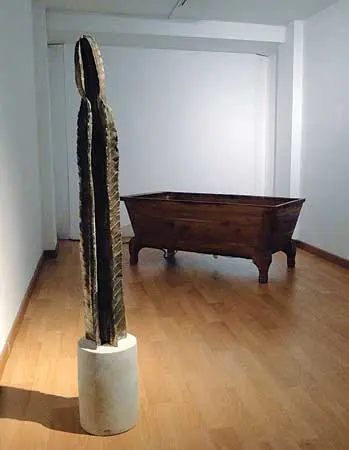
In the next gallery, visitors find a four-legged bathtub carved entirely in wood, with the same kind of rocks in the bottom; water vapor emerges from the rocks, filling the space with a heavy, humid air that envelops observers. In the same gallery is a cactus, approximately 1 meter tall, molded in bronze. An impressive sculpture, nature duplicated, immortalized, refined, and forceful. The original plant was collected by the artist during her journey; in the operation of molding it in metal, Gómez is able to amplify the presence of beauty and danger in the original. The series Caserío and the work titled Balsa, both in aluminum, are based on organic elements. In this case, the mold protrudes from a kind of improvised wall made with pieces of guadua, a thick bamboo-like reed commonly used for dwellings in the Colombian countryside. In Caserío, fragments are turned into abstract paintings; in Balsa, the sculpture leans casually against a wall.
Among the works placed on the gallery walls are Canto XVI.1, Canto XVI.2, and Canto XVI.3, small canvases with monochrome backgrounds, hand-embroidered with the words Rio, Oro, and 18K but in half, to be completed as they unfold: a sculptural operation that replicates the mechanism of the poem, where the written word generates its complete meaning through the viewer’s act of reading.
Gómez has always been virtuosic in her creation of objects, generally city objects. The exhibition Canto XVI presents a facet of the artist that reveals her concerns and questions regarding an encounter with nature and her highly personal vision of the romantic landscape genre.
MARIA CLARA BERNAL