
“Many examples of Camp are things which, from a “serious” point of view, are either bad art or kitsch. Not all, though. Not only is Camp not necessarily bad art, but some art which can be approached as Camp […] merits the most serious admiration and study.”
Susan Sontag, “Notes on Camp”, 1969.
I am interested in the paradox contained in Dani Umpi’s work. It interests me as a concept that represents and betrays itself, on the basis of language itself. Dani Umpi (Tacuarembó, Uruguay, 1974) seems to be generating layer upon layer of contradiction, estrangement, relationships between appearance and parody that remain in an antagonistic location between allusion (aspiration) and the impossibility of transcendence (the jester). Then, on the basis of renunciation or submission, he paradoxically transcends himself, which is what interests him the most (transmutation), and generates, on the basis of precariousness and superficiality, complexity and aesthetic form (language).
Dani Umpi works as an artist, musician-performer, and writer. A widely known art-world figure in the River Plate region, he prefers to keep each expressive modality in its corresponding creative sphere. Thus, as a musician he works with a producer, offers shows in theaters, and has launched four records and a number of video clips; as a writer, he has published four novels, including Miss Tacuarembó (Interzona Editorial, 2004), which was made into a movie directed by Martín Sastre in 2010; and as a visual artist, he thinks about objects and images in close connection with the environment created by the mass media. For those who know him, it is impossible not to see one of these activities as related to the others; yet the artist confesses that, for him, being three artists in one is not a problem, and that he prefers activating each in and from its own cultural and economic circuit.
Direct dialogs do emerge, obviously, since these are productions in different languages but by the same person. In fact, this show, his first as a new member of Xippas Gallery, reflects the syncretic drive in his three fields, as well as the way in which the art gallery space naturally propitiates the encounter between words, visual matter, music, and performance.
Defining Dani Umpi’s art is a difficult task, although terms such as kitsch, trans, and pop are generally used. Indeed, at first glance Umpi’s visual repertoire does give a kitsch appearance, appropriating as it does the universe of advertising and massive popular entertainment, and incorporating, especially in his performances, “trans” elements such as long-haired wigs, high heels, dresses that are sculptures, and an androgynous repertoire of bodily gestures. But a closer look will unveil subtleties that betray the (pre)judgment of this first impression. There emerges in that space an interrogation of those legacies of Western modernity’s visual and cultural history. In this exhibition, Umpi has populated the walls and floors of Xippas Gallery’s two spaces with paintings, assemblages, and sculptures that are arranged into narrative sets dominated by an appropriation of the massive products of the entertainment and communication industries. As they are perceived about a set of works of art displaying a kitsch aesthetics, let us think about kitsch as such. Originally, in late-nineteenth century Europe, kitsch was the cheap copy of an original object intended as a replica aspiring to the status of high culture. It is true that over time the concept associated with this term shifted and came to mean almost the opposite: an underground, subversive culture against bourgeois products: the cheap and the supposedly shoddy as a counter-cultural attitude. A deeper analysis helps us realize that in the end, such labels cease to matter, yet Umpi’s work, by bringing to the fore those relationships, has us navigating the pathways of a visual culture on a map of tastes and styles that are consistently marked by high culture. So, what Umpi takes from kitsch, pop, or camp (moreover if we keep in mind Susan Sontag’s brilliant 1964 essay “Notes on Camp”) is, precisely, a point of stylistic reference directed towards a sensibility having to do with their social position.
A sensibility that takes the aesthetics of artifice as a counterbalance to the seriousness of modernism with respect to the (hypocritical) relationship between man and nature. By appropriating the artificial, the artist incorporates a lie in order to access truth via (self)mockery and irony.
Dani Umpi is in search of inner life on the basis of archetypes and clichés, and of transmutation on the basis of parody. Talking as his alter ego the situation of the jester, he allows himself to circumnavigate contradiction, incorporating himself as an artist, alchemist, and “master” within the parodied repertoire. In the act of parody, the artist generates language, movement, art, aesthetics, and, paradoxically, parody ceases to be important. Throughout his opera-performance Marta la Musical, included as an audiovisual projection in this show and which combines theater, opera, rituals, and performance, Umpi builds the paradox of his supposed transmutation as a form in constant motion. The enlightened master is at the same time the dramatic protagonist and the persona of the director and the jester, and both are in equal amounts controlled (directed) and improvised (not acted) by the artist-director himself.
The exhibition’s title is, at first, disconcerting. What is there of informatics in an art show featuring almost artisanal objects, where, except for one video, everything is paper, collage, and assemblages of objects appropriated from the mass-media industry?
The work titled as the show comprises seven vertical diptychs combining drawings of mystical and mythological motifs made on sports fabric with cones of magazine paper dominated by the color red, abstraction, and repetition. The tips of the cones protrude outwardly from the wall, emphasizing the construction of space: body and three-dimensionality confront the viewer’s gaze in terms of volume and agglomeration, while the drawings in the upper row suggest the opposite motion: they demand an intellectual reading of the symbols. The eye goes in and out, the body thinks and feels, the motion is like the waves reaching the shore and turning back.
The term informática is like a contraction of the words información (information) and automática (automatic). Although it refers to computer science, Umpi incorporates it into his show for its etymology: for his habit of appropriating the world of “automated information” and a recycling drive through which he reorganizes the mass of communication produced in ephemeral, expendable ways to re-generate the intimate and sensible space that such very “informatic” mass undoes.
A similar operation is performed by the series on the opposite wall, comprised of large collage-paintings using (appropriate) texts where each word is formed by cutouts of individual letters from magazines, newspapers, and other mass-circulation print matter. They are like fringes with loose tips, covering with their shadows the words in the lower row. Umpi has transcribed (trans-cutout) Uruguayan president José Mujica’s discourses on the occasion of the Rio+20 Summit, Lady Gaga’s response to Madonna’s aggression at a concert in New Zealand, a fragment of Johannes Keppler’s Harmonices Mundi, among other texts. The result is “paintillist” (as opposed to “pointillist”), and it transforms the message into a decorative composition while at the same time transforming decoration into a message with a new meaning.
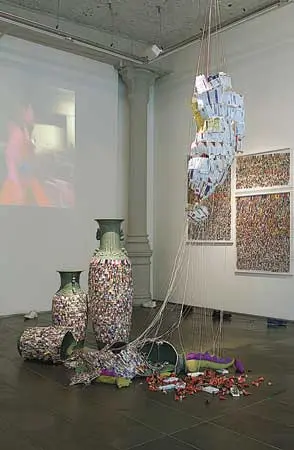
In the central installation, La muerte del patriarcado, there are more cutout letters forming complex texts; here the artist leaves the frame in order to explore the message in the broader space. As he has done numerous times as a musician and performer, wearing outfits that extend capillary from his body into the stage. In this installation, Umpi wraps three “Chinese” (very kitsch) vases, replicas of ancient Greek amphora, with his letter-fringes cut out from all kinds of mass-circulation materials. Suspended by threads from the ceiling, a cocoon-like wrapping falls on the vases, made with empty boxes of a psychiatric pharmacopeia covered inside by the same paper cones seen in the diptychs in Informática. One of the three vases is broken, intertwined on the floor with a reptilian shape that alludes to the process of metamorphosis.
In this installation, Dani Umpi brings together and syncretizes with great clarity all his linguistic and spiritual impulses: let’s agree that it is rather uncommon to find Jung connected to Kabbalah mysticism, alchemy, tarot, numerology, politics, commerce, and advertising, the chronic visuality of globalized post-capitalism. Umpi seems intent on devouring and regurgitating the artificiality of the contemporary world on the basis of its plastic and paper uses and refuses, with an anthropophagic impulse that is highly unusual in the River Plate region: media and commercial excess are detoured in his work towards a more regular destination, emptiness and garbage, and from emptiness and garbage Dani Umpi generates motion, form, sensorial entertainment, a language of his own.
VERÓNICA CORDEIRO