
Using photography, Demian Schopf (1975) does in Los Tíos del Diablo a seemingly simple operation of great aesthetic and conceptual effectiveness. In large formats and with the clarity and cleanliness of advertising images, the images cross vast vistas of garbage dumps in the high plateau with the solitary presence of dancers dressed in colorful costumes of religious and pagan characters, the protagonists of carnivals such as the one in Oruro, Bolivia (before Lent) or the one in La Tirana, in northern Chile (devoted to the Virgin Mary of the same name).
The series on exhibit at Patricia Ready Gallery is part of an investigation that began some four years ago. With it, the artist establishes a repertoire filled with beauty, astonishment, and profound socio-cultural implications, and connected to the neo-baroque style, kitsch, Latin American pop culture, and the landscape tradition in painting.
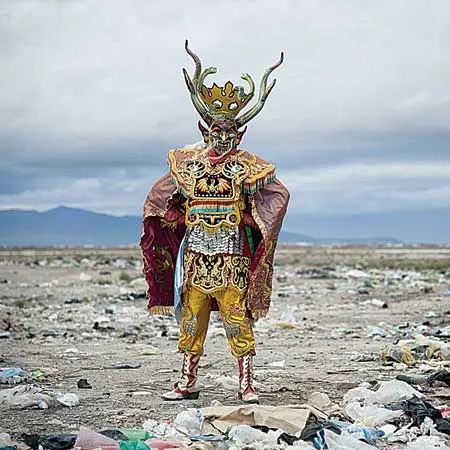
The effect is as delirious as it is devastating. The profusion of details in the garbage mounds: containers, cans, bags, technological devices, tires, and furniture, among others, appear dimmed and gray. The monochrome of the background renders these sites post-apocalyptic. Contrasting with this are the lively colors of the outfits, the sparkles and textures of the fabric, the excessive forms, the designs filled with symbolism, and the grotesque, monstrous, humorous gestures of the models, among whom we can find, for instance, flame-throwing devils, psychedelic kings, and bizarre animals.
This encounter of actors and landscape is a refinement of prior investigations about the neo-baroque and processes of ethnic mixing in Latin America, but it also sends us into new terrains, such as politics, film, comics, and science-fiction.
From the standpoint of the neo-baroque and of ethnic mixing, the abundance of codes and the coexistence of diverse visual territories are, for Schopf, even promiscuous. In dances and processions, he says, there is a convergence of “the most varied religious, social, political, countercultural, gender-based, erotic, eschatological, aesthetic, and even ethical admixtures… all kinds of characters, from old church ladies to drag queens and transsexual she-devils reborn as women on some rinky-dink surgical table.”
The desert, strewn with garbage, is a kind of refuse city, the last gasp of some metropolis that fades into the powerful desert. In the middle of all that, the characters are the contemporary expression of pre-Hispanic cults, of ancient adorations to the gods of earth and fire, to devils who protect mines and mineshafts, to goddesses of fertility. Also present in them is the colonial-era syncretism that linked them to angels and demons, mixed afterward with characters from the mining culture of the high plateau, and now with the fashions of urban tribes.
In their delirium, the subjects in these photographs appear artificial, and the landscape comes to suddenly resemble a stage. Alongside the profusion of elements on the surface, artificiality is another characteristic of the neo-baroque. It is impossible not to connect this project with his 2002 work La Revolución Silenciosa, where Schopf performed a similar operation, recording mannequins dressed as harquebus-wielding archangels (a reference to religious representations of the Latin American baroque) found in the warehouses of the Museo Nacional de Historia Natural in Santiago, where he also photographed stuffed animals and working tools that symbolize totalitarian ideologies. Along with this hybrid aesthetics, the references also pointed to Chile’s military dictatorship: Revolución silenciosa is the title of a book by Joaquín Lavín, an emblematic right-wing politician, about the institutional reforms that paved the way for neoliberal economic policy in the country.
The political context for the current series forces us to seek connections of this kind; we find ourselves, then, looking at situations of neo-liberal crisis and globalization processes, which on this spot on the planet generate deep paradoxes, beyond the coexistence of religious and profane elements, of folklore and pop culture, of the first and the third worlds, from the excess (in every sense of the word)of the outfits to the aridity of the location and its marginality.
The role played by these characters in the dances and diabladas is to personify the connection between the world of the divine and the space of complete freedom. What in the photographs appears at times as a moment of rest after the carnival, the exit just a step away, suddenly becomes a scene from Mad Max, George Miller’s 1979 film starring Mel Gibson. The arid location is host, for Schopf, to “the protagonists of an anime space-opera.”
That “future city” to which the photographer signals is the garbage dumps of high-plateau cities, a periphery that also exists in many other places in the world. A liminal site where some circulate and even live, using consumer society’s refuse as part of their way of life. As in a dream. The vestiges of a series of historical and cultural encounters survive here, human forms left after the catastrophe, and also the emergence of a new lineage.
CAROLINA LARA B.