
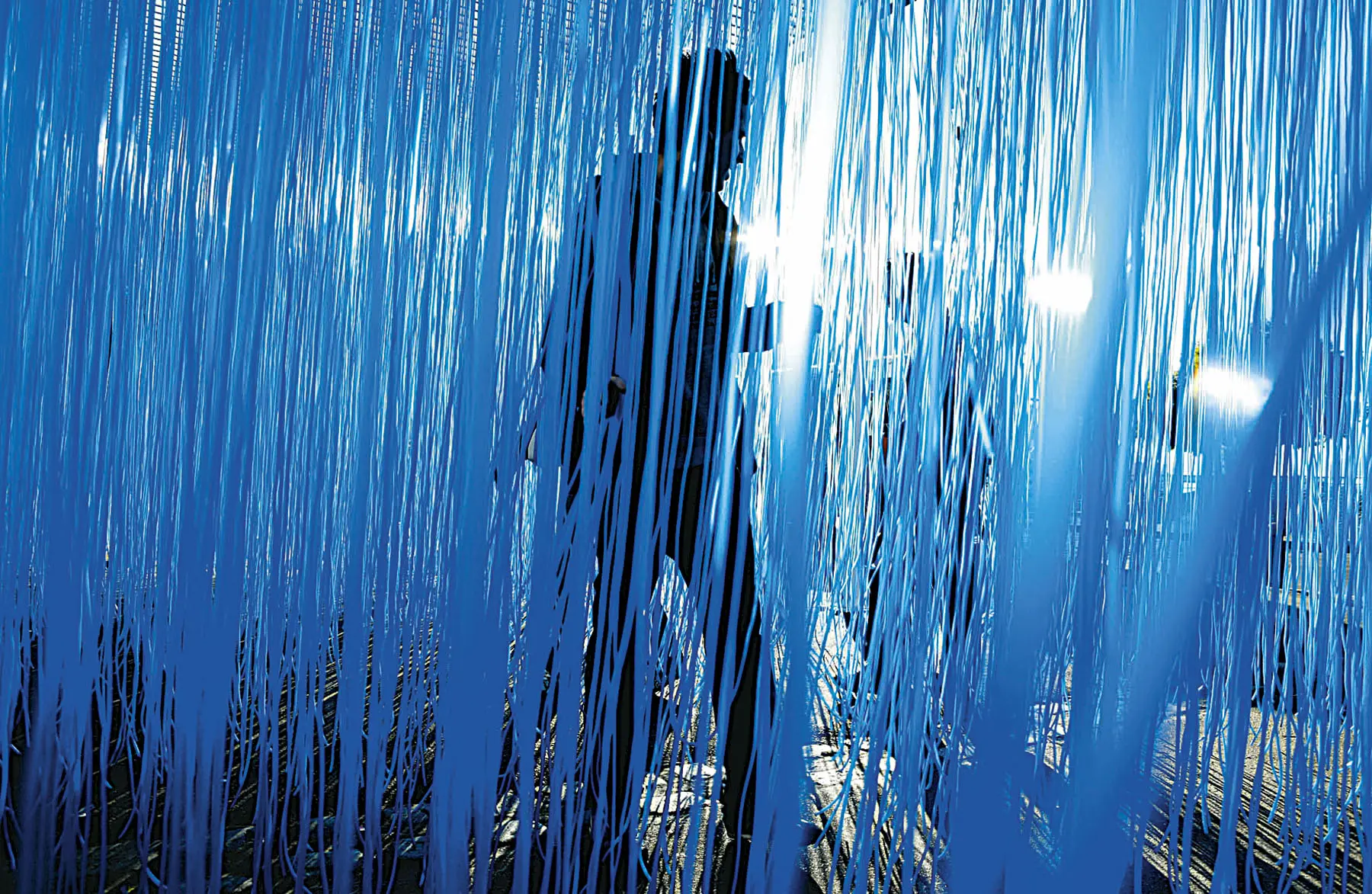
The exhibition is titled Dynamo. A century of Light and Motion in Art, 1913-2013 opened its doors this spring at the Galeries Nationales du Grand Palais in Paris and marked the first time in the history of that institution that a show occupied all the galleries.
An ambitious initiative proposed by curator Matthieu Poirier, the project condenses one hundred years of artistic creation in 3,700 square meters of space and includes more than 200 works by 147 international artists whose experimentations and explorations center on the development of the perceptive system.
Dynamo is based on the notion of movement as a principle for creation capable of evidencing seemingly immaterial categories like space, time, and light. The works selected for this exhibition represent several degrees of modernization of the persuasive mechanism proposed by artists during the last century with the objective of developing the perceptive and participative abilities of the public.
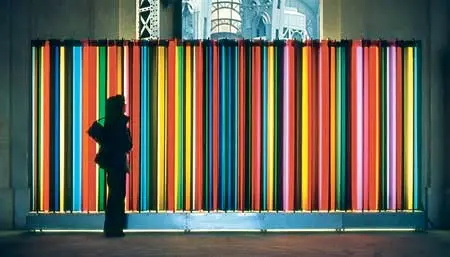
Just as the phenomenological structures of perception described by Merleau-Ponty in his 1945 book titled Phenomenology of Perception contain an active dimension, Dynamo proposes an exhibition in which visitors are subjected to several levels of optical invitations to interact. According to Poirier, the idea is to explore the question of perception in-depth and that the works express the entirety of their phenomenological aura. The selection of proposals in Dynamo appeals to the emotive perception of viewers, as it encourages all sorts of “sensitive apparitions,” experiences in which a transcendental conscience is not required.
The exhibition succeeds in blurring the chronological limits that would otherwise label and subject the participating artist when they show their works to certain types of mass exhibitions. Without pretending to establish any theoretical or historiographical basis of a century of casual experimentations in art, Dynamo offers an alternative approach to the perceptive act and the notion of depth, as it dismantles any logical or intellectual interpretation. Rather than grouping artists according to territory, the exhibition proposes a transversal dialogue on the perceptive phenomenon.
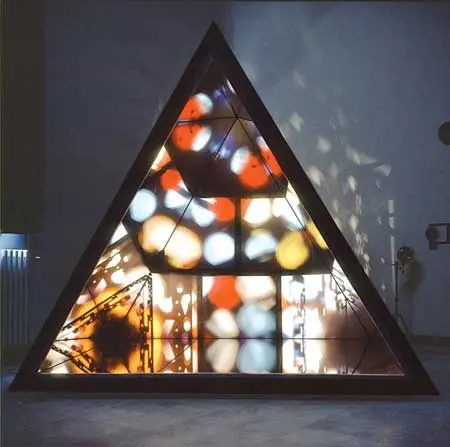
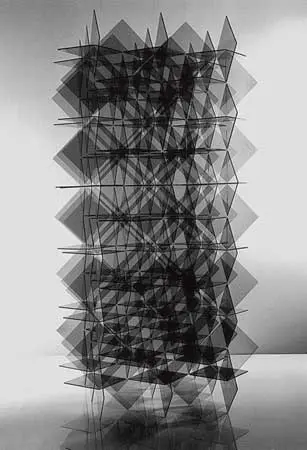
Nonetheless, nothing stops us from listing the Latin American artists that participate in this exhibition—as interlocutors of the synthetic, inventive and fascinating language of perception—and noting their large presence in the show. From Argentina: Antonio Asís, with Composición en Blanco y Negro No. 1804 (Black and White Composition No. 1804, 1966); Gregorio Vardanega, with Torre Ortogonal (Orthogonal Tower, 1987) and Espacios Cromáticos (Chromatic Spaces, 1970); Martha Boto, with Teclado Electrónico (Electric Keyboard, 1967); Hugo Demarco, with Superposición Recto-Verso (Recto-Verso Superimposition, 1965); Horacio García-Rossi, with Caja de Luz Inestable (Unstable Light Box, 1964); Julio Le Parc, with Muro de Láminas Reflectantes, (Reflecting Sheet Wall, 1966), Superficie Color, (Color Surface, from the series 14-2E, 1971), Inestabilidad (Instability, 1959), Continual-Luz Cilindro (Continual-Light Cylinder, 1962), Trama en Movimiento Virtual (Weave in Virtual Movement, 1965), Luz Alternada (Altered Light, 1966), Caja Luminosa (Luminous Light, 1967) and Móvil Transparente (Translucent Mobile, 1962-1996); Luis Tomasello with, Atmósfera Cromo Plástica No. 224, (Plastic Chrome Environment No. 224, 1968) and Atmósfera Cromoplástica No. 413, (Chromoplastic Environment No. 413, 1974); from Brazil: Lygia Clark, with Bicho, (Bug, 1969); Almir Mavignier, with Convexo/Cóncavo (Convex/Concave, 1964); Mauricio Nogueira-Lima, with Objeto Rítmico No. 2 (Rhythmic Object No. 2, 1952-1970); and Mary Vieira, with Polyvolume (1948) and Superficies Circulares Móviles Dentro de su Espacio Esférico (Mobile Circular Surfaces inside a Spherical Environment, 1958-1963); from Uruguay: Carmelo Arden-Quin, with Forma Blanca (White Form, 1950); from Venezuela: Carlos Cruz-Diez, with Cromosaturación (Chromosaturation, 1965), Cromointerferencia Mecánica, (Mechanic Chromo-Interference 1973) and Transcromía (Transchromie, 1972); Alejandro Otero, with Coloritmo No. 43 (Colorythm No. 43, 1960); Jesús Rafael Soto, with Espiral con Rojo (Spiral with Red, 1955), Penetrable BBL Azul, (Penetrable BBL Blue, 1999); Cuadrado Interior con T Negra (Interior Square with Black T, 1979); Elías Crespin, with Circunconcéntricos Transparente (Transparent Circumconcentrics, 2013); and the international group G.R.A.V., with Laberinto (Labyrinth, 1963-2013).
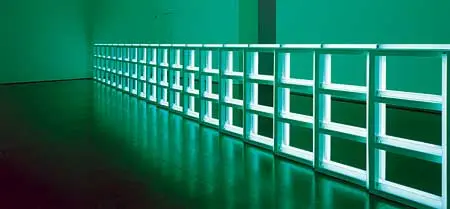
The concern expressed by Torres-García in the Círculo y Cuadrado periodical (1936), with regard to the need for injecting a distinctive look into an already universally appealing abstract Latin American art, tends to vanish in this exhibition, as we observe Vasarely, Schöffer, Le Parc, Cruz Diez, Sobrino and Morellet in the role of “indiscernible moderators” of the persuasive mechanism and the intrinsic potential for participation contained in the work of art.
Each piece included in Dynamo “happens” in an uncertain and obscure space that answers to a force field that continuously plays with instability and forces us to inhabit a disconcerting environment that is enjoyable at times but also terribly shocking.
Structured around two main sections: Vision and Space, Dynamo is subdivided into 16 thematic axles or metaphors intimately related to the perceptive phenomenon: immateriality, monochrome, interference, concentric/eccentric, immersion, blinking, turbidity, instability, distortion, emptiness, invisibility, and permutability, among others.
The depth found in the phenomenon of perception is revealed right behind that “responsive eye.” As soon as the classic forms of abstraction and concrete art have been assimilated, any logical explanation is discarded and the artists appeal to optical reflections, intuition, and the answers from the body. It is then that art overflows, materializes, and floods the exhibition space.
It is important to emphasize the term Expansionism (1953), temporally introduced in Paris by Venezuelan artist Omar Carreño to underscore the dematerialization and expansion of art—geometrically and spatially—as abstract conventions of thought.

Antwerp (G58-Hessenhuis) presents the exhibition Anti-Painting (1962), a title that defines those works that, without being three-dimensional, invade the space as a result of optical and physical phenomena that take us into another dimension that experiences changes in movement and light vibrations.
Beginning with contemporary creators, Dynamo includes a large and varied number of artists who, with the technical advances and artistic languages of their generation, performed explorations centered on the subtlety of movement. Standing out among these works is the Circunconcéntricos Transparentes (Transparent Circumconcentrics) by Elías Crespin, works that were delicately programmed and articulated with a computer; the uncertain depth of the immersive environments by Ann Veronica Janssens atomized with color; the impact of light flashes that Carsten Höller shoots like bullets (Light Corner, 2001); the ultra-polished surfaces—visceral color—conceived by Anish Kapoor (2008) to give us back a disconcerting version of ourselves.
These contemporary artists precede the enormous body of veterans from the multiple manifestations of Op-Art and Kinetic Art. They represent a generation that since the beginning of the 1950s advocated the participative role of the public. In this regard, many artists like Argentinean Raúl Lozza who, beginning with his work Perceptismo (Perceptivism, 1947), demand a participative attitude from viewers that, rather than encouraging mere contemplation, are geared toward action and the exaltation of the public’s own interactive abilities. In this regard, Nicolás Schöffer affirmed that it was imminent “to create creation” and invited the public to occupy and give meaning to his proposals.
Beginning with the mystic exhibition titled The Movement (1955) at the Galerie Denise René in Paris, the manipulation of artworks became imminent as Vasarely enticed visitors with a banner that read “Please Do Touch” at the gallery’s entrance. The Hungarian artist who lived and worked in Paris was an important advocate of the social dimension of art. Likewise, Manipular y Cooperar (To Manipulate and to Cooperate) were the premises established by the group G.R.A.V.—that participates in Dynamo with the reconstruction of their Laberinto from 1963—in search of viewers that are aware of their creative and participative abilities. The exhibition The Responsive Eye at the MoMA in 1965 also played a part in propelling the necessary conditions to create a participative public. It is with this in mind that Soto proposed sculptures that could be penetrated within the exhibition spaces of museums, or Cruz-Diez’s “color that would happen” in the time/space of its Chromosaturations (1965). Likewise, Le Parc elegantly models a light that caresses Continuel–Lumière Cylindre (1966); and Gianni Colombo, who invites viewers to occupy un Spazio Elastico (Elastic Space, 1967-1968).
The exhibition exquisitely closes with the lucid and visionary lessons from the beginning of the last century that preceded the notion of speed, movement, space, and perception. Rodchenko, Moholy-Nagy, Duchamp, Kupka, and especially Gabo and Pevsner, renounced to volume earlier to introduce the notion of “depth” as the sole visual form of the space. From that moment on the Realist Manifesto (1920) laid the groundwork for the artistic evolution of an entire century, as it proposed the need to recreate in real time the essential forms of our perception animated by kinetic rhythms.
An avalanche of 3,500 visitors daily has turned Dynamo into one of the most talked-about exhibitions in the French capital. From the most subtle of stimuli to those that unequivocally go through viewers, the walk through the exhibition spaces generates a vertiginous experience that is clearly destabilizing.
The public that visits Dynamo is exposed to the spectacular nature of contemporary art. Of course, the exhibition is not for everyone, as some might not react favorably to the perceptive demands it imposes. The artists from the last century have creatively celebrated the endless possibilities of perception, as they have created a profound atmosphere that continues to be inhabited by spectators who bask in the light of new art while also being part of the show.
*All images illustrating this text are courtesy of the Press Department of Grand Palais.
ELISA RODRÍGUEZ