
Before opening for the public last March 23rd, 2013, Casa Daros, Río de Janeiro had already started its Research and Creation Residency Program. Their first guest was Brazilian artist Iole de Freitas. The program is directly connected to the philosophy that inspires the Daros Latinamerica Collection, that of seeking to become a space for permanent reflection and study, exploring in-depth the concerns and creative processes of the artists represented there. It doesn’t intend to commission works from its participants, but to ‘visit’ and ‘accompany’ an investigation in progress, creating the conditions for their proposals to take place and/or unfold in different directions.
Eugenio Valdés Figueroa, When and where did your question, “What are the museum walls for?” emerge? Was its formulation prior to your residence at Casa Daros, which was already present for instance in your Documenta in Kassel installation?
Iole de Freitas This began a long time ago, in 1991, with my first large-scale site-specific work for the Morumbi Chapel in São Paulo. That Chapel fuses Brazil’s old rural and mining traditions of the garden wall and the Modernist intelligence of Gregori I. Warchavchik, the brilliant early Twentieth-Century architect who remodeled the building. I know the garden wall technique well, those small, mud-filled wooden planks because I come from the interior of Minas Gerais. I wanted to use the walls, but they didn’t work for me, because the walls would not hold the weight of the work. On that occasion, I was saved by a large wooden beam, where I was authorized to fasten it. The challenge of using the walls began there. Progressively, I abandoned a kind of gestural work on the material, although this work, in particular, was still part of my large baroque reliefs from the early 1990s. Nevertheless, starting with that intervention my point of view shifted and I began to realize that walls would not always be gentle with my aesthetic thinking.
EVF Are you talking about negotiation with space, with the boundary?
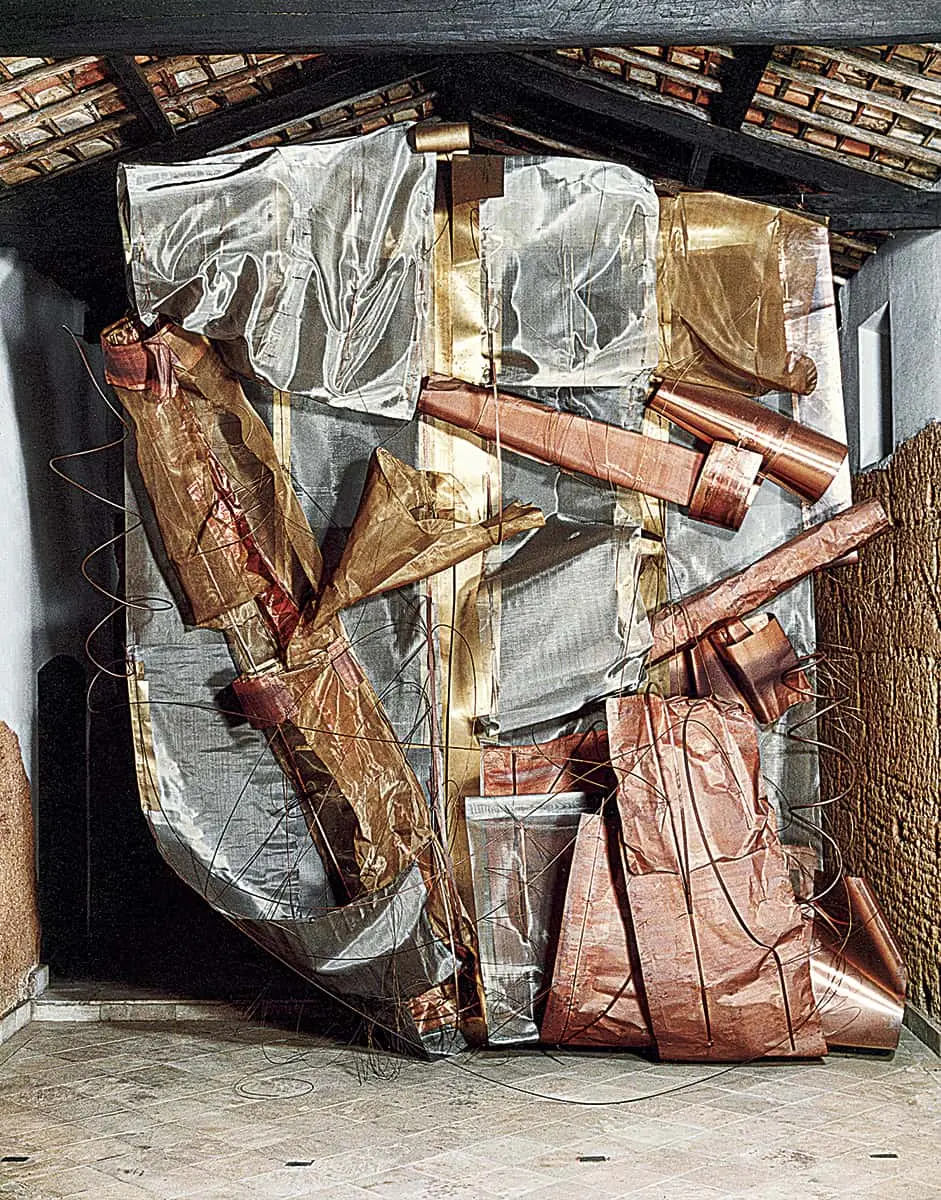
Iole de Freitas When I want to and, of course, when I am allowed, an instance is created. But you are right, it is a negotiation because the work cannot do it all. The wall can refuse to comply. On occasion, the work can even break the wall. It is often like that: you are told you are not allowed to do anything, or everything is permitted. And when I’m told that I can do whatever I want, it is up to me to place a limit. Almost two decades later, at Casa Francia Brasil in Rio de Janeiro, the issue of the walls continued to prod me, not only in physical terms but also, and mainly, from the structural and conceptual point of view. The roof was designed by the Nineteenth-Century architect Grandjean de Montignyen for that building has a structure that is similar to an ancient ship, overturned. It is pretty. I had to climb on those cranes and scaffolds until I was able to access some interior tunnels and discover the wood elements that gave structure to the walls by means of connecting joints. When I understood that, I thought: “They must have been crazy when they said that I can perforate the wood. If I damage the supporting structure, the whole thing will come tumbling down.” I found the points where I could tie things but didn’t dare hammer anything in. I even noticed that the word Cristo was written in one of the beams, and I thought it ironic: were I to hammer a nail there, the whole roof structure would fall. To me, above all, the museum walls have a symbolic meaning. Thus my question: What are they good for? It is a museum. To hold a collection? To shelter the art? Not always.
EVF Museums are not always a “sheltering” place. How could a museum contain everything that art has been and can become, without its boundaries becoming institutional barriers? Mankind erected its first wall in search of shelter, and in the process also ended up erecting the walls of its first prison…
Iole de Freitas The museum walls would have to be permeable to new ideas. There are courageous curators who prefer works that propose a rupture. But there comes a moment when such permeability to ideas, of institutional instances with regards to my work, requires a physical anchor. For the work to be able to fly out and expand the museum to the extramural space —a word I learned with you— the historical legacy, the curators, and the architects need to make it possible for the walls to be perforated. Only in that way are they able to lose their rigidity in institutional and aesthetic terms, and cease to be walls to become anchors.
EVF In Kassel, in 2007, your work overflowed and the wall became porous…
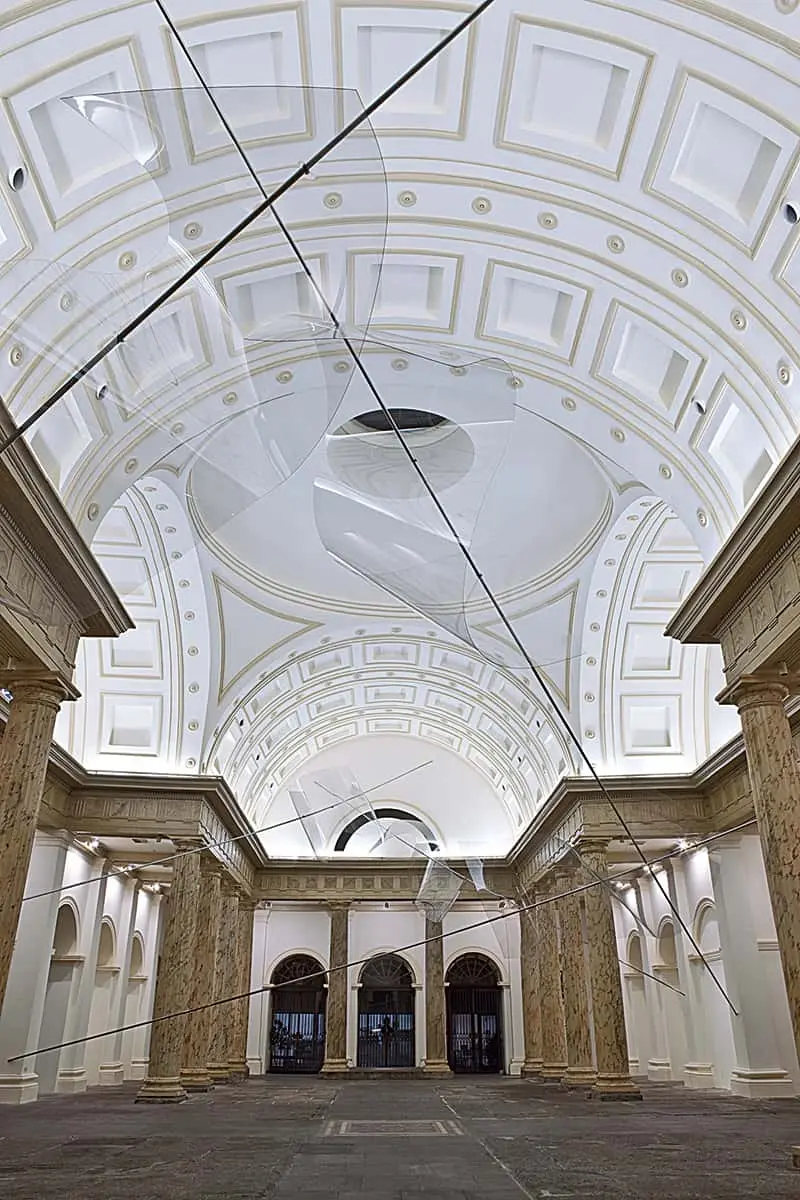
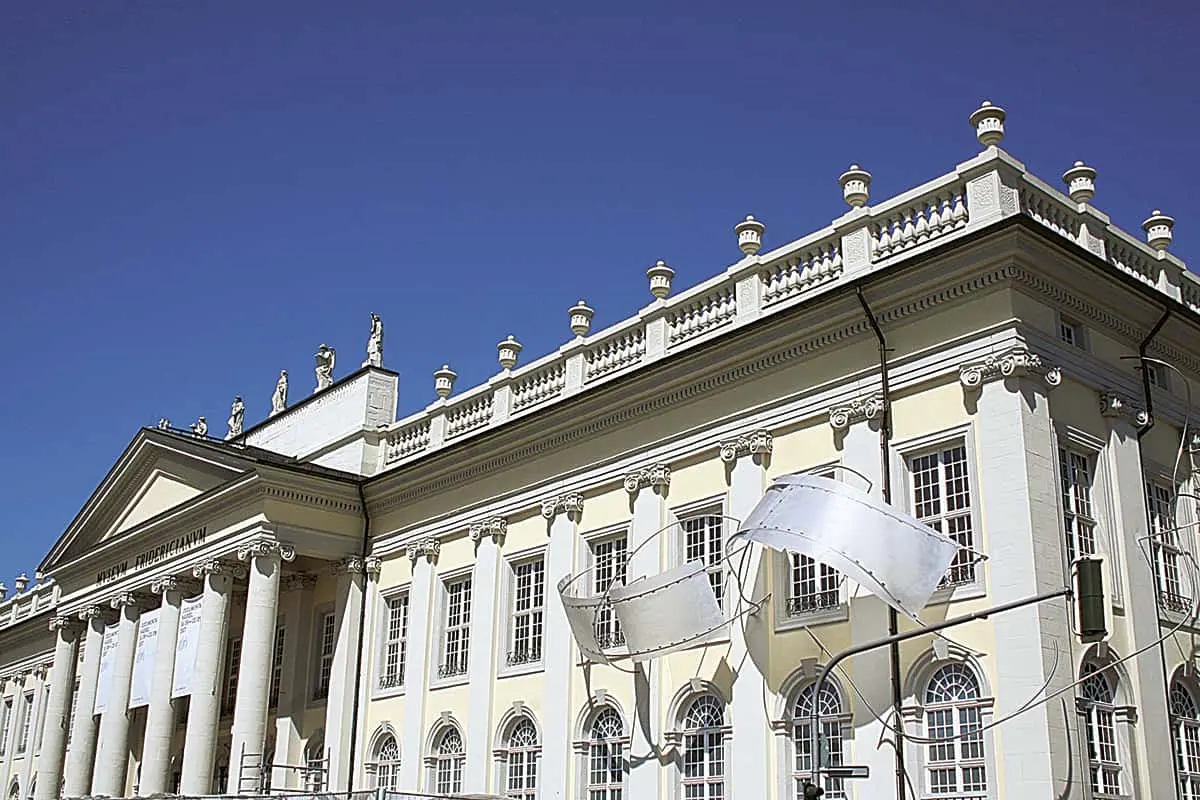
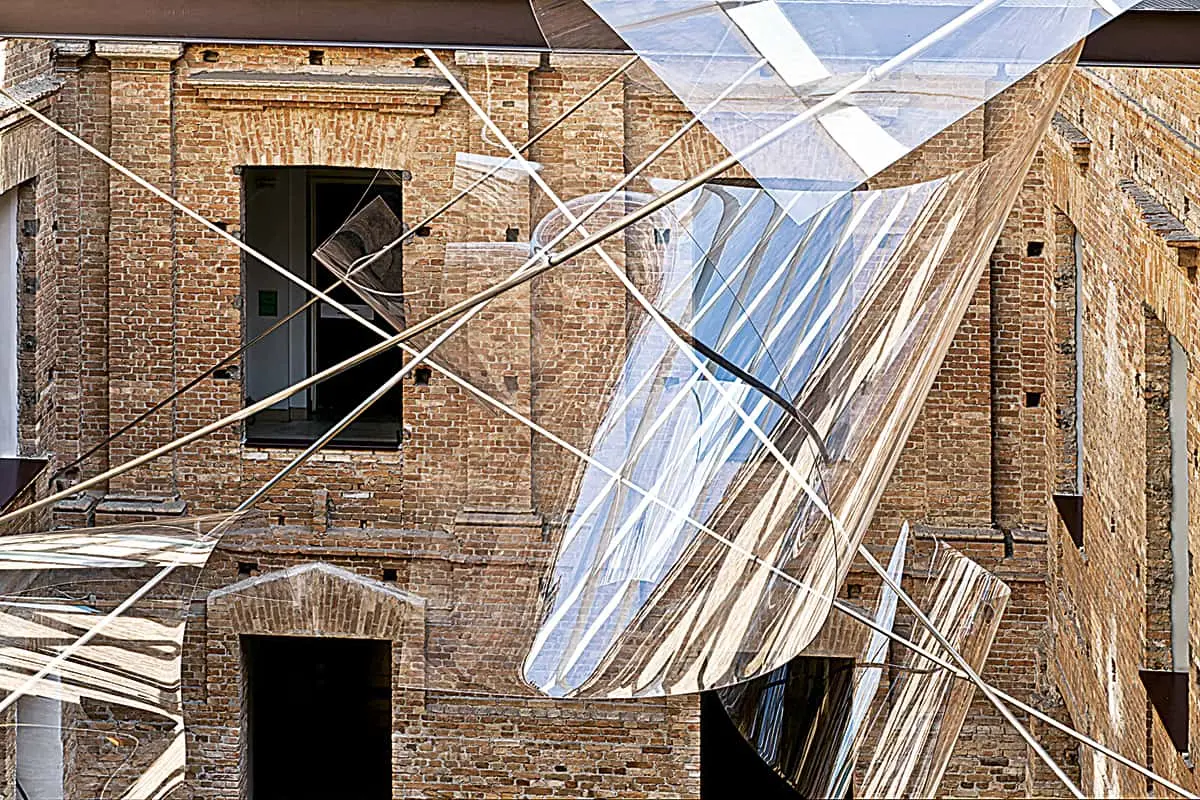
Iole de Freitas At Documenta 12, curator Roger Martin Buerguel told me: “Come check it out and if the proposal seems interesting to you, I’ll give you whatever space you want.” I thought, “Don’t tell me that, I am going to want a lot of space.” I asked for the corner of the Fredericianum, in the air, second-level, with plenty of light. I took over the entire 30 meters. The work begins outside the museum, in the air, without support in the urban field. But at that point, what speaks is the work itself: “I must hold on to some point, I must have support.” The work then decides to penetrate, thus connecting the outside and the inside, transforming the wall into a membrane. There, the wall ceases to be a limitation.
EVF But walls are always a limitation…
Iole de Freitas The wall? That depends…
EVF They determine a boundary, an inside/outside…
Iole de Freitas Which I break.
EVF The wall itself is a demarcation…
Iole de Freitas At Documenta, the wall became a membrane, a membrane of light. My work was in the exterior space. While your footing was firmly inside, on the second or third floor, your body was projected outside. Because your eye launches into space and the body is carried by it. It is not that you need to step into the outside. I feel antipathy for a certain kind of “participation,” an “art of participation” where the audience is induced to manipulate the work, to reconfigure it physically. I was a dancer. If you want to dance, dance. Yet, there is no need for a launching pad in order to move forward into the outside, where the work is suspended. You are connected to it because the work never stops taking you into account and acting on the space where your footing is firmly anchored. But at the same time, it launches you into the air, and invites you to do it. Committing suicide is not required, looking at the work is enough.
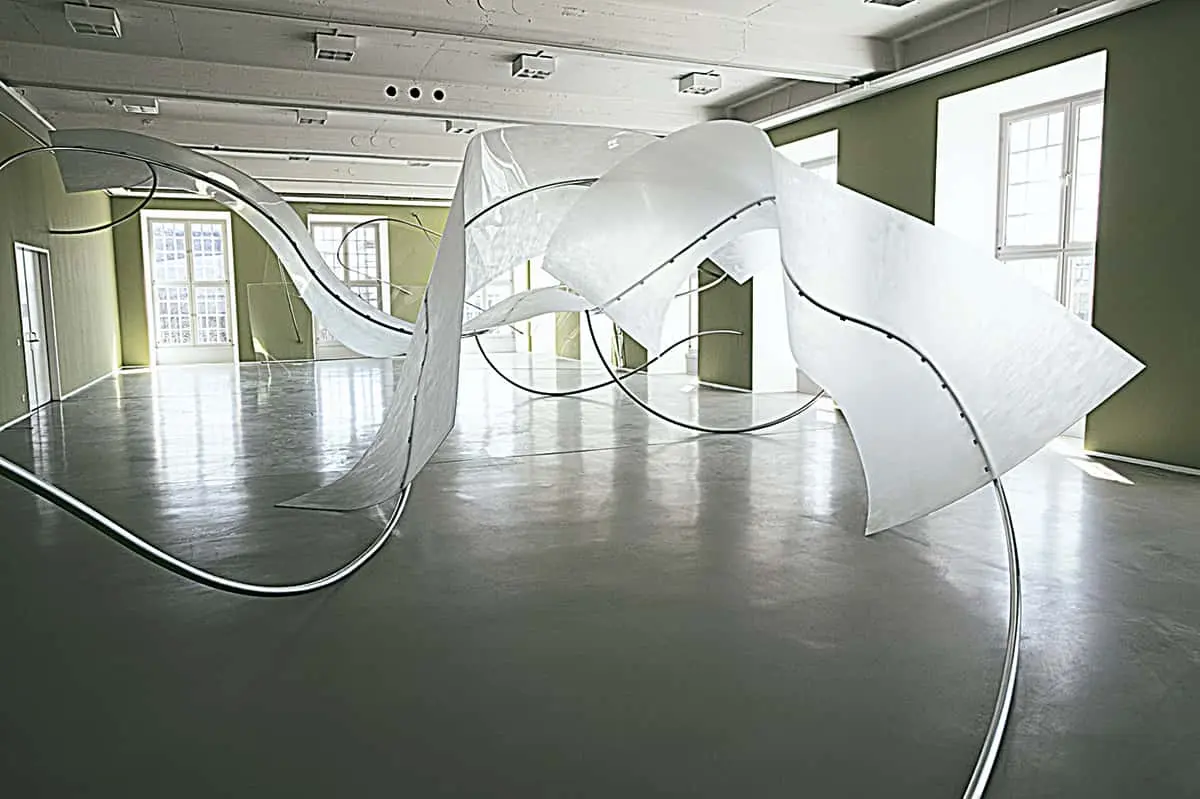
EFV I had the privilege of being there as your works were being installed. By being careful about spatial relationships and deciding the point of anchoring, you are not too far removed from the markings that a dancer does on the floor. The dancer takes into account gravity, volume, weight, balance, and rhythm within a highly specific space-time. You prepare in the same way, paying particular attention to the attachment and the point of return to which gravity takes you as if you wanted the jump to remain suspended. How does the space-time of dance influence your way of thinking about sculpture, about architecture?
Iole de Freitas, I was a dancer until the age of 23, and an awareness of my body moving through space was always fundamental. Traversing the stage at Teatro Municipal in Río de Janeiro, I was much more interested in that bodily awareness of speed, of motion, of balance. In sum, the idea of the plumb line can be understood as the internal axis that maintains the stability of our bodies. Knowing that axis is that I can mark the point of anchoring on the floor, and jump. Great jumps are only achieved with a good point of support. I understood that with clarity not only with my own body but when I saw [Rudolf] Nureyev dancing at La Scala in Milan with Margot Fontaine, who is like a feather. I asked myself, “How will he do it? That man is going to have to jump and do those high-flying leaps I have only seen in photographs and films.” Nureyev was very large, thick, muscle-bound. It was incredible. How was he able to lift all that weight and become feather-like in the air? Well, it is because of the way in which he anchors himself on the floor. In a similar way, the line or steel tube is able to anchor itself on the wall and push through it. That is what determines the great leap and also the curve that the work will execute. I exercised and developed that notion of the body more and more and also an interest in the way in which my own body cut space.
EVF Cut space?
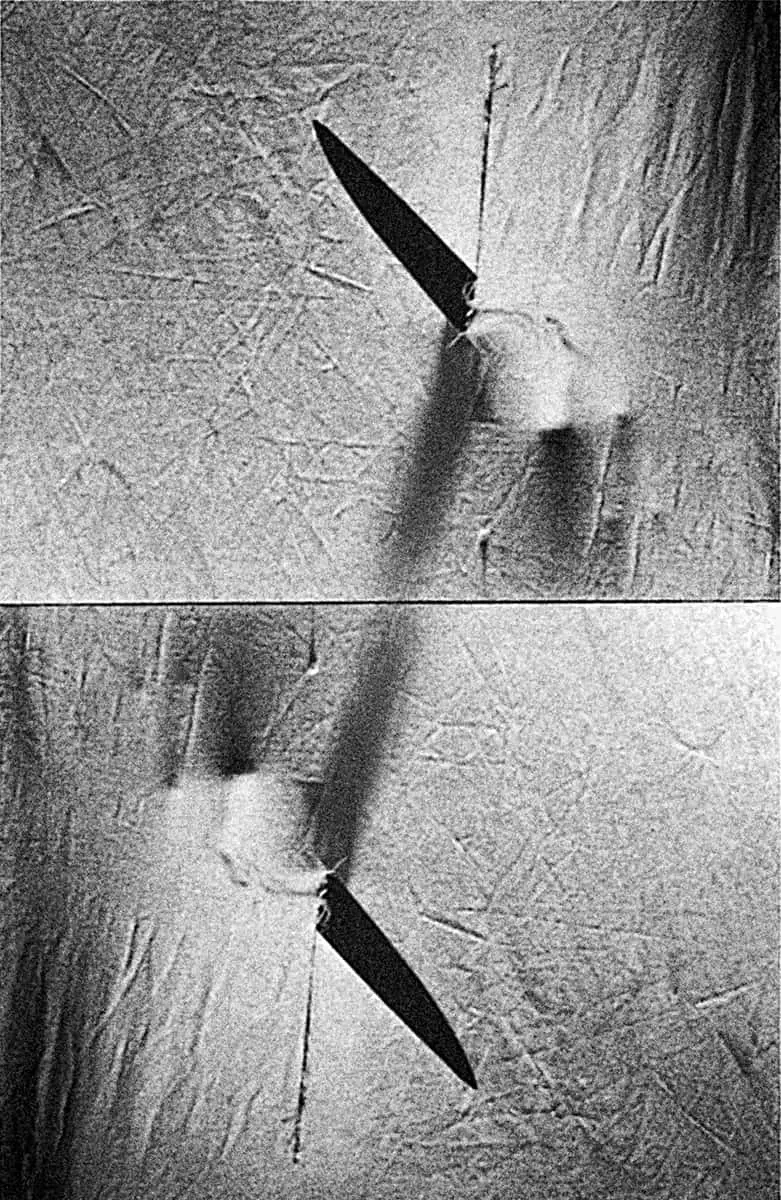
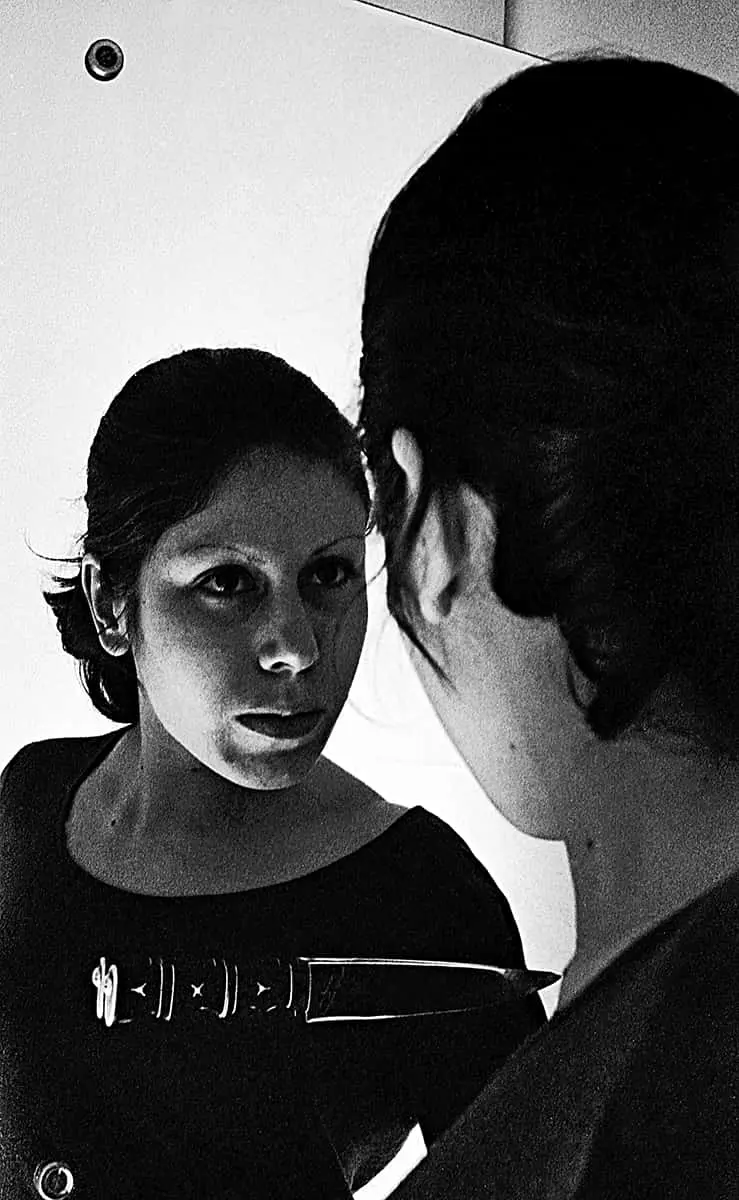
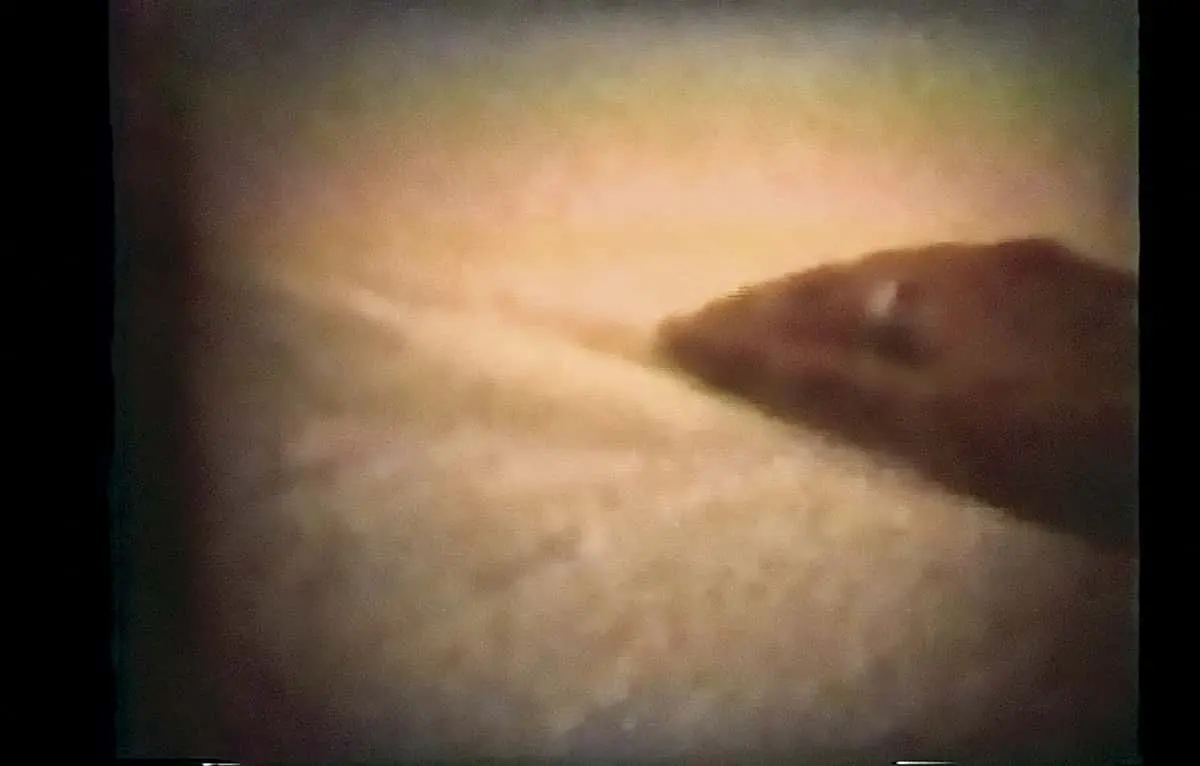
Iole de Freitas Yes. In Exit, a film I made in the 1970s in New York, I cut a white fabric with a very large knife, during an action that had nothing to do with Buñuel or Fontana. It was not a gesture of aggression. It had to do with how my body pushed into a 50-meter cloth diagonal extended inside the loft where I lived. Like a membrane, the fabric moved following my own motion, and the cut revealed my presence on the other side. The same happens with my more recent works, when, in the museum space, they themselves seek the point where outside and inside touch. Starting with that much more interiorized motion, which carried the forceful psychological density of my works from the 1970s, I moved towards the activation of the spaces around me.
I am fascinated by Tatlin and his Corner counter-reliefs. Tatlin cut space. By tensing up the structure between two walls at a right angle, using their corners, he forced the wall to submit to him. And that interests me because when I traverse an entire room with these sheets, I am cutting space. My current work has become a fluid movement: it is air, it is water, it is the skin of the river or of the sea. That water skin that can be seen in my works at Casa Daros continues to insist on the idea of the plane, of a surface, of a membrane, which germinated in the 1970s. In these recent works, you could say that flesh has been hollowed out; volumes are empty because space is the space of the corporeal, of flesh, and of the subject’s sensorial system. In the end, what they are after is to create a vacuum that will be occupied by humanity’s innumerable possibilities.
EVF During the renovation at Casa Daros, you confronted a slippery physical space, one that was in permanent transformation. It was a site under construction, a yet-unborn institution. It disappeared, walls were not erected, the garden shifted, and machines or scaffolds appeared from one day to the next. How was it to work in such an environment, where everything seemed marked by fleetingness, embryonic, provisional?
Iole de Freitas After working on the installations at Documenta, de Iberê Camargo Museum, Casa Francia-Brasil, and the Pinacoteca do Estado de São Paulo, I needed a field of instability. When I projected the structure for the Iberê Camargo, in Porto Alegre, I explored a new system, somewhat different than at Documenta. But after repeating that same system in the spatiality of Casa Francia-Brasil and the Pinacoteca do Estado de São Paulo, I told myself: Enough now, I understand too much for my taste.” It was time to return to dealing with situations where I didn’t understand a thing. I like it when, as soon as I think I understand something, my understanding is dissolved against the extreme physicality of the walls. There I attempted, along with you, to create the occupation of Casa Daros’ palm tree garden.
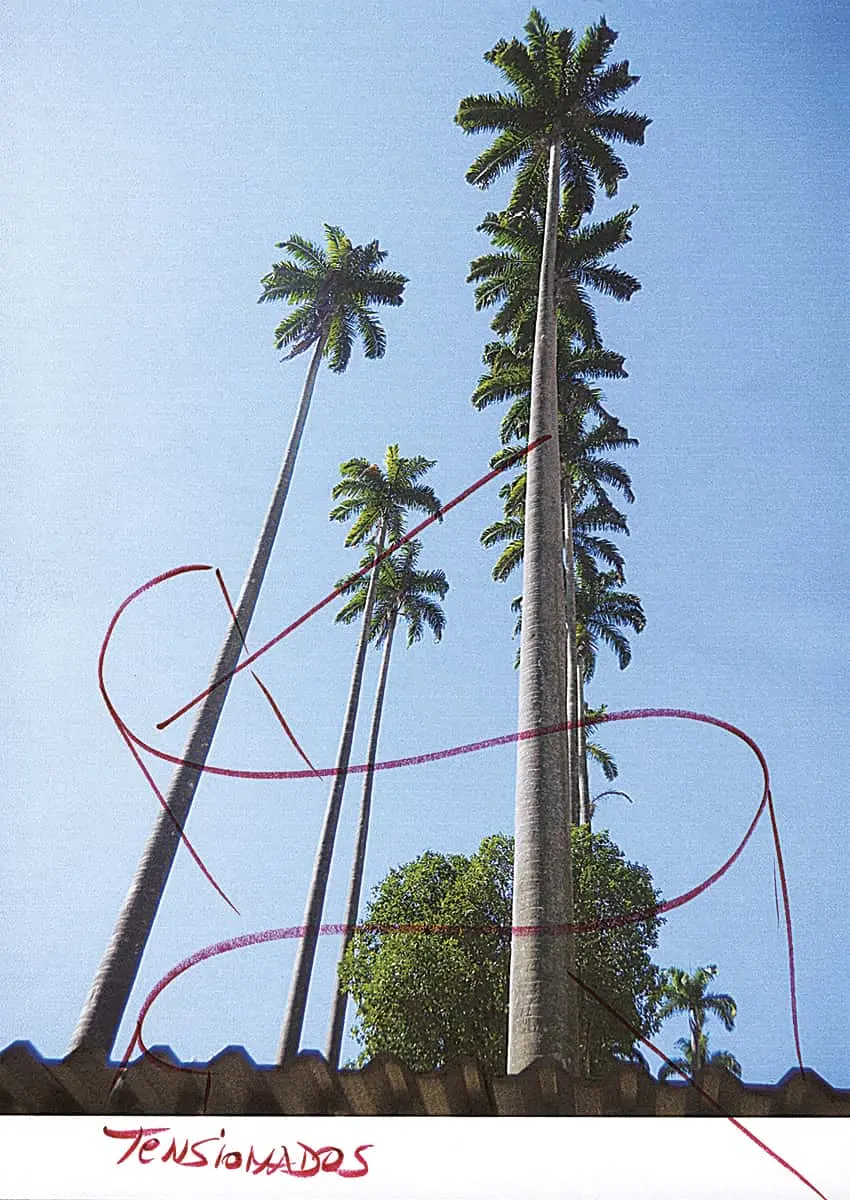
EFV But that intervention really began with your series of drawings titled Utópicas and Arquiteturas Impossíveis, many of them made over pictures of you in the palm-tree-lined pathways that characterize Casa Daros’ gardens. In them, the photographic image works as the sole anchor of the “real”, in that site overtaken by successive shifts and mutations. Those were sketches for unrealizable sculptures that fluctuated over the palm trees. Later, in November of 2011, we ventured into a symbolically powerful installation that would come down the entryway staircase for only 24 hours. Finally, we were able to enter the building, on the occasion of one of Casa Daros’ inaugural exhibitions…
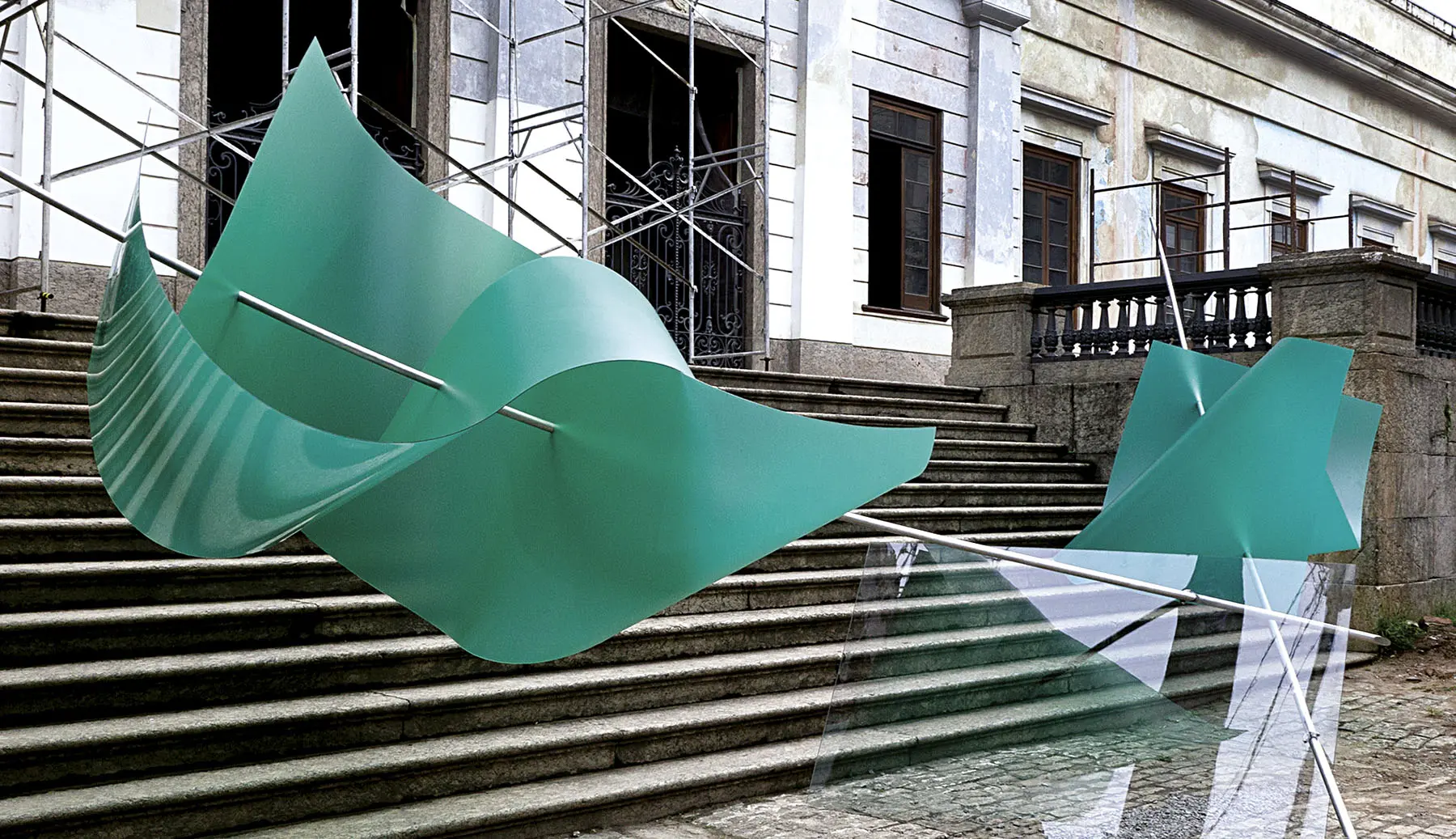
Iole de Freitas A space-time in suspension was created. In general, I am very assertive, I accept the challenge, get down to it, and do it. In those sketches, I built something in my mind and executed my drawings on top of photographs. I did that knowing that the landscape that had been photographed could soon cease to exist; complex installations were projected in the form of models and sketches for mutable sites of a fleeting appearance. This derived from the work for the palm tree garden, which shortly before its assemblage encountered an unforeseen obstacle: the land had been removed by excavators, destroying any possible anchoring for the large transparent sheets. A proposal emerged then that was highly unusual for me: installing a site-specific work at Daros’ exterior stairs, still closed to the public. In truth, the production extended for 24 hours, but its fruition lasted for little more than three. This “adventure,” as you accurately call it, was intended to be shared with a group of friends and colleagues —Abraham Palatnik, Julio le Parc, Antonio Dias, Waltercio Caldas, Paulo Sergio Duarte, among others— in a meeting that only endures in photographs and videos.
EVF From the question “What are museum walls for?” your projects are radicalized in the statement “I am my own architecture,” without abandoning the notions of process and impermanence…
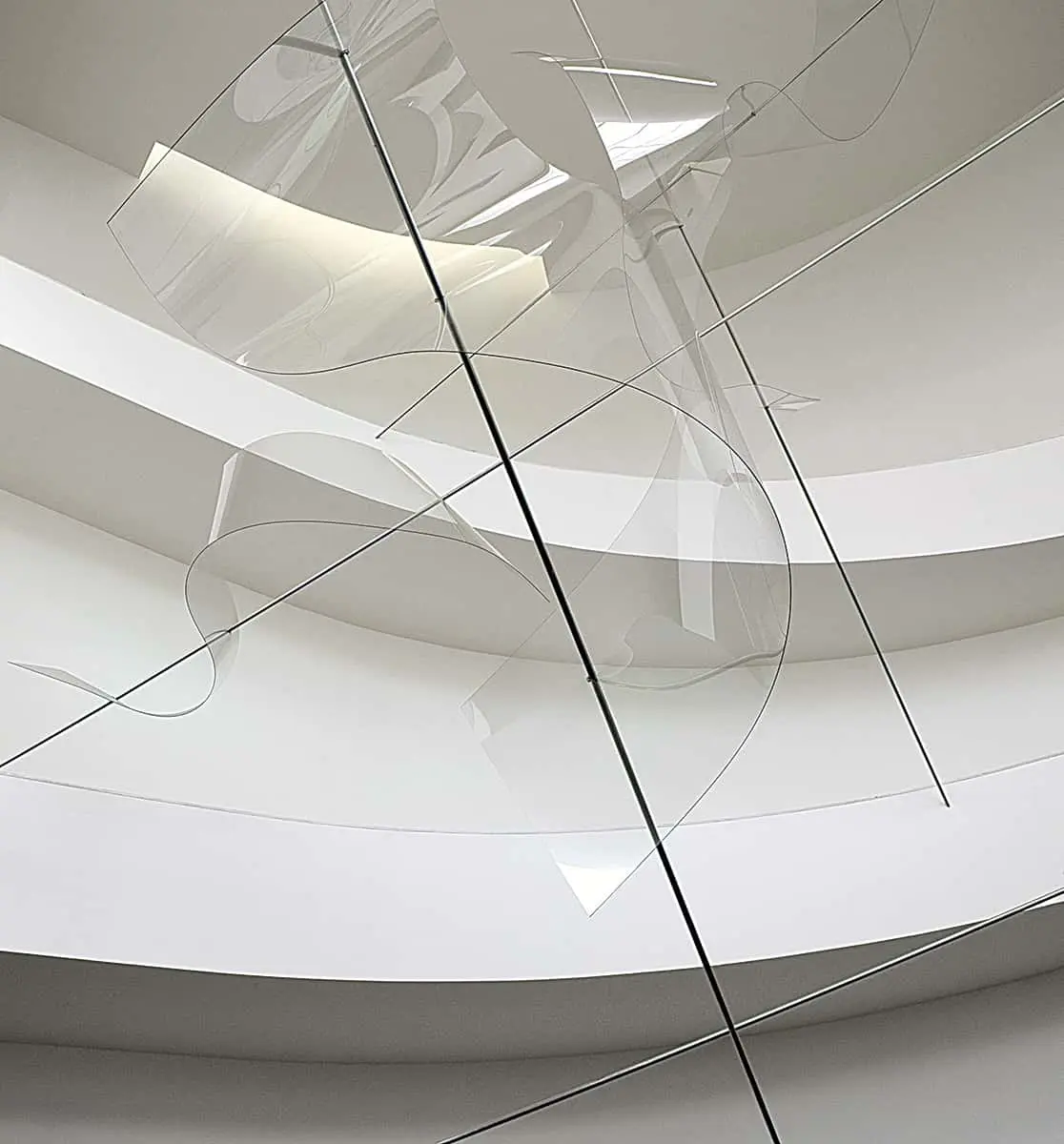
Iole de Freitas That is how I wanted to refer to the inaugural installation for Casa Daros’ exhibition gallery devoted to the artist-in-residence program, in March of this year. Several prototypes were created in my workshop until I was allowed to drill into the walls. Time and again I had to map out the anchor points with precise measurements in the walls of a recently restored century-old building. I remember that on the day when I was finally able to resolve the work, after a conversation with you, I went for a walk by the beach. I needed physical contact with the water, walking on the sand, I was trying to understand the work… I wanted that, as they entered that gallery, the work surrounded people. I didn’t want to simply provoke the sensation of having been covered by green sheets, but of the site being totally overtaken, which is very different from having something pass overhead —airplanes and helicopters do that all the time. One enters and perceives that it is a different place, surrounded by an environment that peels off that banal everyday balance and disorganizes one’s aplomb. This is how the work itself formulated it: I am my own architecture.
EFV Iole de Freitas assumes that she has her own architecture. What about everyone else?
Iole de Freitas No doubt. Everyone else has their own architecture. But I want them to know mine, which took more than a few years to be built. And for that to happen, my architecture has to touch them in a way that stimulates, questions, creates discomfort —but doesn’t assault. I want people to lose their calm, but not to take away their peace. I want them to feel shaken, not to bring them down. Because a different emotional instance is created when our visual perception harmonizes with the way in which space progressively takes over the subject’s physicality. What, exactly, is it that shakes, breaks, segments space? Ultimately, when this happens with space, it also happens with the person within it.
Often in the street, we run into people of all ages in cardboard boxes, just lying there, as if they had been packaged to be sent to a museum. If the work is unable to shake the will of the audience, then I don’t know what art is good for. But it will do it without attacking, ensuring that the aesthetic question remains connected to ethics. Beauty is an attribute of nature, and we humans are a part of it. The set I created at Casa Daros has that simple, soft, alleviating appearance. My work could be understood as an open shelter. It has a vitreous-green hue that resembles water… merely a ruse. What it does is it confuses everyone with that light sensation with which it begins to cleanse psychic layers of dullness, of our qualities and defects, of our anger and affections, ire, and of everything that clings to us day after day, and begins to loosen up what we essentially are. Now, for that to happen, the person must be willing to enter the magnetic field proposed by the work, rather than being content with a purely contemplative attitude.
EVF And what about “institutional architectures?”
Iole de Freitas Well, it is like this: I don’t like to obey, I don’t like to accept. However, I am always willing to collaborate, and I enjoy it. My works are always created in collaboration because I have neither the audacity nor the arrogance to believe that the artist exists in solitary. Artists survive in a cultural fabric comprised of other agents, with whom I want to interact, be it by provoking, debating, prodding… I am very aware of that cultural fabric, I don’t stay isolated in my ivory tower. In these situations, and even in my classes, I am guided by affinities. When I open myself up to debate, it is because I feel very comfortable with people. I am not going to encase my work, nor am I to repeat what I have done before. I think that art professionals, curators, and even collectors must invest in trust and affinity. My work will always be traversing that instigating institutional grid, and what results from those journeys is very important to it. But, beyond that, I can’t allow myself any mistakes in my work, which are very weighty and complex. It is great to maintain utopias, but the human body is a concrete reality that demands deep respect and good judgment in our calculations. I try to relate cultural, institutional, mental, and emotional positions, seeking to produce an impact that is as visual as it is corporeal. Perhaps we can free ourselves from so much futility accumulated around us, and, even if only for an instant, enter into contact with ourselves and our capacity for feeling.
EUGENIO VALDÉS FIGUEROA
Art curator, critic, and historian. Director of Art & Education. Casa Daros, Río de Janeiro.