
It is a triptych that consists of three large screens, each 1.60 meters high by 3 meters wide (5.24 by 9.84 feet). Each screen projects the photographs of faces at a frame rate speed that oscillates from the long display of a still to the cinematographic threshold of 24 photograms per second. The pictures have been enlarged until the size of the grain becomes the main contributor to the image’s texture. The standard monochromatic grey appears as if it has been dyed in sepia with hints of violet in one of the screens, while the other two screens have been covered in a green-grey—at times slightly yellowish—color. These are photographs of the demobilized paramilitary organization known as the Northern Bloc of the United Self-Defense Forces of Colombia (AUC, its Spanish acronym), the very paradigmatic heart of the paramilitary in Colombia. The group was formed in response to the Peasant Self-Defense Forces of Córdoba and Urabá (ACCU, its Spanish acronym) and was under the leadership of the Castaño brothers and Salvatore Mancuso. By the time the group was demobilized—in a late but wide-ranging action—it was structured around Rodrigo Tovar-Pupo, aka “Jorge 40.” These armies that operated in the shadows are projected on the three monitors to form a wide horizontal stripe. Their granulation of the photos is such that it almost disfigures their faces. Seldom is a still image left for too long. And when it occurs, one can observe an isolated face destined to never be forgotten. But within seconds that face is buried under an avalanche of other faces one on top of another with such speed that they form a single face barely broken by the differences between the photograms. A shape that is formed and deformed by the almost simultaneous superimposition of different features contained in the face of a single person. This is the shape that Restrepo calls, not without irony, “the face of evil.” In this unsettling intermittent, names are also superimposed one on top of the other to form a single illegible name. The harassed retina is nonetheless able to single out some of the most common names: Luis, José, John, Luis again; common names that could belong to anyone.
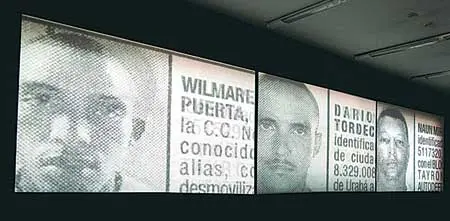
These rarified animations by Restrepo are reminiscent, in an asymmetric manner, of the audiovisual sessions that were projected in large cinema screens—as part of the symbolic acknowledgment of the fallen, under the judicial framework of the Justice and Peace Law—to show the families of the victims an endless number of photographs of those killed by the paramilitary. The families of the disappeared would then wait for the image of a loved one to appear on the screen. The rhythm of the projection was regular, tranquil, and constant. Each photograph would last a few seconds on the screen to then disappear into what appeared to be the farewell procession of silent enigmatic faces. These sessions could sometimes last up to forty minutes.
In contrast to the arrhythmic and vertiginous movement reflected on Restrepo’s screens, four large sketchbooks measuring 34 by 25 rest on a simple wood table under the quiet yellow light of a black desk lamp. It is the only light in the room beside the spectral greyish light that emanates from the projected photographs. The sketchbooks cannot be observed unless viewers turn their back to the screens. There, surrounded by the silent darkness of the room, and like someone who has arrived after everybody has left for the crime scene, it is then when we can open the sketchbooks and slowly go through the pages. These are remnants, clippings from periodicals, composite sketches, phrenology treaties, books of emblems, quotations from the bible, and photocopies of book pages in which someone marked along the margins the parts that must be read. First and foremost, the sketchbooks look like sections of a particular criminal report compiled by accident through centuries. The large decomposed figure that emerges is that of a criminal. It is the bloody mass of the disfigured, the marked, the execrable, the excommunicated. But humor is also present in the works. A couple of clippings about that other strange event whose investigation was also based on prints—particularly a face print—found their way into the pile; the miracle. There, there are also the portraits of the demobilized paramilitary, now paused, dormant amid the grave of faces that is the album. As one turns the pages, the photographs gradually recover their original size: small 2 x 3 cm images at the most. The granulation disappears under the simulation of identity. Now the face becomes one and different. And one is the name and one the ID card. Each one, one, but not anyone. It is all of them in one. Motionless photos. Framed. Sages comme des images.
But then we turn around and the horror continues to move. Hypnotic, restless grains distributed across the white screen as if the whites were the sole possible escape from the horror. The white that is not marked becomes that which has been kept safe because it has not been touched (yet).
The exhibition by José Alejandro Restrepo is undoubtedly a suggestive collection of impressions whose most subtle and disturbing gesture is the transition from a single person to anyone and from anyone to One.
ANDREA MEJÍA