
Juan Pablo Echeverri is, without a doubt, a true transvestite. And he is a true transvestite inasmuch as his discourse activates the resorts—always apotheosis, always extended—of the culture of the spectacle and the carnival of multiple, patchwork identities. His work, intelligent, bold, and fun, subjectivized each and every one of the states of “appearance.” Everything is possible, nothing is definitive: the given lies, mocks its status as truth, like identity itself as it mutates, like the face that shifts and ensures for itself the cubism of a visuality that is inscribed on the thicket of literary texts abducted by the baroque impulse. Resulting from this torsion he introduces into the play of mirrors is a kind of imperialism and tyranny with respect to that “natural” context implied in the everyday image, the image the mirror shoots back to us in the morning. If, as Severo Sarduy noted, “in the baroque, the signifier is always erect, always aroused” 1, in Echeverri’s transvestite snapshots it is the referent (his own visage) that is always on the prowl for desire, searching for its sublimating and seductive functions. In this way, the work signals the true-to-life—yet deceitful—passage from neurosis (when he has what he wants, he stops wanting it) to psychosis (which goes from homicide to suicide). In this way, the performance never ends. The subject transforms time and again into a masturbatory delirium and the desire for restitution/death. From such ambiguity of the signifier altered ad infinitum in its narrative potential, from this unsheathed passion for the conquering of the expanded cubism of appearances, the work is born as a cult of the eternal nightmare of correction and cosmetics.
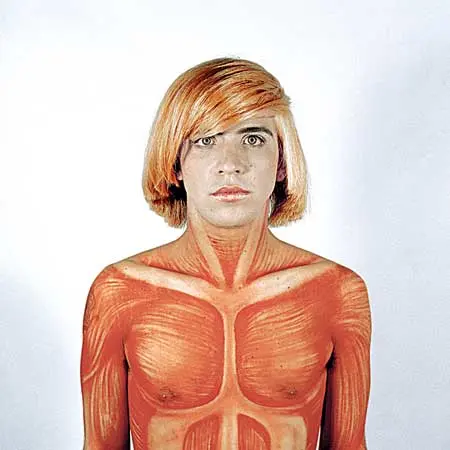
Echeverri’s two recent solo exhibitions in Spain, curated by Alex Brahmin in Madrid (yosoytuereselesella, at Fresh Gallery) and Barcelona (todo x el pelos, at CiS Art Lodgers), trace the outline of a physical indestructibility—vulnerable in the end—that boasts of critical delectation in simulacra. Without any debatable disparity in method, both exhibitions, each in its way, revealed the boldness of a speculative and potentially playful essay in which the subject of truth is the alibi of all kinds of deceit. Both traced the persuasive and anything but discreet writing of the trajectory in which self-representation becomes the result of the fiction of the contemporary drama of an identity requiring the wild cards of gender, passports, assumption of the notions of race, nationality, sex, social status. Echeverri’s staging implies, then, a licentious and rabidly erotic slap in the face of the hegemonic socio-semiotic narrative that dominates the concurrence of those social and cultural stereotypes charged with constraining the subject’s freedom. These photographs believe more in “being” and its exponential diversity than in the “ought to be” of the most rancid modern psychology. Thus their transvestite and transversal character, their taste for juxtaposition and palimpsest, for admixtures and for the seminal orgy that fecundates the image in an infinite logic of delirious multiplications where, in the effort to assert themselves, the dichotomous distances of all Cartesian binaries fail. At their core, in the hermeneutic locus of this essay, opposites commingle as in the baroque banquet of the Americas, which provokes socio-cultural experiences of varying degrees and depth. The transvestite image appears then as voyeurism, as an object of desire, of seduction, as an aesthetic pirouette that slakes (or amplifies) the thirst for ambitions of an era when the death of the ego has only generated its extended mystification. And it is precisely here that the reassertion of the subject, multiplied in its more radical otherness, must be read as the gesture of a narcissistic and predatory age that needs the figures, as volatile as they are anodyne, of power and prestige.
In this way, Echeverri’s work brings forth a particular vision of his own complexity as a tribute to the ontology of the human, in dialog with the establishment and consolidation of a different discursive regime for the subject’s identity. Because of this, I think, by virtue of the prodigality of his references and the diversity of his cultural interests, that the greatest lucidity of Echeverri’s poetics resides in his own praxis, in the way in which it opposes the order of conventions and static classifications, of models and their tyranny. The fact that we are talking about a Latin American artist, nomadic and on the move like the majority of them, forces us to think also of the dimension of the mutability of the very concepts or categories that are discovered, atomized, in his works. This disguise, this game at once fun and dangerous of being everything and nothing at the same time, is but the nominalization of a cultural paradigm like Latin America’s, which has always been exposed to being enunciated and named by others. Clothes, masks, artifices are, then, weapons for attacking—from within the system—this discussion of the centrality of discourses that render is always other, always an alternative, always the savage marked by seduction and derision. Let the disguises and cosmetics outwit the image proposed by that mirror. Juan Pablo knows, and knows well, that the ideology of language precedes and determines us. This is where his game, his dance of masks and deceit, comes from. With it and from it we discover an audacious hollowing of the signs of power entrenched in the discourse of domination. In the end, the mask becomes a face.
NOTE
1. Severo Sarduy. “Farther than the image”. Interview with Jacques Henric, published in the Revolución y Cultura magazine. (Havana). No. 2, 1998. p. 67.
ANDRÉS ISAAC SANTANA