
“(…) I only painted on Sundays and on rainy days (…)”
Manabu Mabe
The selection of works included in the exhibition Chove no Cafezal - Mabe, da Figura à Abstração, presented at CAIXA Cultural in São Paulo through the month of July, made possible a renewed reading of the Brazilian master’s career.
Among CAIXA Cultural’s projects, the itinerancy of visual-art exhibitions is an important component of a strategic plan for the education of the public, as is the case of Mabe’s show, which will travel to several cities across the country.
CAIXA Cultural, an organ of Brazil’s state-owned financial institution Caixa Econômica Federal, offers among its initiatives a number of actions addressing the management of cultural projects and the promotion of the country’s artistic production.
This institution, established as a significant space for the formulation of cultural-patrimony preservation policies, includes visual-arts exhibitions among its activities and has become an axis of support for art research and creation in Brazil.
Manabu Mabe, an icon among a generation of talented painters devoted to abstraction, lived shadowed by the condition of being an immigrant in an unknown land: Brazil.
The exhibition Chove no Cafezal - Mabe, da Figura à Abstração presented its audience with an itinerary of Manabu Mabe’s work, in his earliest experiences with painting.
Thanks to curator Enock Sacramento, the career of this Japanese-born painter was recounted since his arrival in Brazil in 1934, revisiting two decades of intense chromatic investigation. Starting in the 1940s, Mabe lived among peasants in the interior of the state of São Paulo, working in the cultivation of coffee and painting.
Chove no Cafezal - Mabe, da Figura à Abstração, slated for a long itinerancy— CAIXA Cultural Rio de Janeiro (July 15-September 8), CAIXA Cultural Brasilia (September 17-November 17), and CAIXA Cultural Salvador (December 10, 2013-February 16, 2014)—showcased the profile of an artist still in his formative phase.
Manabu Mabe’s work confirms his central role in the Brazilian debate about the paths taken by figurative representation and the significant presence of abstraction, a strong trend in the 1950s.
Indeed, Mabe’s career responded to the country’s process of modernization in two decades that set important patterns for the local art scene with the establishment of the Museu de Arte Moderna de São Paulo (1948), the Museu de Arte Moderna do Rio de Janeiro (1949), and the São Paulo Biennial (1951).
The historical section of Chove no Cafezal brought to the fore the beat of a poetics that was able to capture the local color palette and to fix, in landscapes and portraits, a visual sensation of a newly-discovered setting.
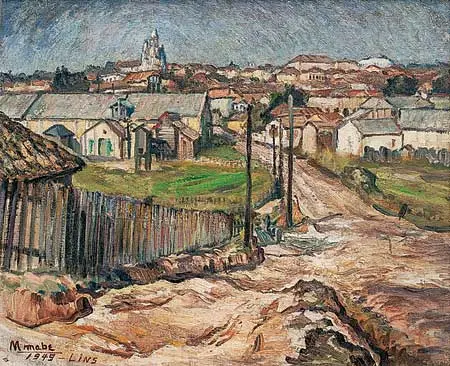
Among the paintings and drawings included in the exhibition, Paisagem de Lins (1949) reveals the vocation of a painter devoted to the study of sensations, in touch with nature, with his rural surroundings, and with the reddish soil of the coffee plantation.
The path proposed for visitors at CAIXA Cultural de São Paulo emphasized the dynamics of visual poetics under construction, in the midst of the earthen hues that recreate the environment of work in plantations in the interior of the state.
In his reiterated exercise of communing with nature, Manabu Mabe gradually explored the resources of abstraction in painting. Initially influenced by the foreign work seen in the early editions of the São Paulo Biennial, Mabe’s painting arrived at an intense dialog with gestural abstraction.
Indeed, it was a gestural abstraction that won the artist national and international recognition, which makes the space given in Chove no Cafezal to his earlier figurative period, the starting point for his entire oeuvre, all the more laudable.
From figure to abstraction, Mabe demonstrated the pathways of a well-conceived visual investigation, between the gestural synthesis and the formal conciseness proposed in his paintings from the late 1950s, especially after the award received at the 5th São Paulo Biennial in 1959.
According to the curatorial proposal, by documenting “the period of transformation of Manabu Mabe’s pictorial language, from figure to abstraction,” the exhibition established new avenues for approaching the artist’s constant learning exercises.
Revealing the efforts of that young Japanese immigrant who worked arduously in the coffee plantation while painting on sheets of cardboard and wood panels, the show brought to light the vocation of a painter who discovered the “importance of the creative act.”
CLAUDIA FAZZOLARI