I see a stork arriving from Paris and before I clear the small clouds from my eyes, I use them to count sheep in a dream, sheep that jump a fence to follow the yellow road. Then, one stays on the Berlin border… or, I am not sure, was it perhaps the Great Wall of China? I meditate without crossing the barrier of fluffy walls of whiteness so intense that it beclouds my vision.
I rub my eyes to discover fences and barbed wired bars—hurdles where the need for freedom is present in the remnants of clothing and other fabrics. It is then that I think that the way many countries celebrate their nationalisms depends on the degree of homogeneousness among their peoples and that the more homogeneous as a group the more they celebrate their identity equality… But no, I am actually looking at the exhibition Across the Border by Miguel Ángel Ríos.
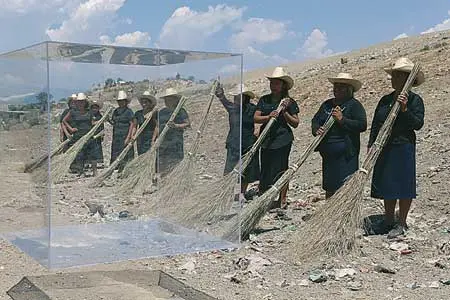
Notwithstanding the support or medium used, Ríos’s work encourages us to wonder whether or not—with the advent of cognitocracy—cosmopolitism is nothing but a constellation of images created by transnational and advertising companies and publicized through mobile devices. Anarchic groups attempt to assert their own voices by sabotaging the commercial empire—the same one that promotes standardized and short-lived stereotyping, the most plausible through pseudo-autonomous thought (vg. TAZ), even if at the end of the day turn into imaginary communities (Benedict Anderson)—just as ungraspable as the fake nations (annotation?) that once were/are nomads (indigenous, gypsies, etc.) and that have escaped the plans to be mapped and outlined. Contradictorily, because of new technological devices they now unlawfully hold a certain gift of ubiquity: phantasmagoria, the same one used for the transparent cube.
Between San Pascualito and the Santa Muerte there are at least two types of believers between life and death. Anyhow, here we are interested in the work by an artist who explores bordering territories that are not necessarily geographic in terms of Latin American demarcations. We are before an artist that does not reveal any edges. His phantasmagoria of the transparent cube is seductive in that it places a sort of lens that maximizes our everyday imago of journalism. But it will not innovate anything beyond the title if one is incapable of looking down on it further.
Either way, the subject (the border) is approached spontaneously, almost empirically, and—thankfully—with a theory not explored or surpassed and—thankfully again—never assumed. If I paint my line of the margin, then, where is it that I cannot cross? It would appear that Ríos has gone through customs in many galleries. The question we should ask ourselves is whether or not his documents are in order according to aesthetic laws. And the answer is yes, his audacity heads him toward a ratio that is no longer golden, but one that could be defined with other chemical symbols like the one for uranium: utopia.
In other words, his artistic record is outstanding, his handmade technique not solely when it comes to video but also his ludic illustrations invite us to confront behind the glass a different reality of borders that places us outside of an accommodating center. Because it is not enough to approach border issues as if they were merely transhistorical. Here we are able to dissect the scars of history in Argentina, Brazil, Mexico, Peru… the periphery seen through a golden ratio that is the cube. To my way of looking at it, we are witness to a ludic perception of the canon. In other words, we look down on the rural—exposed in the drawing as if behind the scenes—previously believed to be moldy; that video recorded in the proscenium of a realm otherwise removed from fractures that are not solely sociopolitical, but also cultural, and why not say it, above all economic.
While to some extent it is about a certain cinematographic narrative in which we are able to X-ray eugenics through the earlier drawings, rather than a forceful, closed, discourse; as I see it, it is about a proposal in the manner of an opera aperta that deserves commentaries from viewers; dipsomania of eyes that do not support a panoptic like the one sold in mainstream news, both printed and electronic. No, here it is about plunging into the cube like a lens and rethinking the cameras, while we ask ourselves whether or not we are tourists of reality.
Therefore, when it comes to the ambiguous current situation, this truly controversial work proposes a palimpsest—a small one perhaps—but also presents us with an artist who, by putting the cards on the table, dispels not solely the crux of his production but also the moments in which he has worked with verve. Not necessarily successful in its entirety, the interesting thing now is to reflect on how to capture, to rob the soul of those already fractured through drawing. And most importantly, the question is how to perceive the reality of people immersed as subjects of a drawing that will eventually be filmed by someone behind a lens who will not represent them in an exhibition.
In other words: Are we before the musealization of the scars of history? In Through the Border, Miguel Ángel Ríos leaves marks in our aesthetic experience, as he also provokes a plausible headache in the sociopolitical appreciation of our daily lives.
MAYRA INZUNZA