
A group exhibition of Chilean artists, with works created since the 1990s around the concept of “minimal.” The artists are Son Pablo Rivera, Josefina Guilisasti, Bernardo Oyarzún, Cristián Silva-Avaria, Claudia Missana, Rodrigo Vargas, Cristián Salineros, Isidora Correa, Patricio Vogel, Livia Marín, Nury González, Carolina Illanes, Christian Quijada, Rodrigo Galecio, Ricardo Pizarro, and Iván Navarro. The first thing one must acknowledge is the accuracy of the title. The show could have been named Minimalismo hecho en Chile, but instead, the option has been a pointed English-language Made in Chile. The intention is to provoke a suggestive and necessary debate. Because we are talking about an artistic style exported from the United States and imported into the local scene. At first, the debate is posited, then: around the Chilean obsession with adapting and adopting foreign proposals with the intention of elevating a cultural and socio-economic status, or, if we want to be more perverse, with the intention of gaining commercial acceptance in a hegemonic nation.
The concept presented at Matucana100 by curator Gonzalo Pedraza posits an aporia in its definition that is worthy of Xeno of Elea. And this is intentional. Few, very few of the artists included in this Minimalismo made in Chile: can be considered minimalists. An interesting paradox if we keep in mind that it could have been otherwise possible to group Chilean artists who follow the style more closely, such as Claudio Girola, or creatives working in different disciplines, such as those from the Valparaíso School of Architecture. In my opinion, however, the results would have been less appealing.
Minimalism originated in the roaring 1960s, with a group of artists who in their large majority were white and male (Donald Judd, Sol LeWitt, Carl Andre, Dan Flavin, and Robert Morris…). The result of an economic boom and of aesthetic influences such as the Bauhaus and Russian Constructivism, minimalist was the first artistic style purely from the United States, and is very well summarized in this maxim from one of its most important practitioners, Frank Stella: “What you see is what you see.” Perhaps the greatest legacy of minimalism is the incorporation of the specific space into the work. The exhibition site is as important as the work of art on display. The viewer—and the viewer’s motion—begins to be taken into account by the artist as an active subject. Another feature of minimalist style is the elimination of narrative (all is reduced to contemplation, and the work, to its essence) and of any authorial trace. “What you see is what you see.”
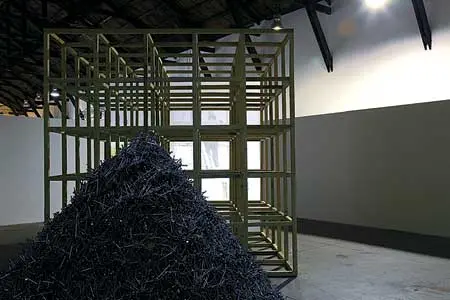
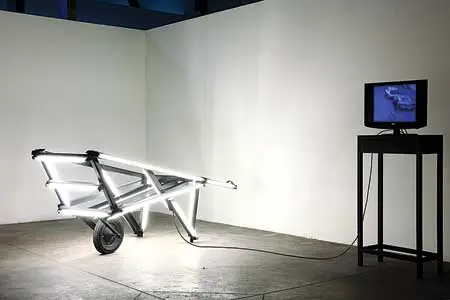
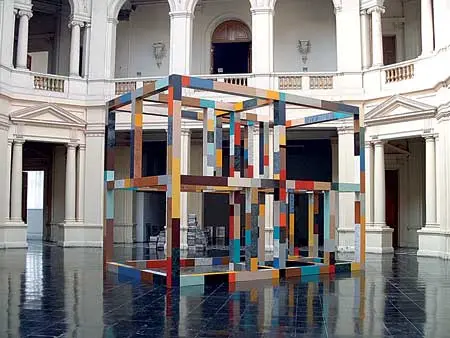
The question here is whether the work of these Chileans fit within these parameters. Whether they “are just what we see” or there is “something else.” Let’s begin with the context. Chile received a massive dose of neo-liberalism from the Chicago Boys under the Pinochet dictatorship. In a variant of the Ludovico Technique, a privatizing economic system was introduced, the consequences of which are felt today in a variety of realms, such as education or the condescendingly called “Mall culture.” The results can be appreciated visually in the so-called “Sanhattan”, Santiago’s financial district where a New York-like skyline is imposed in an act of skeumorphism. Given this, Chile is perhaps the perfect country to simulate minimalism outside the United States. But, is what we encounter in this art show as faithful an imitation as what we find in the economic and architectural realms? Let’s unpack the premises mentioned above. In terms of achieving the incorporation of the site’s specific space and the viewer’s walking paths into the project on display, we must admit that the results are partial. Many of the artists gathered at Matucana100 do not consider the viewer an active and mobile subject. Besides, the works have been arranged in individual compartments that cannot be circled around at a sufficient distance. The artists have been encased. With regards to the second point, the eradication of narrative and authorial signatures, we again see the absence of an evolutionary connection. In some instances, there is a “story,” and in others, more obvious, the artist even appears as part of the work, as in the case of Bernardo Oyarzún. The artist appears in a video building a wooden structure using a hammer and nails, and later extracting the nails from the device. Across from the monitor screen, we find the large structure and a mound of nails. In addition to the apparition of the manufacturing hand, the hand of the artist, there is a narrative. In terms of the last premise, as established by Stella with his lapidary phrase, we see that there is something else. Pablo Rivera’s installation, the skeleton of a small building ornamented in lively colors, is connected to the problem of housing. In Iván Navarro’s, a neon shopping cart and a video featuring a person pushing it across a garbage-filled wasteland as a song play in the background (“I’m not from here, I’m not from there, I have no age, I have no future”), we encounter a re-reading of Dan Flavin’s imagery from a social standpoint. In the case of Oyarzún, already mentioned, references to work, to capitalism, and to slavery are obvious.
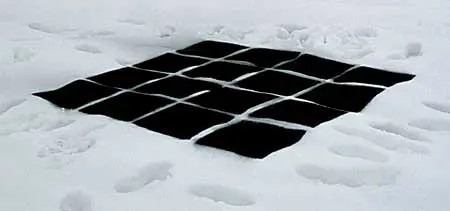
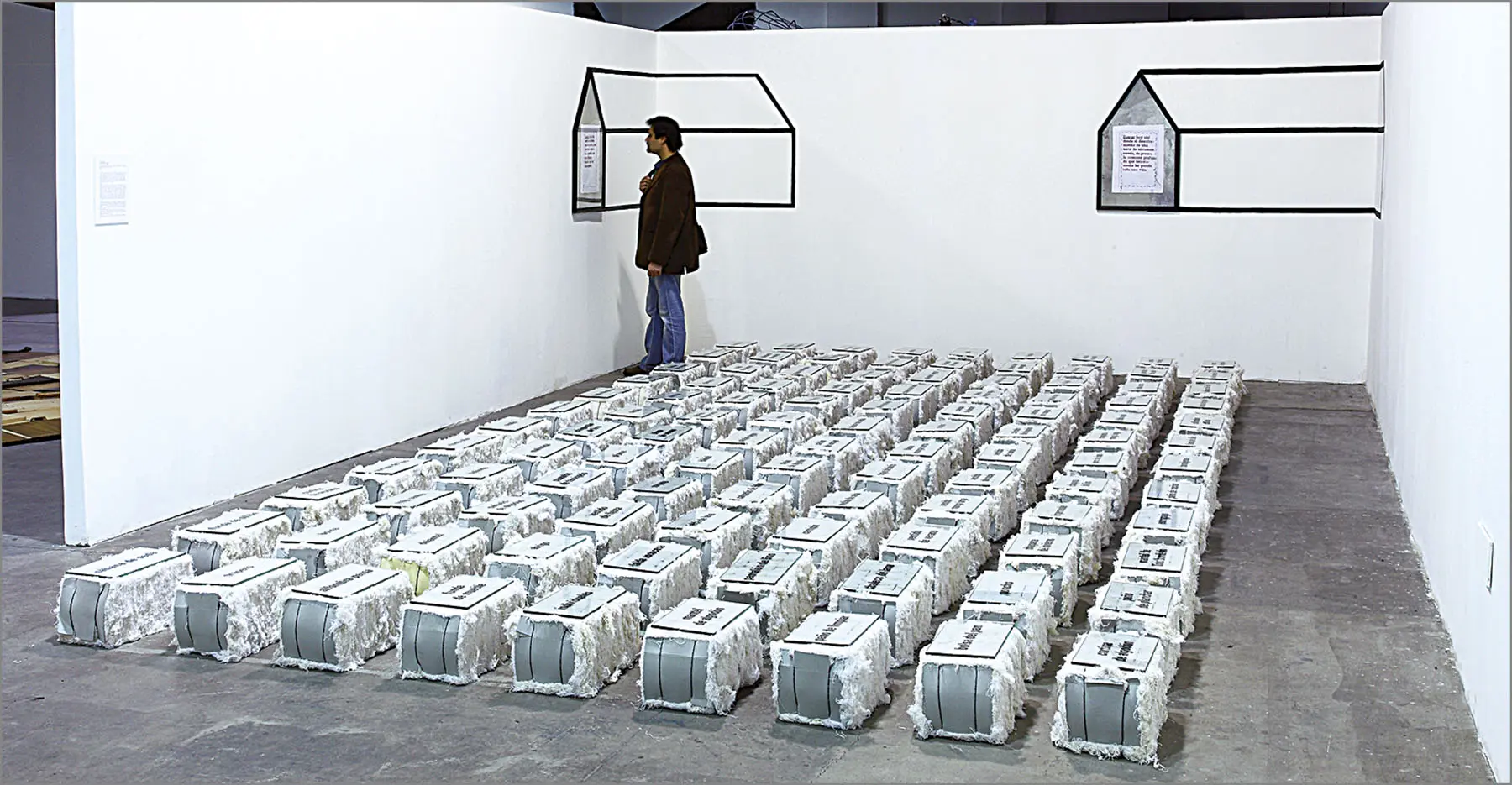
Without the need to explore in greater depth the possible signifiers in many of the works on display, what we see is a disconnect with minimalism in the strictest sense, if we are talking about the artistic movement. There are works that are closer to Land Art (Claudia Missana and her black reticules against a snowy landscape) or to biography-infused conceptualism (Nury González, with her one hundred cotton-waste bundles and her mural drawings in ash), than to minimalism. I said at the beginning that this curatorial paradox is intentional. The intention is to establish several pathways for approaching the exhibition. Post-minimalism is admitted, as is, even, a strong critique of the original source. What we are analyzing is contaminated minimalism, a kind of Chilean syncretism. Minimalismo made in Chile opens up the possibility of debating Latin American art, or why the translation of “foreign” elements can result in stimulating works of art. In that sense, this show is a suggestive proposition.
* All images illustrating the text are courtesy of Matucana 100.
JUAN JOSÉ SANTOS