On March 17 the Galería Carmen Araújo Arte inaugurated the exhibition titled Inthahouse by artist Muu Blanco. The show included a series of videos, an installation created with abstract paintings, and a sound installation titled Nueva Poética Venezolana (New Venezuelan Poetic), all expressions aimed at critically approaching contemporary art practices.
The darkened exhibition space contained a show that was for the most part laid out on two walls at an angle. Like a two-dimensional installation, the left wall displayed a series of abstract-looking works that were actually “finished” paintings at some point intervened by Blanco with brushstrokes that concealed their original configuration through a process that involved erasing or hiding the original images. There was also a small screen that projected a photographic montage from the series Abstracciones Paisajísticas (Landscape Abstractions) that mostly consisted of images of urban building tops juxtaposed to a luminous sky. Some of the images were sideways or upside-down to avoid a conventional presentation.
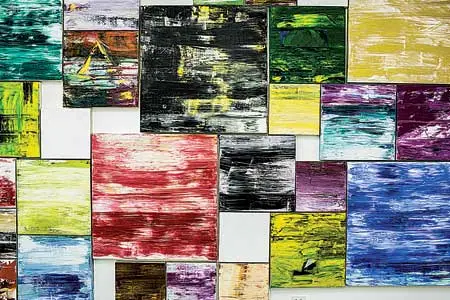
The wall facing the exhibition space acted as a screen that projected several videos at the same time on some of the intervened paintings. The videos showed Blanco “taking the painting off” from some of the works. By playing the videos in reverse, it was possible to watch Blanco working like a “house painter,” in a fascinating process that involved freeing the image from its pictorial layers until the clean canvas was finally revealed. In the opposite corner near the entrance, there was a montage of a small totem created with several objects that included the head of a black doll, a plastic toy elephant, an image of Saint Sebastian, tapes, an art book, and an inflatable therapeutic cushion.
Being also a sound artist, Muu Blanco made the soundtrack of the exhibition an important part of the environment. Urban sounds recorded by Blanco were mixed with a soft melody from a contemporary academic Venezuelan repertoire. Thus, urban sounds and that melody with creole influences merged to create a perfect amalgam in which Caracas could be perceived; the urban landscape that Blanco lives in, and where all of his aesthetical experiences have been created.
In Inthahouse, home becomes the exhibition space, but so does the city, the place that contains Blanco and with which this artist dialogues. It is a metaphor to express that art occupies a place that is possible and simply human. Through the exhibition, Blanco narrates a discourse that is necessarily fragmentary and built on residual images and objects that represent small and large stories from the city, from the artist’s mind, from his artistic endeavor amid the complex contemporaneity.
As Gerardo Zavarce correctly pointed out in the written information displayed in the exhibition area “Muu Blanco uses ‘himself’ as the sensitive experience but avoids rehashing the same identity perspective or pursuing an exploration of an existential nature. Blanco does not incorporate art into life, or vice versa, but transcends those dichotomies to detonate, from a contingent singularity, reflections on the regimen of the meaning of contemporary art: its production, flows, and shifts.”
Blanco relies on the record of his everyday experiences, family memories, his relationships with the city, and on his own aesthetic reflections and contradictions—as a visual artist and musician—in order to generate these expressions and to present them in the exhibition room. In the process, he also generates a disruption of the senses that bring into focus a critical view of art and its institutionalized mechanisms of projection. As a result, Blanco reveals the fragility of the aesthetic experience today.
Symbolically assumed as home, the exhibition space becomes the terrain Blanco uses to unfold (himself), in a gaze that more than being mere self-reflection, is a take, an appropriation of the exhibition space as an area to aesthetically inhabit his introspections, his takes on art and on the city as container and producer of his multiform Imaginarium.
Muu Blanco was born in Caracas in 1966. During his early career, he worked with painting, drawing, photography, and assemblages but eventually concentrated on the production of videos and music. In 2002, he completed a Master’s Degree in Practice and Criticism of Contemporary Systems of Representation from the Instituto Universitario de Estudios Superiores Armando Reverón, in Caracas.
He has presented solo shows at the Galería Sicart in Barcelona, Spain; the Art Center/South Florida, in Miami, US; the Hardcore Art Contemporary Space, in NY, US; and, in Caracas, at the Fernando Zubillaga, Sala Mendoza, and Faría + Fábregas.
Since 1990, Blanco has participated in group exhibitions in several spaces in Latin America, the US, Europe, and Canada. His work is part of important national and international collections.
KATHERINE CHACÓN