
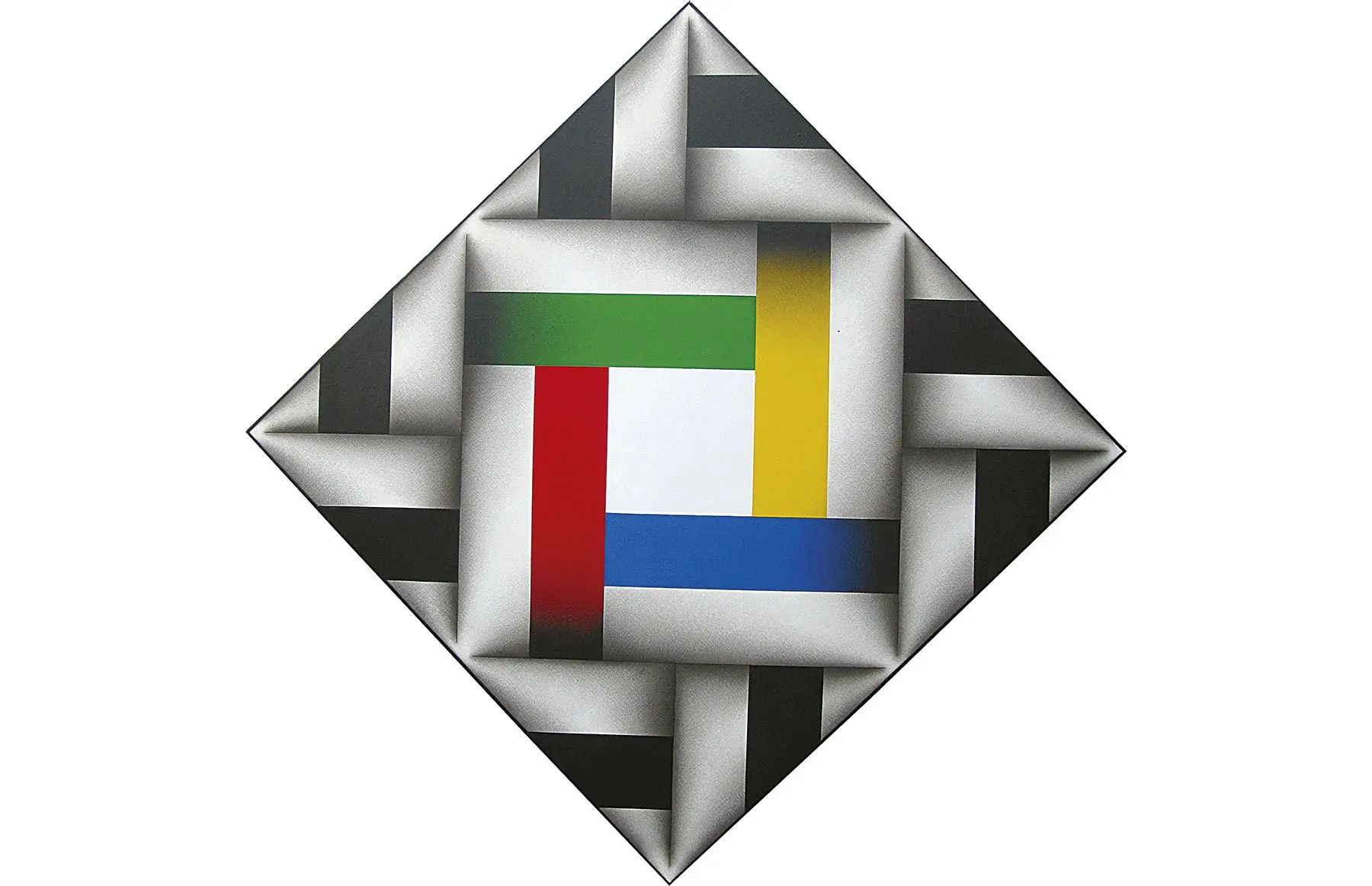
Omar Rayo’s proposal was characterized by its geometry, optical illusion, and technical exactitude. The first artistic choice of this self-taught artist born in 1938 was a caricature, and he stood out as one of the genre’s best practitioners in 1940s Colombia. To distinguish his style he decided to geometrize the feature of his subject, whom he represented using wood planks; he christened this peculiar manner maderismo (woodism). Rayo’s first exhibition as a creative artist was planned for figurative forms influenced by Surrealism. Elongated and stylized with plant reminiscences and set against metaphysical landscapes, he deemed this period his bejuquismo (reedism).
In 1954, Rayo set out on a South American journey. His travels lasted for four years and took him to Ecuador, Peru, Uruguay, Argentina, and Chile. In the capitals of these countries, he not only produced works but also exhibited them. His art then not only gives an account of the places, arguing around them, but also moves towards geometry as a language, which coincided with many of his future colleagues across Latin America, such as Alejandro Otero, Jesús Rafael Soto, Carlos Cruz-Díez, Julio Le Parc, Eduardo Mc Entyre, Edgar Negret, or Eduardo Ramírez Villamizar, to name some of those with whom Rayo shared certain elements and sustained personal relationships. In this nomadism, his explorations were enriched by a variety of experiences: nature, the popular arts, the region’s pre-Columbian inheritance, ethnic diversity. These were the arguments he dealt with in the series known as Vía Sur. From this period I want to highlight Paisaje de Nazca II, dated in 1956, where Rayo’s interpretation of the pre-Hispanic legacy is evident as a point of reference, as is his drive towards abstraction, simplification, and color economy, features that will accompany his later proposals. Also, the watercolor Bodegón de Buenos Aires, of the same year, which reveals the influence of Joaquín Torres García not only in the geometric distribution and the use of crosses, letters, and numbers but in the essentialist chromatics.
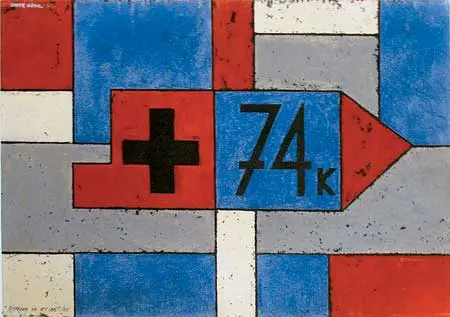
Rayo returned to Colombia in 1958 but only to exhibit his new works and to prepare for his trip to Mexico. There he made contact not only with artists like Siqueiros and Tamayo, but also with the newest cohorts: Cuevas, Rojo, Felguérez, García Ponce, López Loza, Aceves Navarro, Coen, Goeritz, Sebastian, Von Gunten, Gironella, Toledo. Rayo remained in Mexico through 1961. His Mexican sojourn was key for the conceptualization and affirmation of his artistic personality. His painting became decidedly abstract, with flat colors and hard edges. He used the circle, the square, the rectangle, and their relationships to create controlled asymmetric compositions. The chromatic range encompassed colors such as blue, green, red, yellow, gray, black, and white. Rayo painted in acrylic on canvas. Some of these intertwined shapes began to feature shadows around the edges in order to create an illusion. There, the artist would find his way to posit vibratory elements and consolidate a differentiated image.
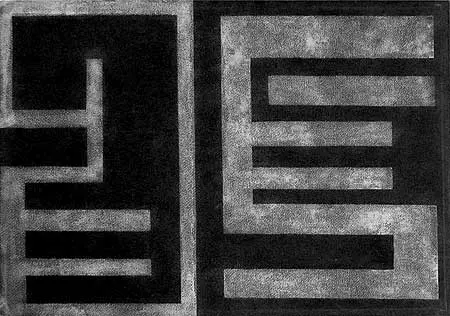
Another great find of his Mexican experience was an approach to printmaking and the development of his reliefs on 300-pound Arches paper, which are known as Intaglios. These developments began in Mexico, but the works were only exhibited in New York, where they were greatly appreciated and moved the Modern Art Museum to acquire a dozen of them for its collection in 1962.
These graphic works, resulting from plaques carved on cardboard by the artist, produced relieved images that existed without the need for lines. Many of the plots focused on hooks, scissors, buttons, saws, nails, shirts, neckties, plates, utensils, and other elements, which connected them to the then-nascent Pop Art movement. Jasper Jones acknowledged publicly the influence that Rayo’s work had exerted on his own. One of these color-free “Intaglios”, Porque la Torre Blanca está cansada, from 1966, was noticed by Marcel Duchamp, who requested it from the artist for an auction for the benefit of chess players. A thankful Duchamp gave Rayo a metal engraving dated in 1925, featuring two figures in profile. Duchamp’s work with a dedication for Rayo is preserved at the Museo de Dibujo y Grabado Latinoamericano established by the Colombian artist in Roldanillo, his native city, in 1981, which remains open to this day.
Writer and critic Juan García Ponce commented in regards to these graphic works: Undoubtedly, originality in and of itself does not suffice to make a work of art valuable; but in Rayo‘s case the latter is supported also by a solid compositional sense and a formidable inventive power that renders each work a unique experience with its own values. Utilizing his discovery in different directions and in some cases employing color to accentuate the weight and rhythm of shape within the general space of the composition, Rayo is able to make each one of his works come through as a particular and independent world. There, at times, the clean texture of the paper to which no color has been added projects a daring play of perfectly balanced spaces and volumes, with the gentleness and precision of the composition providing an almost ethereal quality or, by means of one or through breaks, abrupt contrasts where pure space asserts its poetic potency; at other times, the use of gray and black inks serves to signal the differences between the different planes through tonal breaks that produce a depth effect and shift the relationship between the shapes, or provoke a disturbing sensation of emptiness against which the rest of the composition struggles. In one way or another, through each one of the different solutions, Rayo’s poetic invention and rhythmic lyricism appear always as brought together by a voluntary economy of means and a formal exactitude that, without imposing limitations, help the artist find his freedom within what we can call the classical rules of composition: geometric order, the balance of forces, planes that support one another, a total sense of space. Thus, each one of Rayo’s works lives within a kind of pre-established inner order that communicates a calming sensation of safety and harmony without negating mystery, revelation, and poetry.”
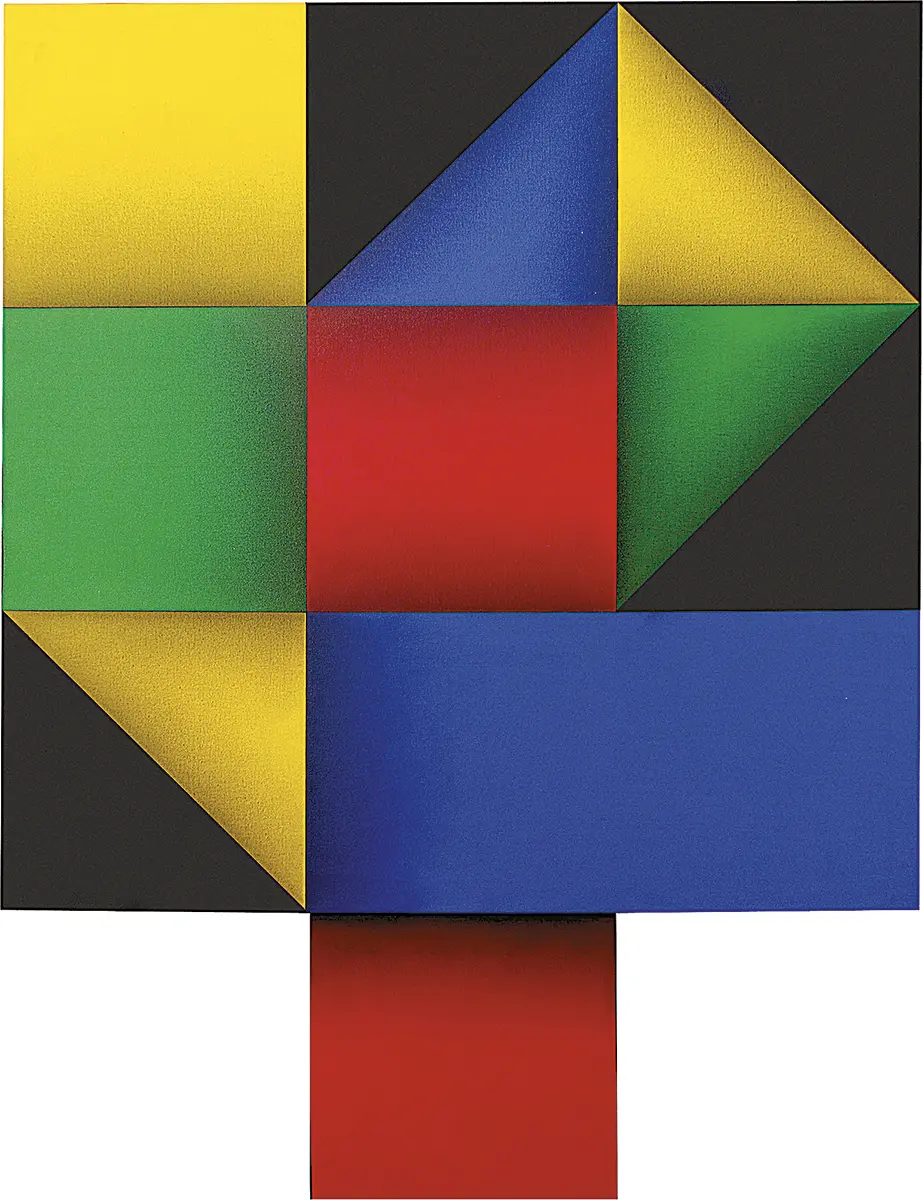
Rayo moved to New York in 1961 and remained closely connected to the city until his death, in 2010. There he produced many of his great series and paintings and his graphic oeuvre, although these had as their points of reference Europe’s classical music and Art History, Latin America’s pre-Columbian cultures and ethnic groups, and the light and colors of the tropics, as well as the artist’s fascination with the Orient, especially Japan and China.
Several Latin American artists chose New York in the 1960s as their place of residence, in order to be in direct contact with a city that had become the capital of the art world after the Second World War. Abstract Expressionism had triumphed and represented the first contingent of US artists capable of contributing to international art. Later would come assimilation of European attitudes such as Pop Art, born in London, and optical experimentations emanating from Paris. As a reaction to action painting, another group also opted for pure geometry, flat colors, and hard edges, which constituted yet another one of the era‘s reflective positions. This was the exciting, inventive environment that artists coming from South America found in the Big Apple. Among those with whom Rayo had a relationship and were his closest associates are: Rodolfo Abularach from Guatemala; Juan Gómez Quiroz, Mario Toral, and Enrique Castro Cid from Chile, César Paternostro, Marcelo Bonevardi, and Felipe Noé from Argentina; Julio Apuy from Uruguay; Antonio Enrique Amaral from Brasil; Rafael Bogarín from Venezuela and Luis Molinari from Ecuador. Colombian artists working in New York at the time included Edgar Negret, Eduardo Ramírez Villamizar, David Manzur, Fernando Botero, and Leonel Góngora. Rayo frequented all of them, but his great friendship was with Góngora, a compatriot from Colombia‘s Del Valle Department whom he had met back in Mexico.

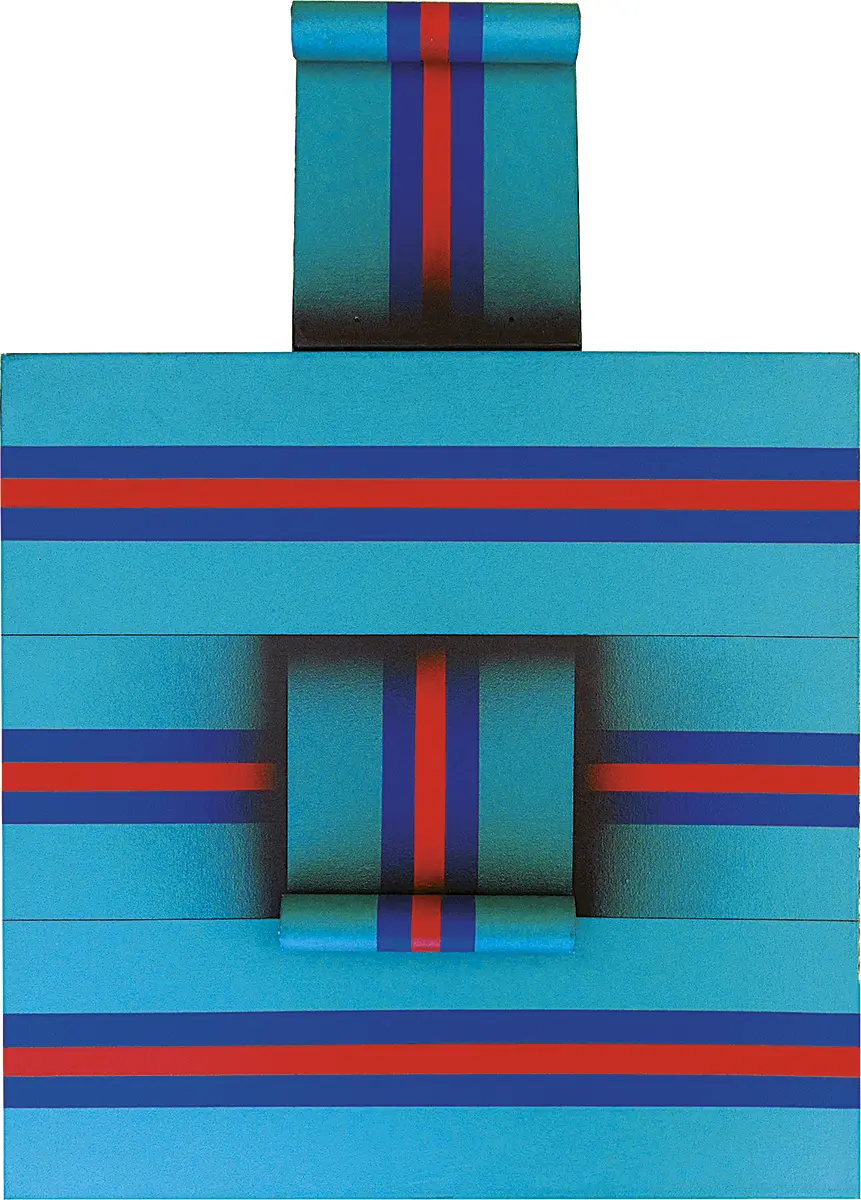
Omar Rayo began to create paintings featuring intertwined ribbons and bands in the 1960s, using vivid and contrasted colors coming from the multicolor, luminous era of the discotheque, neon advertising, psychedelia, and the gamut of psychotropics that emerged during †hat decade. Geometry exasperated the squares and rectangles in his canvases and made them irregular, prolonging their formation with segments in different directions and asserting them as invasive elements that dislocated the tradition of the regular frame. From very early on, starting in 1966, we find works resolved from a perspective that questioned all formalisms. Several also included actual wooden rollers that augmented the illusion. An example among many is Acid Rain, from 1967. Rayo retained this way of resolving his canvases throughout the rest of his career.

One of the artist’s most frequent practices was his use of black and white with the corresponding range of grays. He sought to evoke plots from the ancestral world and indigenous ethnic groups not solely in extensive series of paintings; titles like Catio, Panche, Quipus, Arhuaco, and many more exemplify his special interest and point of reference in that sense. Rayo also speculated about many formal elements and created an homage to cities, artists, and other cultures. In 1973, Mexico-based Peruvian critic Juan Acha wrote, on the occasion of Rayo’s solo exhibition at the city’s Museo de Arte Moderno, a long essay from which this judgment is excerpted: “His mastery in the handling of form takes Omar Rayo to a rich variety of forms. In his painting Memoria H. R., for example, features a rhythmic modular repetition of great aesthetic intensity that resembles a piece of basket-weaving. On the other hand, I believe that Rayo reaches his highest peak of achievement when he represents a unique almost-knot, as in Arhuaco, in an unexpected trimmed format. Here, the entire surface is transformed into an object, inside which we can see the transitoriness of a proto-knot. Arhuaco is the emblem contained in other paintings and prints coming out in search of space, of independence. The ribbons waver between being knotted or expanding, yet preserve their verticality and horizontality. (…) Those who are accustomed to the high instances of what we call spirituality will surely reject such estimations centered around the perceptual and the elemental. But they forget that poetry flows equally from the elemental and the obvious; with the advantage that, when it is achieved, it is more durable and ‘open’.”

Rayo connected his work with the familial realm, and dedicated the series Agedóptero en la red (1966) to his wife; the series Los juguetes de Sara (1900) and Coleopsara (1990) to his daughter; and Los juguetes de Mateo (2007) to his grandson. His last series were devoted to Embrión de Dragón (1997), Criaturas Abisales (2001), Semillas del sol (2002), Corteza del arco iris (2003), Crisálida del Arrebol (2004), Mullida Huella del Viento (2005). At the moment of his death, his last works, titled Tizón fósil de fuego, were on exhibit. This proposal was characterized by the dominance of the color red. Concerning this change in tone, the artist had declared: “Red is stronger and more solid than black, because red is supported by black, flows in it, melts in the shade in front of it. Only at night, the color red cedes to the power of light that which it devours… yet, fires push back the night. Red is strength, is fire, it fights hand to hand against black and white without any gaining dominance. It only is transformed.” Rayo always retained his refined technique; his skill did not decay with the passage of time and remained unbeatable. He was able to treat a variety of themes and subjected them all to the exactitude of geometry and the optic balancing acts that exercise the viewer's retina. He constructed a visual grammar based on precision, on chromatic and formal variations capable of bringing forth his personality, which became singularized and entered collective memory even beyond the circle of the visual arts.
*Images illustrating this article, except for the first one, are courtesy of Museo Rayo, Roldanillo, Colombia.
MIGUEL GONZÁLEZ
Professor, curator, and art critic. Member of AICA.