Since the beginning of his career in the 1970s, Pancho Quilici has been interested in capturing interior spaces based on the superimposition and juxtaposition of plants, columns, beams, and elevations, among other elements that allow him to create mysterious and labyrinthine structures. He begins with sketches of human figures that eventually disappear under landscape proposals that include architectural, geometrical, and natural elements. In this manner, Quilici constructs a framework of forms that gradually opens to the exterior space until they form vast and generous landscapes of sidereal or planetary connotations. During the decades of the 1980s and 1990s he combines several types of planimetry in an attempt to compare visions from several scales: far vs. near, particular vs. universal, fragmentary, and its context, through modular paintings that describe huge horizons built through unusual associations. In these creations, Quilici incorporates topographic designs, outlines, and cartographies that look like vestiges from archaic civilizations; ghosts from ancient cultures or, even, reflections of future worlds trapped in the coordinates of an infinite time, limited by whirlwinds of straight lines and curves that structure the plane and give it fluidity and plasticity. In the creations that follow during those years, the artist projects increasingly more daring perspectives, with unusual movements that increase the compositional complexity of the works, and in addition, there are the types of drawings with heroic construction infused with galactic atmospheres that highly contrast with the arrangement of mountains, oceans, rivers, and clouds whose organic nature is confronted with the rationality of geometric order. Although human beings are no longer identified in his work in their physical form, they are nonetheless present through the cosmogonic conception that he elaborates about the world. About this Quilici has said the following: “I am interested in interiority; to try to find a sort of psychology—a term he invented—something like representing that which we regard as the psyche…”
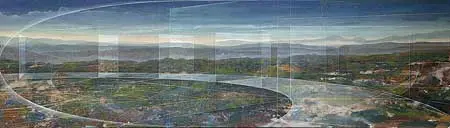
During the beginning of the 2000s, Quilici relies on new resources like digital technology, nylon supports, the translucency of veils, and acrylic engravings; all of these mediums offer the possibility of subtle and refined visual finishes. The attempt to dominate the space in an almost obsessive manner has always been the objective that guides his visual work, while his passion for architecture has led him to explore the real and imaginary possibilities offered by this discipline: “My drive—once said Quilici—is to build like an architect does on a plot of land: the measures and advocates reason over chaos. One becomes the center of the circle, but I think that architecture comes in a close second. It is that which protects us, envelops us, and based on it we can observe nature...”
The result of these reflections was the works exhibited at the Galería D’Museo in the Centro de Arte Los Galpones, presented from March 3 through April 28 of this year. With the title of World One, it presents some of Quilici’s explorations of recent months that consist of four paintings, a group of six drawings, and three-dimensional work. It is a selection that summarizes the achievements Quilici has gained during his prolific trajectory. The Maqueta para Projecto (Mockup for Project) is a sculpture-installation created with wood, nylon, and acetate combined to build a monumental sphere; an aerial, weightless, volume that is at the same time dynamic and expansive. In these works, the recurrence of circularity is another constant part of this artist’s discourse. We can appreciate it in the already mentioned Maqueta (Mockup), as well as in Entorno (Surroundings) and Ex-Ducción (Ex-Duction), two two-dimensional works in which Quilici recreates spirals, cones, ellipses, parabolas, hyperbolas, circumferences, etc.: concepts that the artist has explored supported by notions in physics and astrophysics and also by the symbolic resonances suggested by these images. As a geometric form, the circle possesses a centrifuge and centripetal dynamic. It is central but also peripheral and communicates the inside with the outside. It is also dominating because it covers—virtually and actually—a segment of the space and the environment that surrounds it as a result of its multidirectional quality. It is for these reasons that the circle is associated with the uniqueness of the whole. According to Quilici: “They represent the thoughts of our internal worlds about the self, about oneness with respect to otherness. For instance, I associate the mockup with a sort of cosmic pseudo-mandalas… The idea is to make others dream, to create free interpretations of universal forms with highly archetypical values that can take us a little further. It fascinates me to struggle with matter, to perceive its limits. I am a dreamer and enjoy inventing things, to imagine. It is part of a game, and to some extent, it is something that every artist has…”
GLADYS YUNES YUNES