
The exhibition entitled Nicaraguan Women Artists, 2013, at The Americas Collection explores the recent works by Patricia Belli and Patricia Villalobos, two creators that have participated in the configuration and development of the vital Central American artistic scene. One from Managua and the other from Michigan, both artists have developed their carriers without losing touch with the Nicaraguan and local scenes that have nourished them and in which they have been actively participating for decades.
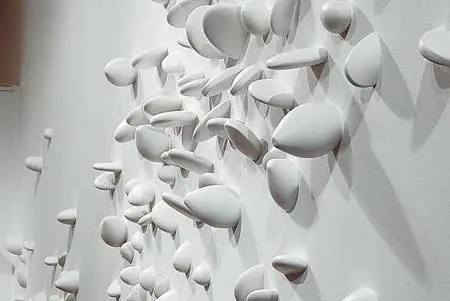
For this exhibition, Villalobos (Nicaraguan, born in the US in 1965) created Swarm, an entire world of silent protuberances that take over the walls of the gallery as the work calls attention to the manner in which small everyday changes can provoke enormous and profound transformations.
Emphasized by the use of unblemished white, the delicacy of this work is set in contrast with its viral character. A succession of forms are mimicked and silently take over a space they undermine and transform. They metaphorically allude to those internal explosions that, as time passes, contaminate the private and public realms as they leave indelible marks on the social fabric of our time.
Villalobos has used this same idea to invade museums, public spaces, and events like The Mattress Factory, Pittsburgh, PA (2009), the 1st International Triennial of the Caribbean in Santo Domingo (2010), the Urban Institute of Contemporary Arts, Grand Rapids, MI (2011), the Museo de Arte de El Salvador (2011), and the 11th Havana Biennale (2012).
With Swarm at The Americas Collection, Patricia Villalobos continues to create a state of permanent change. This complex and subversive work seduces us as it digs and unearths those small and large ghosts that we inhabit and that we project onto our surroundings. It is also a reflection on the fragility and malleability of the power structures, identities, cultures, and the spaces for social exchange in which we coexist and interact. Villalobos’ piece is a wake-up call about the layers that cover and unsuccessfully try to hide the need for changes that are centuries in the making and that suddenly, unstoppably, burst into the outside world.
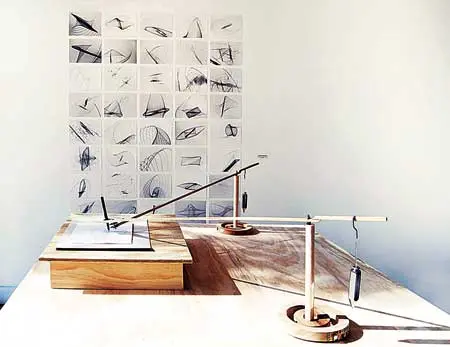
With the work entitled Uncertainty Principle, Patricia Belli (Nicaragua, 1964) for her part proposes new ways of representing perfection and equilibrium. Meticulously and elaborately engineered, her pieces activate the primary principles of physics and delve into a deep study of art history. They are also the logical result of an entire body of earlier works in which Belli would combine natural elements, found objects, fibers… with which to create objects and installations that began to play with the idea of equilibrium in its most basic sense.
Relying on natural elements and mundane objects, Belli constructs various machines that work with “combustibles” as different as a small touch, the imperceptible movement of a viewer, or a whiff of air that happens to circulate in the exhibition space.
With unique combinations, Belli produces objects that are reminiscent of the scaffoldings used by Renaissance artists, the proposals by the vanguards from the twentieth century, and the most basic resources ingeniously used for centuries by entire communities.
Relying on her great imagination, Belli builds objects that can only function in an artistic context or within an exhibition space. Most of these objects are completed and their nature revealed once they are set in motion; during a moment in which the interaction with viewers or chance become the essential spark that will activate the pencils—that are part of the objects—to “draw” the lines on paper that may eventually be exhibited or taken as a souvenir. This almost unreal “automation” is also part of the entire machinery that reveals the ludic nature of the work.
In other pieces like The Most Precarious Balance, with a great economy of resources, Belli plays with the power of fragility to create terrifying tensions or unconscious attractions in which viewers become the central protagonists. By playing with dissimilar elements, Belli also blurs the lines between forms, concepts, and perceptions, as she superimposes different languages and elicits an endless number of reactions from the public that give her proposal an undeniable flavor.
The two artists meet at some point in the gallery, and it is in the manner that both interact with the viewers’ vital spaces, on the one hand, and with the exhibition space, on the other.
Both artists seek the active participation of the public becomes the trigger of their works. Villalobos achieves this through reflection and the creation of an apparently sterile space that the observer must enter and gradually appropriate until the piece becomes the mirror of his/her own reality. It is exactly at that moment that the work stops contaminating the wall and intervening in the space, in order to enter the skin and vital space of the observer. For her part, Belli achieves this during that second in which an almost imperceptible gesture provokes and the enormous amount of internal triggers that immerse the viewer into several stages, such as stupor, the need to interact with the objects, the need to establish a distance from them and the caution and attraction toward the unknown.
VALIA GARZÓN-DÍAZ