
Paulo Whitaker demonstrates great inquisitiveness in the way he discusses his own visions and questions about the world. His creative gesture always connects with an incessant search for answers regarding existence, in a constant dynamic of transformation. According to the artist, the way he found for his work to always remain “fresh” was to create new problems to solve.
His exhibition at Marília Razuk Gallery brought together a series of 20 works that include paintings and drawings, and the result was a translation of the artist’s passion for the constant reinvention of his art. For this exhibition, Whitaker selected drawings that represent a synthesis of what has occurred in the last two years, while some of the paintings belong to his most recent periods and others to older moments (albeit not seen in Brazil). These are works that were exhibited at the Montreal Biennial in 2007.
Creativity is a natural quality of Whitaker’s personality. Long before committing to the visual arts, towards the end of the 1970s, a young Whitaker, restless and hungry for challenges, left São Paulo for Santa Catarina, where he lived in a fishermen colony named Barra da Lagoa. And even if unwittingly, communing with the caiçaras 1 he began his creative education. Observing the fishermen at work, Whitaker began to build his own home using a hand saw; it was a rustic dwelling made entirely of wood. His dialog with the people of Barra de Lagoa de Conceiçao was decisive in opening paths or what became his constructive exercise in the realm of art.
Whitaker remembers with emotion the period when his time was split between studying at the university and working as a teacher in the rinky-dink local school. He remembers his surfboard and his saw, the tool he used to build his home. He doesn’t forget Mrs. Noemia, the shop owner, the person who truly financed his studies in that state, via a little notebook where she recorded his food purchases (a tab that was never closed). Mrs. Noemia never allowed the young student, who was also her community’s schoolteacher, to go hungry. Beyond the generosity and the warm welcome, Whitaker’s imagination was filled with questions in always pleasant conversations. One day, the news arrived of Mrs. Noemia’s passing: the death by suicide of the woman who had become his substitute mother marked Whitaker deeply.
It was there, in Santa Catarina, where Whitaker shifted gears and moved from the study of the humanities to the visual arts. In 1985, already a graduate, he returned to São Paulo. At that time, he made the acquaintance of the artists who were taking part in the 18th São Paulo Biennial. Sharing with other artists and discussing his own work helped his technical maturation.
After living abroad, in countries like Germany and Canada, the São Paulo artist alternated exhibitions between local and foreign galleries.
For Whitaker, the problems to be solved in his artistic practice begin with a series of questions: What to paint? How to paint? Why painting?
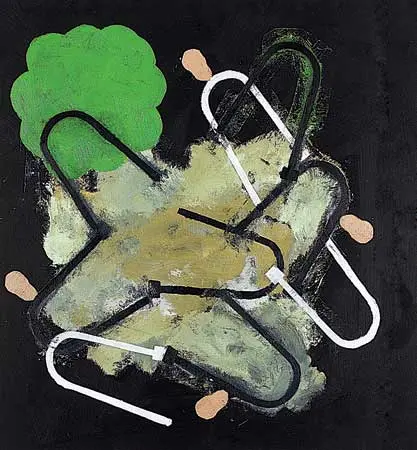
The pleasure of manipulating color compensates for the limitations imposed by two-dimensionality. The production of meaning emerging from the emotions that fill our witnessing of everyday events, gains in Whitaker’s hands a new profile, always in search of establishing a dialog with the world by means of the thought of painting and the creation of his own lexicon. In that sense, Whitaker seeks to clarify the process of his production, much more than to emphasize the representation of his figures.
The monochrome background of Whitaker’s paintings contrasts with highly colorful figures, painted in a language that tends to abstraction. These figures are built using stencils. The artist’s restlessness is revealed in his working process: he never gives up. Whitaker never sees his works as finished; he revisits, changes, intervenes in them and proposes new explorations. This demonstrates that his production moves forward in continuity. Years may pass for a given work to come to rest; they are ready only when they survive the artist’s own judgment.
Whitaker’s proposal challenges viewers to decipher his ideas and, at the same time, to experience their own sensations when confronting a dialog with the artist’s pictorial vocabulary.
Whitaker puts on display his strategies, his choices, and the decisions made in the execution of his works. He incorporates the trials, the errors, the erasures, and in that way brings to the fore the constructive path followed to arrive at any given place.
The exhibition O sempre, o todo, o não sei at Marília Razuk Gallery in São Paulo, was an opportunity to encounter works produced over the last five years. Next to large-format canvases were small-format works on paper showing the artist’s versatility, his exploration of multiple results, and his permanent search for new ones. Above all, the exhibition made it possible to understand Whitaker’s original roots, from the caiçara elaboration to the erudite approach of his proposed artistic universe.
NOTE
1. Caiçara is a tupí term referred to coastal populations. It has been in use since the Sixteenth Century, the product of the contact between Portuguese settlers and indigenous peoples.
HÉLCIO MAGALHÃES