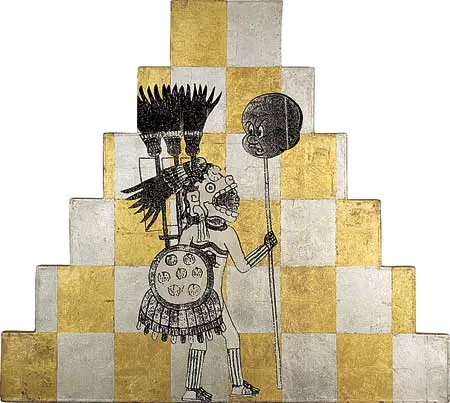
The exhibit at the Neuberger Museum of Art at Purchase University, New York, displays the work of four Latin American artists who have engaged pre-Columbian art in iconoclastic ways: Enrique Chagoya, Demían Flores, Rubén Ortiz-Torres, and Nadín Ospina. Unlike previous generations of Latin American artists who were interested in pre-Columbian sculpture and architecture, the artists in Neuberger’s exhibit share a critical suspicion of the ways in which a variety of aesthetic and political projects have appropriated these artifacts. While earlier artists like Diego Rivera or Rufino Tamayo felt titled to draw directly on Pre-Hispanic artifacts either to study their form or to extoll their grandeur, contemporary Latin American artists seem all too aware of the ideological uses made of these artifacts. What has vanished in a matter of a few generations is not only the myth of uninterrupted historicity linking modern national cultures with the pre-Columbian past but also the unquestioned patrimonialist relation towards a purported legacy. The pieces at the Neuberger show that contemporary Latin American artists’ engagement with Pre-Hispanic art is now predicated on their capacity to reflect on the history of these usages and to thematize the very distance that stands between contemporary man and that utterly inaccessible world.
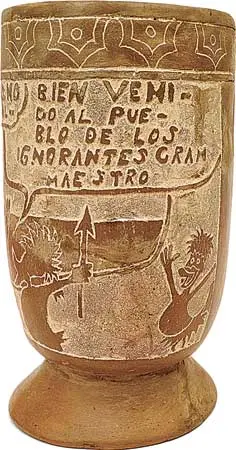
Pre-Columbian Remix brings together numerous works, of a variety of media, that approach pre-Columbian art in this decidedly indirect way. What renders the works of Chagoya, Flores, Ortíz-Torres, and Ospina so powerful—and their dialogue so insightful and suggestive—is the way the artists approach pre-Columbian art obliquely, by manipulating and reworking the complex and multi-layered mediations of our relation to the Pre-Hispanic past. Once the objects themselves become unavailable—for example, by the iteration of forgeries in Ospina’s Vasos tipilecas—the empty space left behind by their displacement offers a vantage point into the phantasmatic space of ideology.
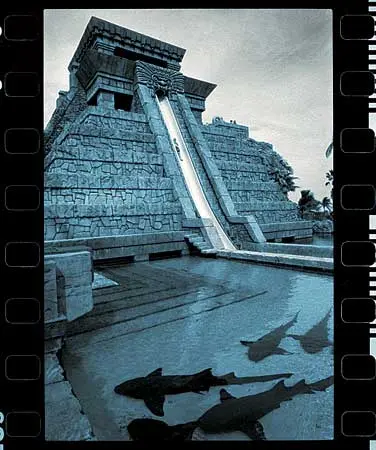
Rubén Ortiz-Torres’ photographs capture precisely this kind of displacement. His photographs show replicas and loosely inspired renderings of Mesoamerican monuments in theme parks, supermarkets, and coat checks. In a vein close to that of Lothar Baumgarten’s work on the Amazon from the 1970s and 80s, Ortiz-Torres captures the phantasmatic dimension that structures our conception of Aztec temples and Mayan cities by depicting the iterations of imaginary architecture set against the background of bleak modern-day non-places. The tourist industry’s deliberately imprecise and ahistorical recuperation of the past offers a rare view into the workings of the imagination. In some cases, the content is readily expressed in clean-cut metaphors, as in Human Sacrifice with Sharks, Nassau, Bahamas, in which a victim-tourist slides down a reproduction of the Temple of Kukulkan in a toboggan, into what appears to be a pool of sharks. But in other, perhaps more powerful pictures, Ortiz-Torres captures unexpected disjunctions and connections: a dramatic change of scale that equates Olmec head sculptures to Mayan temples, or the establishment of unexpected connections between artifacts from different cultures and geographies by means of contiguity. The photographic intervention—a certain composition and a precise moment—triggers a proliferation of meaning that stands in contrast to all those elements in the picture that would seem to curtail them: a parking lot, an unsuspecting tourist, a decidedly non-exotic urban landscape. In Rubén Ortiz-Torres’ photographs, the phantasmatic space is revealed not only as a repository of cliché metaphors but as the uncanny tension between a disjointed and bogus imaginary architecture and the re-consecrating power of the photographic medium itself. Ortiz-Torres further stresses this contrast by nodding to the classic age of photographer-travelers through his compositions and by presenting his pictures as cyanotypes or salt prints.
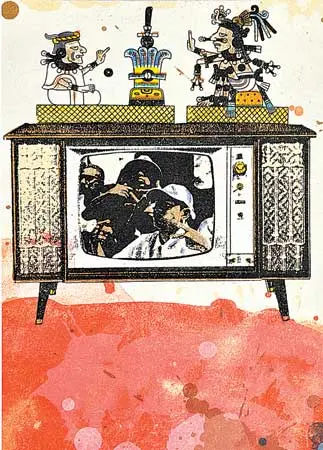
The subtle uncanniness of Ortiz-Torres’ work gives way, in the case of Demían Flores and Enrique Chagoya, to saturation of images. Both artists fill the empty space left by the pre-Columbian artifact in different ways. On one extreme, the space is populated by such an overbearing yet organizing national signifier as the Motherland, in Demián Flores’ series La Patria, a series of large-format paintings in which a famous state-sponsored personification of Mexican mestizaje is literally buried behind layer upon layer of urban and pre-Columbian images. On the other extreme, in Enrique Chagoya’s sprawling and visually stunning comic codexes, the space is no longer national and opens to other gazes, such as the American imagination of Mexico and Mexican migration. In works such as Illegal Alien’s Meditation on el Ser y la Nada, for example, Aztec deities preside over an image of gang hand signs projected on a TV set from the 60s, a vibrant reflection on the way society imagines an idyllic past disrupted by atavistic violence in order to explain its antagonisms.
The four artists in the exhibit share the conviction that the artifacts, monuments, and images of the Pre-Hispanic past cannot be meaningfully disentangled from the multiple mediations that have made them available to us. In the Mexican context, for example, the Mesoamerican past was imagined and construed by numerous ideological projects, both local and foreign: from Jesuit proto-nationalist historiography to Romantic fascination with ruins; from post-revolutionary nationalist ideology to Modernist bourgeois exoticism; from the identity politics of migrant communities to mass media; from representations of pop culture to racial stereotypes. This is why the four artists implicitly assume, as their point of departure, the essential discontinuity that separates them from the pre-Columbian world. Nadín Ospina expressed this clearly in an interview: “We are standing on top of this cultural heritage, but it doesn’t belong to us in a contemporary way; that is, the relationship to this past is as removed as it might be to a Swiss or a Japanese or an African individual.”1 As reflected by his own career, Ospina was calling into question the array of unwritten expectations that global art has levied on Latin American artists as possessors of a certain heritage or as holding a privileged relation to more “primitive” or original forces. By fully embracing this discontinuity, Ospina sought to debunk the unwarranted patrimonialist relation to the past that art institutions as much as racial stereotypes have imposed on Latin American artists. In “Pre-Columbian Remix,” Ospina’s various series of sculptures address the imaginary expectations and demands of a market of greedy and gullible collectors. In a series of technically impeccable and realistic stone sculptures—one of the highlights of the exhibit—Ospina mixes well-known Mesoamerican models with Disney characters, as in Chacmool I, in which a nonchalant Goofy adopts the pose of the famous Chichen Itza sculpture. And in a series of deliberately aged bronze sculptures called Jefes, the all-too-familiar figure of Homer Simpson dons various headdresses and supposedly indigenous regalia, while maintaining a regularity that points to its mass production. In Ospina’s case, the pre-Columbian artifact cannot be disentangled from the fantasies of its collectors, and while the collector might represent just one particular relation to these artifacts, he stands as a synecdoche for the desire that structures the very notion of pre-Columbian art, just as the sheer desire for classical indigenous antiquity moved a generation of Mexican scholars to find such markedly Western institutions as lyric poetry or philosophy among the ancient nahuas. This desire, Ospina suggests, not only unearths and helps interpret ancient artifacts but also warrants the misapprehension and partial invisibility required for its fulfillment.
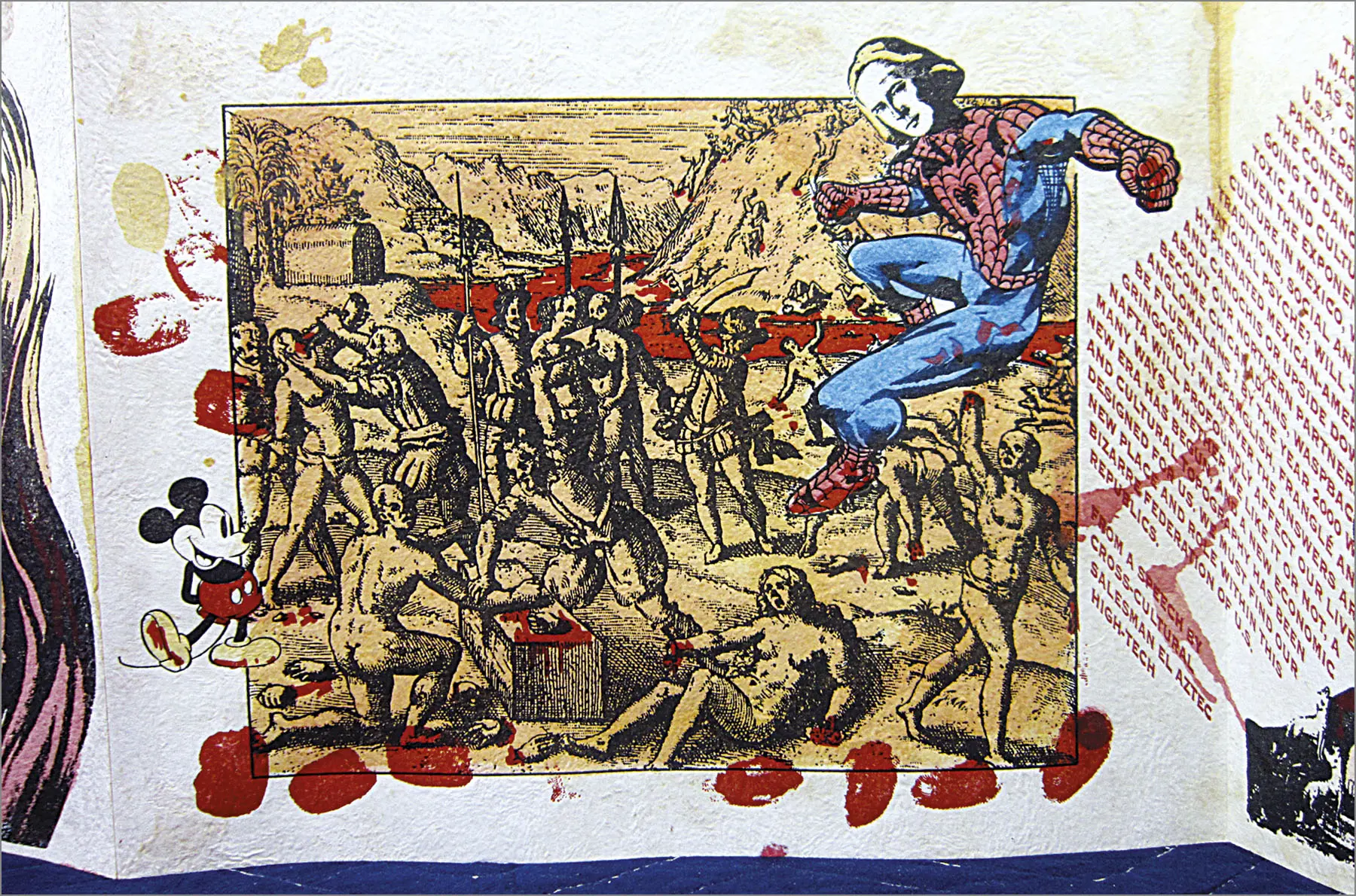
However, while Ospina’s foray into the desire of the artifact is predicated on a fundamental discontinuity, this is only part of the story. This sits at odds with the multiple ways in which popular imagination, political discourse, or even the entertainment industry has systematically overridden the gap. In this regard, Latin American artists seem to hold a more privileged relation to pre-Columbian art, if only because of their longer exposure to its distortion. One must only compare Enrique Chagoya’s Codex Espangliensis: From Columbus to the Border Patrol, displayed at the Neuberger Gallery, to the German artist Nanne Meyer’s variations on Mesoamerican codexes in the pieces Codex Meyer I and II at the Berlinishce Galerie für Moderne Kunst. While both artists take as their referent the unfolding “painted books of the Mexicans,” their aesthetic intent could not be more different. And their difference is predicated on the position both artists have towards the pre-Columbian world. While the abstract work of Meyer presupposes a certain detachment, the oblique approach of Chagoya presupposes an urgent intimacy.
Meyer’s intent was to depict her own astonishing discovery of Mayan systems of writing and representation through travel. In her Codex—the title of which aptly reproduces the central European nomenclature of many Mesoamerican codexes, thus underscoring their transplantation—a detailed graphic deconstruction of Mayan epigraphic writing and figurative conventions becomes suffused with personal memory as the signs dematerialize and transform into an archeological map of a Mayan site. Meyer integrates Mayan signs into her own visual repertoire through the abstract metamorphosis of historically disparate systems of representation. But even when this translation reaches contemporary icons—Mickey Mouse or the Fasten your seatbelt sign, the metamorphosis is triggered by purely formal similarities. Meyer’s operation abstracts Mayan codexes from the history of their reception and usages, inscribing them in a kind of transhistorical Wunderkammer.
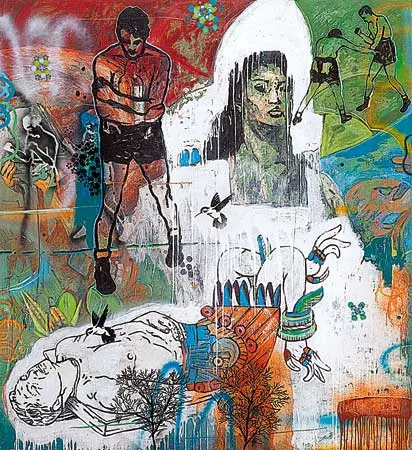
Enrique Chagoya’s Codex Espangliensis (Latin, one presumes, for Códice Espanglish) performs an almost opposite operation. As historian Serge Gruzinski writes in the catalog of the exhibit, Chagoya’s work harnesses anachronism as a powerful tool: the Codex manipulates and disrupts our historic relation to the past.2 Instead of Meyer’s detached formalist contemplation, Chagoya grapples with the disjointed network of iconographic resonances that pre-Columbian artifacts have elicited both in Latin America and the United States. If in Chagoya’s work, these images can no longer constitute a heritage nor be recuperated in a patrimonialist way, this is due to the fact that they have come to express the symbolic violence of an Other: the racial and cultural violence of Chicano and Latino stereotypes in the U.S. By mixing the codex with comics, Chagoya creates an effective mechanism capable of giving visual consistency to silent symbolic violence. By rewriting the grand narrative of the Discovery and Conquest as a history of Invasion (from Columbus to the Border Patrol), atavistic violence, and humiliation, the Codex Espangliensis denounces the symbolic violence that holds together any sense of national identity.
Finally, the work of Demián Flores explores a new form of mediation and proximity to the pre-Columbian past. In series such as Monte Albán or Aztlán, the Oaxacan painter dresses popular characters—from Superman to Elmer Fudd but also the characters from popular self-defense manuals—with Aztec attributes of power and war. These characters, petrified in awkward combat positions, don feathered shields, headdresses, or macana swords as if expanding the ritualized war choreography of the ancient nahuas. The more analytic and fragmentary usage of Mesoamerican glyphs and symbols in Flores’s paintings lends a different status to anachronism: rather than actualizing pre-Columbian images, his paintings tend to inscribe contemporary icons as well as Mexican national symbols such as La Patria or the effigy of President Juarez into the symbolic universe of the Pre-Columbian past. Unlike the logic of mixture (Re-Mix) found in the work of Ospina or Chagoya, Flores uses a logic of codification: connecting the past and the present through gestures and symbolic markings and attributes that incorporate without eradicating iconic stability.
Cogent in its discourse, and ambitious and exhaustive in its breadth, Pre-Columbian Remix, curated by Patrice Giasson, establish an exemplary dialogue in which four Latin American artists illuminate and refract one another. Much can be learned from contemporary art’s engagement with the past, creating new archeology that probes into the desire of the object and its phantasmatic trails.
NOTES
1. Giasson, Patrice. “Pre-Columbian Remix and the Art of the Present.” In Pre-Columbian Remix. The art of Enrique Chagoya, Demián Flores, Rubén Ortiz-Torres and Nadín Ospina, exh. cat., Neuberger Museum of Art, Purchase, NY, 2013, p. 11.
2. Gruzinski, Serge. “Cannibal Images: The Virtue of Anachronism and the Writing of History in Contemporary Art.” In Ibid., p. 49-52.
DAVID HORACIO COLMENARES