
The work of Rubem Grilo shines a light on the importance of printmaking as an artistic language. This is on display in the exhibition Rubem Grilo A Trajetória do Artista, Aquisição de 500 Obras - Prêmio de Artes Plásticas Marcoantonio Vilaça. Featuring 123 woodcuts made at different times and in a variety of formats, the exhibition summarizes the artist’s career, covering 41 years of professional activity (1971-2012).
This exhibition marks the culmination of a solid career, which included the Procultura Stimulus to the Arts Award (National Arts Foundation, Ministry of Culture) in 2011. The project consists of the transference of 500 works authored by Grilo to the MNBA’s Gabinete do Gravura, adding to the 900 previously donated by the artist to the institution. The works featured in the exhibition were selected from this collection, and the show is intended to present a broad perspective on Grilo’s entire career, starting with his first xylographs, from the early 1970s.
This look at Grilo’s vast production brings to the fore the coherence and high quality of his work. Despite specific shifts over the years, the artist has remained faithful to a vigorous poetic project, which made him one of the most important names in contemporary Brazilian printmaking. Through Grilo and other artists of his generation, printmaking in Brazil returned to its greatest roots, a tradition begun by Oswaldo Goeldi (1895-1961).
Born in Porto Alegre, Minas Gerais, in 1946, Grilo moved to Rio de Janeiro in his youth. There, he studied woodcutting with José Altino at the Escolinha de Arte do Brasil, and frequented the Iconography Section at the National Library, where he became acquainted with the printmaking work of Goeldi, Livio Abramo (1903-1992), Marcelo Grassmann (1925), among others. Visiting the studio of Iberê Camargo (1914-1994), he received lessons on metal engraving; at the Escola do Artes Visuais do Parque Lage, he studied lithography with Antonio Grosso.
The presence of figures, humor, and vivacity are central elements in Grilo’s poetics. These features are easier to understand when we look at the beginnings of the artist’s career when xylographs emerged not as a specifically formal choice but as a means of ideological expression accessible to many. During that period, Grilo illustrated newspapers and created autonomous works, always working on political themes: the military dictatorship, matters of everyday Brazilian life, public bureaucracy, and social differences.
The artist’s intention was to communicate directly with the audience, and this drove him to use words alongside his images. He did this in newspapers like Opinião, Movimento, Verus, Pasquim, and Jornal do Brasil. With tenuous lines and contrasting compositions, Grilo transfigures and recreates strong shapes that occupy every space on the plane.
In the course of his career, Grilo developed a strong sense of visual autonomy through systematic aesthetic investigations and permanent contact with the best of Brazilian printmaking; this was to be expressed even more forcefully in his work starting in the 1990s, after he received an award from Xylon International, in Switzerland. At that point, Grilo stopped producing illustrations for print mass media, although social critique remained present in his more personal production.
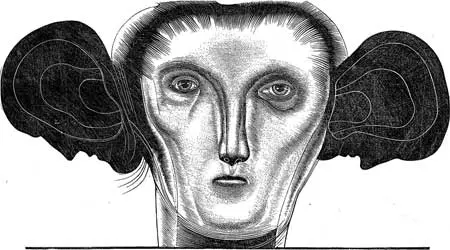
Grilo focuses on graphic simplicity. His attention to humor and ambiguity is unflagging, as shown in The Seer (2011), Big Ears (2012), and Dislocation (2008), all of which include surrealistic elements. Unanticipated juxtapositions and disconnected objects are part of the fantastic realities expressed by the artist.
In his recent work, Grilo demonstrates that printmaking must never be considered a minor genre. Even as a biting social critic, he never transformed politics into allegory. Above all, his works reveal the force of visual synthesis. The result of a great artist’s creative effort, in his most unexpected poetic desire.
ALESSANDRA SIMÕES