
The work by Sergio Vega (Argentina, 1959) is characterized by its solid theoretical background. Entitled Disassembling Paradise, his most recent exhibition in Miami at KaBe Contemporary is a classic example of the manner in which this artist uses historic referents to question contemporary realities. This exhibition is part of the project that Vega has been developing during the last ten years. Entitled Paradise in the New World, the project is inspired by the homonymous book written by Antonio de León-Pinelo in 1650. In broad strokes, Pinelo’s thesis was that the Garden of Eden was located in South America. Vega follows the travel proposed by Pinelo in his text and arrives in Brazil, specifically in the area of Mato Grosso. Once there, Vega took images, most of them of the towns and houses of the area, and then used these as the basis for his work. Based on those images the artist constructs his visual version of paradise. By using the seventeenth-century book as a referent, Vega embarks on a historical survey of the colonial past in South America that takes him all the way back to the present, as he establishes direct connections between the past and that which he sees as the resulting the socio-economic order that exists in the region.
Disassembling Paradise consists of a series entitled Parrot Color Charts and the installation Shanty Nucleus After Derrida. In this show, it becomes clear the manner in which Vega relies not solely on historic referents, but also “tests” spectators with quotations from universal and regional art. The formal and conceptual references begin with the more evident ones, like Piet Mondrian as the tangible purist abstract component of Parrot Color Charts—a reference that is acknowledged by the artist and one that he consciously made. On the other hand, the parrots allude to the way in which religion is perceived as something exotic, an image that is also projected through the use and combination of brilliant colors. In working with this notion of the exotic, Vega is referencing visual historic associations that would include parrots as symbols of the exclusive nature of paradise—something that has been widely represented in painting, especially during previous centuries. Formally speaking, besides the reference to Mondrian, Vega establishes a dynamic of relationships between form and color, the “mutilation” of the image of the parrots with eye-patches of brilliant colors that reproduce those in the feathers of exotic birds.
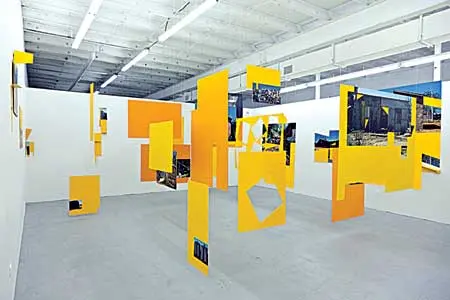
There is no doubt that Shanty Nucleus After Derrida is the central work of the exhibition. This installation was shown before at the Museum of the Americas in Washington D.C. in 2010. The title was inspired by Grand Nucleus, the well-known series of innovative installations that Hélio Oiticica (Brazil, 1937-1980) created between 1960 and 1966. Formally, the piece also reminds us of Oiticica’s work with its innovative yellow and irregular modules suspended in the ceiling. Vega places similar elements in the space that share the same brilliant colors of Oiticica’s proposals but also adds images from the Mato Grosso slums. This solution creates a sort of paradox between the precise arrangement of the modules, their immaculate surfaces, and photographs that depict a local architecture characterized for its improvisation, irregularity, and spontaneity.
In his installation, just like in Oiticica’s, Vega “restructures” the space through forms. The pieces are organized like spatial and visual labyrinths in which images of architectural elements are superimposed one on top of the other like a sort of jigsaw puzzle without any apparent logical order. These artificial structures show a surreal deconstruction of the space that offers the artist the ideal opportunity to communicate with viewers, as they are challenged to reflect on the reality that surrounds them. With his camera, Vega dissects parts of his seemingly chaotic immediate surroundings to then present us with a fragmented version of it amid the isolated—one could venture, even sterile—environment of the gallery. By combining photography and abstraction, Vega achieves an intentional dichotomy between both visual languages that intrigue and disorient viewers. He inevitably establishes a dialogue with his work that is both intelligent and challenging. Through this visual clash, he achieves a contextual revision of the Latin American landscape that expands from art to politics.
As the title of the exhibition suggests, Vega “disassembles paradise.” With a biting historical vision he uses these referents to reveal a line of continuity between the colonial past and the present and, to prove its validity, he relies on the civic and economic structures of the region.
Vega is backed by an impressive artistic trajectory with a curriculum that demonstrates his commitment to art. Some of the most important exhibitions in which he has participated include: the 51st Biennale of Venice, in 2005; the 5th Gwangju Biennial in South Korea, in 2000; the 5th Biennial of Lyon in France, in 2000; the Yokohama Triennial in Japan, in 2001. Vega is also the recipient of two of the most prestigious international awards: the 1999 John Simon Guggenheim Memorial Foundation Fellowship and the 1990 Pollock-Krasner Foundation Grant.
IRINA LEVYA