
The Orange County Museum of Art, OCMA, presents a new configuration of the biennial format the Museum had been organizing since 1984; this year, Dan Cameron, their new chief curator since early 2012, has committed to a fresh view of a triennial format, one that comprises not only California but countries along the Pacific rim, including artists from Australia, Canada, six Asian countries and six countries in Latin America. The result is an exhibition that showcases works by 32 artists also from different generations and although not arranged thematically, the works share obvious connections that range from aesthetic to conceptual ones, due to the geographical historical contexts of colonization, trade, and contemporary economic factors that these countries have in common.
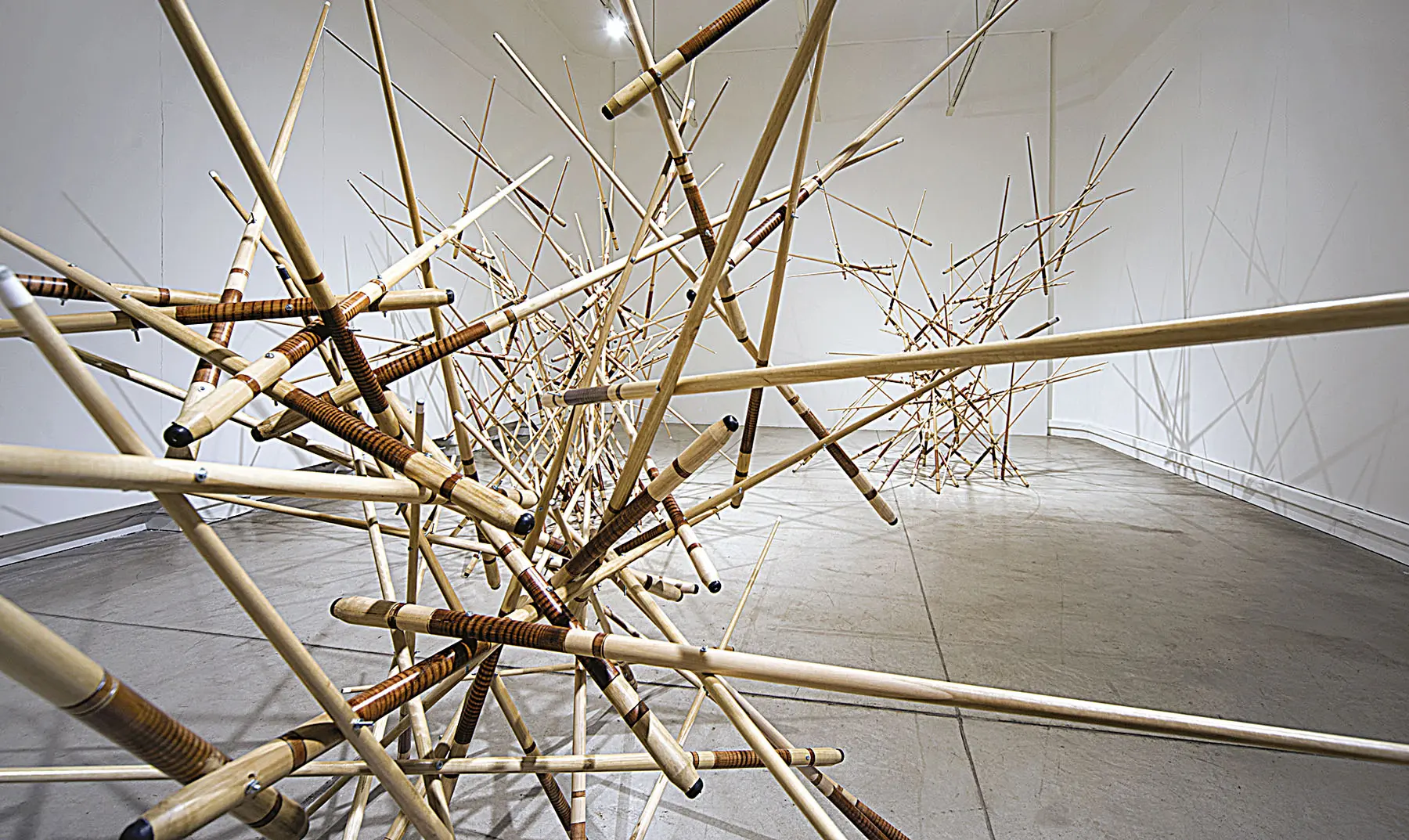
Transparent Sculpture , 2012 by Darío Escobar (Guatemala, b. 1971), is a conceptual sculptural installation of cue sticks, presented in the ceiling of a hallway at the beginning of the main galleries, along with a large-scale mural installation by Mark Dean Veca (the USA, b. 1963) titled Pete’s Place, 2013, which is a vibrant and pop interpretation of a throne in heaven. At first sight, the installations almost clash with each other visually but they actually engage in a conceptual dialogue that has to do with Baroque aesthetics that have transcended time and style, since the artists’ contemporary interpretations signify development of the tradition as proposals of Modernity in the case of Escobar, and an ultra-graphic pop in the case of Veca.
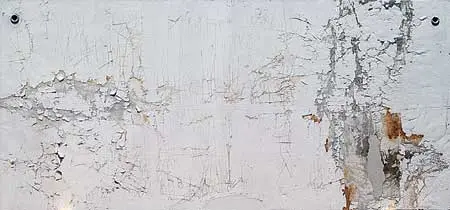
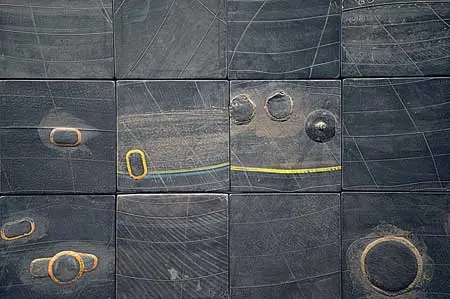
Gabriel de la Mora (Mexico, b. 1968) participates with four different works; Puerta 1A-B, 2012, Altamirano 20 I and Altamirano 20 III and El peso del pensamiento (The Weight of Thought, 2013). De la Moras’ works in this exhibition recover common materials and elevate them to an ethereal state—the first work mentioned here is a deteriorated metal panel that used to be part of a door, like a title implies, but is also a relic charged with the passage of time and the symbolic suggestions of an object that has a memory of the events and people that have also been part of its story. The next two pieces that share the title Altamirano perhaps as a reference to the cave paintings or the name of a street are in fact ceiling panels that have been detached and also suffer from peeling and deterioration, but the damage patterns of the surface create stunning accidental abstractions. El peso del pensamiento is an installation that is almost “hidden” in the back of a projection screen from a video installation of another artist in the exhibition as if de la Mora intended for it to pass undetected. The installation consists of rectangles of discarded shoe soles, cut in even sizes but in different materials and textures, continuing with the artist’s exploration of the use of existing objects and materials that give evidence of a past life. This work in particular is in direct conversation with Topografía, 2012 by Adán Vallecillo (Honduras, b. 1977), which is a large installation on a wall of squares made out of discarded recycled tires. Vallecillo’s piece is a comment on an economic practice in Honduras and other Latin American countries of repurposing materials but is also a representation of the contemporary development of abstraction in the works of artists who utilize everyday materials such as Vallecillo, de la Mora, and Escobar, included in this show, who not only criticize mass production but have the ability to transform common objects in poetic ways and even echo each other not only with these pieces but also with previous works.
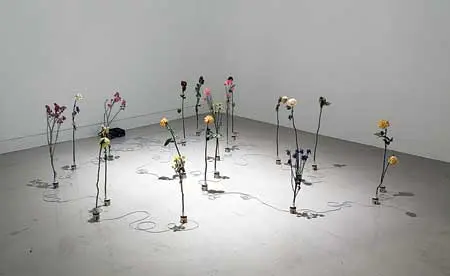
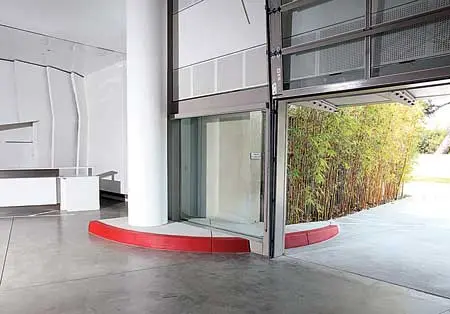
Also studying and recording the passage of time with their works, Sebastián Preece (Chile, b. 1972) and Adriana Salazar (Colombia, b. 1980) created site-specific installations that although apparently not related with each other, both engage in dialogues with the local area. Preece analyzed the urban area by re-walking on the same path from his hotel to the Museum back and forth, realizing that the surrounding area was not all pedestrian-friendly. His work is an intervention of the space in the form of speed bumps placed strategically in OCMA’s parking lot and by the entrance of the Museum, creating a path that forces the pedestrian to pay attention to the surroundings. The conceptual work by Preece is also related to the investigation of spaces, architecture, and common objects and transforming them into monuments that are evidence of the people who lived or had a presence in them. Salazar’s work is concerned about human experiences in time, such as mortality. For her installation Moving Plant #30, 2013, she collected flowers from a local cemetery and connected them to motors to create a kinetic installation of flowers that move on the floor in a circular slow motion, withering during the course of the exhibition.
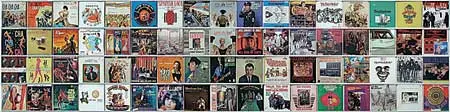
Wang Guangle (China, b. 1976), also comments on time and human mortality with his abstract piece 120403, 2010, in which he painted that number of overlapping layers of pigment on a canvas twice a day, in allusion to the custom in which elderly people paint a coat of paint on their coffins each year, in celebration of life and preparation for death. The work of outsider artist Robert Legorreta (the USA, b. 1952) is a selection of objects, figurines, and records from his personal collection (now part of the archives of UCLA) which rather than being melancholic, are a trace of an era suspended in time and an effort to find and preserve cultural identity.
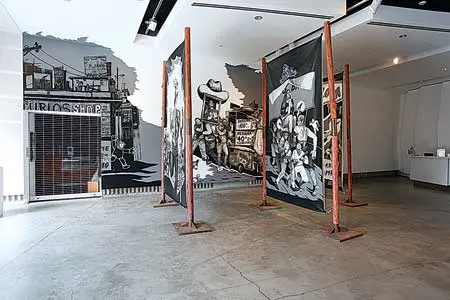
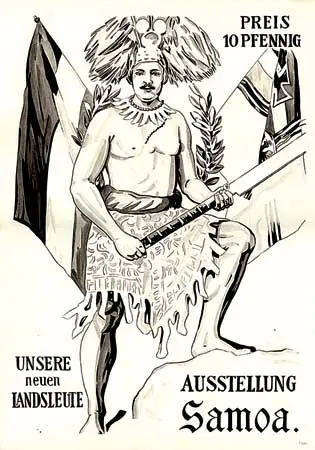
According to the curator, Dan Cameron, what all the works in the exhibition have in common is the “deep and abiding sense of their work relative to the place in which it is made.” There are also more intersecting connections that go beyond localities and socio-cultural references, such as the evident aesthetic relations, not only in conceptual and abstract languages but also in the presence of many works that relate to graphic design and other derivative pictorial languages. Artists John Bankston (the USA, b. 1963), Fernando Bryce (Peru, b. 1956), Hugo Crosthwaite (Mexico, b. 1971), Pedro Friedeberg (Mexico, b. 1936), Eko Nugroho (Indonesia, b. 1977) and Mark Dean Veca, work within the realms of the tradition of drawing and graphic arts or illustration, a strategy that is also connected to mass media and the resurgence of drawing as the main medium. Two contrasting examples are Bryce’s Südsee, 2007, and Crosthwaite’s drawing murals on the theme of Mexican carpas. While both Bryce and Crosthwaite’s drawing practices are rooted in studies of societies and cultures, present and past, Crosthwaite, focuses on a more vernacular site-specific narrative of his native Tijuana which is at times rough or grotesque. Bryce’s style derives directly from his sources—magazines, periodicals, historical documents, and texts, which he hand copies and presents as a way to question their historical contexts and role in shaping national and ethnic identities.
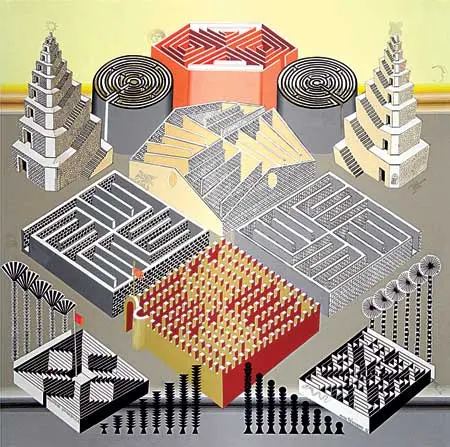
The works in the exhibition by Mexican artists Pedro Friedeberg and Yoshua Okón also seem to link together aesthetically and conceptually with the works by artists representing Asian countries, such as Lin Tianmiao (China, b. 1961). Friedeberg’s surrealistic and quasi-psychedelic works are a combination of literary, popular, and occult references. Being part of an older generation of artists from Mexico, Friedeberg has not only influenced contemporary artists but also innovated in design since the 1960s. His artistic language references sacred and ancient cultures and religions, such as the Chinese. Lin Tianmiao’s work relates to textiles but also to a profound understanding and representation of death. Okón’s work in video analyzes marginalized societies in what he calls “sociological experiments” of race, culture, and economy. His piece Latex, 2012, explores the representation and visual exploitation of violence in mass media in Mexico and the “culture of fear” that has characterized the past decades in his country.
Cameron explains in one of the catalog essays that this Triennial is meant to answer some questions which were not asked in the context of Pacific Standard Time, the Getty Foundation initiative from 2011, which overlooked more global factors such as the history of California and the trans-Pacific routes that have dictated in a great degree the cultural diversity of the area and the overlapping histories of the Latino and Asian cultures. It is perhaps this context that has resulted in a selection of stronger works from Asian and Latin American countries in contrast with the US artists in the exhibition, but nonetheless, Cameron has set a precedent in the Los Angeles area of an exhibition model that is conscious of global and regional histories and contexts and gives a more accurate representation of the diverse cultures that are close to becoming majority populations in California.
SELENE PRECIADO