
Crude, disturbing, and frankly moving, the black and white photographs by Adriana Lestido (Argentina, 1955) are unforgettable. The small-size images compel viewers to get closer in order to better appreciate them and to perceive the steps and gestures that confront them, mostly, with what is not there. Curated by Gabriel Díaz and Juan Travnik, the exhibition titled That Which Is Visible. Photographs 1979/2007 at the Museo Nacional de Bellas Artes, was also made into a wonderful anthological book (published by Capital Intelectual / Mecenazgo de Cultura de la Ciudad, Buenos Aires 2013).
The exhibition consists of a group of photo essays that are mostly about a world of women immersed in an expressive albeit exceptional everyday life. Although observers can sense that the female subjects are deprived of many things, the images abound with empathy and consideration. Lestido is able to put herself in the shoes of others, she gets involved and at the same time gets viewers involved as well. According to her “For a long time, it was said that my images were about portraying a feminine universe, but that is not all. I would portray the constant absence of the masculine, and that is not the same. (…) But not any longer. I think that I have healed that part in me.”
Lestido dedicated her work to “the light, kindness, and beauty” of her first husband. Guillermo Willy-Morally was kidnapped and disappeared by the 1978 military dictatorship when the couple was already separated. Lestido was also separated from her father at the age of 7 when he was accused of fraud and was sent to jail for four years. So the young girl was left clinging to her mother. Despite this personal affliction, or because of it, her photographs of separations and absences have always been the element of hope.
One photograph titled Madre e Hija de Plaza de Mayo (Mother and Daughter of Plaza de Mayo, 1982), taken when she had just begun her work as a photojournalist is an emblematic image of her artistic trajectory. It depicts a woman who wears a white scarf carrying a young girl—also with a white scarf on her head. Both with identical gestures call the name of someone that has disappeared. Lestido always assumed that they were trying to find a husband and father, but she eventually learned that they were actually looking for a brother and uncle. And even as the current Argentine government—with the collaboration of some of the Mothers of Plaza de Mayo—uses for its own benefit the struggle of the Mothers as it manipulates the historical truth—presidents Néstor and Cristina Kirchner never participated in the struggle for human rights during the dictatorship—Lestido’s image, nonetheless, continues to maintain its authenticity and chilling power. It was her “first important photograph,” in which “everything is contained,” and the one that earned her the respect of colleagues that used to distrust her, perhaps because she was a woman or, maybe, because she was so young.
Lestido’s first photo-essay was Hospital Infanto Juvenil (Children and Adolescent Hospital, 1986-1988). It was followed by Madres Adolescentes (Adolescent Mothers, 1988-1990). Both projects somehow anticipated the series Mujeres Presas (Imprisoned Women, 1991-1993) and Madres e Hijas (Mothers and Daughters, 1995-1999). After having worked as a photojournalist for several newspapers editorial departments—where she completed her education and learned to work fast—Lestido completely focused on photography as she understood that to go deeper, she needed time that journalism does not offer.
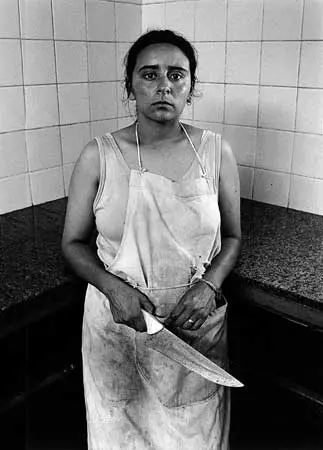
In the images of Mujeres Presas tension but also tenderness is set in contrast with the rough environment that surrounds the protagonists, many of them with their children. The hard and direct images were taken throughout the year in a women’s prison located in the Province of Buenos Aires. There is the image of a young woman gazing at the camera with a kitchen knife in her hand—the picture that appears on the cover of the book—showing both misery and dignity. Madres e Hijas reveals four stories of mothers and their daughters, with whom Lestido shared trips, portrayed for a period of three years. Dialogues and recordings complete this exploration centered on understanding those “difficult relationships.”
The series titled EL Amor (Love, 1992-2005) is dedicated to her second husband and suggests emotions before scenographies or poses. The images burst with imposing landscapes, austere interiors, and the glimpse of the male figure. Once again divorced, the last and serene photographs from the 2005 series Villa Gesell reveal the beautiful natural locations of that spa resort on the coast of Buenos Aires. Scenes of water and sand, wind, and fire are barely interrupted by a dog, by the succinct profile of the artist, self-portrayed, reconciled.
Recognized and awarded for her work, Adriana Lestido teaches photography and has published five books.
VERONICA VERLICHAK