
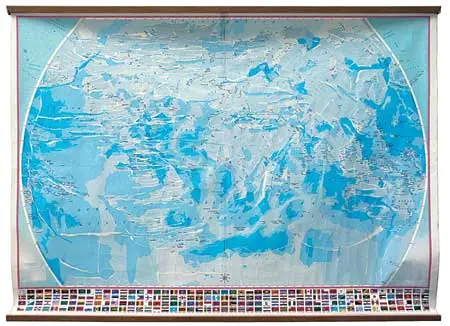
In his process as an artist (as can be seen in an exhibition of his work curated by Guillermo Satamarina and held at MACO), Benjamín Torres took an unusual leap between the third and the second dimension; this is to say, between the elements that dominate a volume and those that adjust themselves to a surface. I say this is unusual because Torres doesn’t seem to have stripped the attributes of space (and I don’t mean to say that he uses pictorial resources), but, despite working on more or less defined surfaces, piles the elements on each other and trims the contours so that something is missing or something is left over that stands out from the surface as an edge that negates it as such. As in contour plans and orographical maps, superposition is reduced to its own outline: the mountain is its own negation. The body is enunciated in its abstraction. As a body, it ends up a contour; as a contour, it ends up the edge from which to grasp the abyss: the minimal thickness it possesses as a body, a surface. But it is also enunciated in its absence; erased, it becomes space. I don’t know whether what is important in 360 RPM (2001), a monumental wheel made of crutches, is that which is not there, that which drips through between the crutches negated as these are in a body comprised of dots and lines, a body that tends in itself towards drawing, the illusion of perspective on a surface. Described in Torres’ Moldes para gis (2005) is the absence of a drawing, of a writer, of a body. In its emptiness, which shapes and defines the non-existent chalk, are the chalk’s drawing and writing on a blackboard, not the illusion of a third dimension but its evidence, small and disturbing, between one matter and another. It is in this negation, in his not enunciating the bodies on the surfaces by covering, trimming, or emphasizing them, that Torres does enunciate (and achieves) the third dimension on his surfaces. It is present as allusion and as evidence in the surfaces’ potential to become bodies, as it is implicit in the design that articulates Torres’ cereal boxes (Sin título, 2007): the body is here as such; their assemblage generates a space that they possess as such, even if they do not occupy it (what is contained, in the end, in a cereal box with no cereal in it?). It is and it isn’t a ruse. It is a simplification, or better yet, a reduction of the bodies: the line on the plane enunciates them. The lack, the absence, reveals them. In Diluvio Universal (2009), Torres intervenes a world map (which is at the same time plane and sphere, or the plane of a sphere): he conceals, under different hues of the color blue, the mass of the continents, which are and aren’t there (they have not been erased, but covered; yet, what does it mean to erase if not to retrace the drawing?). To erase a drawing is to enunciate it through its un-enunciation: a trace and a residue. Torres does something similar with a print that illustrates birds, omits them although they are named in the stamp itself and its label: Aves. They are there, in the contour that is left over as a negative drawing, in the spot where they are (where they remain) posed on the branches Torres has left intact, as a support for that which can no longer be seen (under the world map he has left the flags of the countries assimilated into the blue); only the name of each bird can help us see them again, as their remains are compared and checked: they can only be seen if they have been seen before when they were still there.
As happened with the continental masses (and the countries) in the world map and with the cereal boxes, the birds are recognized as seen-before, in our learned catalog of the world. It is only in the recognition of a prior world that their absence can be perceived. Torres expresses this again, with great subtlety and simplicity, in Eva dislocada (2001), a diptych where the artist cuts out a female figure from an illustration and presents them in two separate fields (illustration and figure) in order to enunciate it in its absence, but also in order to point out the evidence of its shadow, the fact that results from attaching it to a new surface. After his collages created by the superposition of photographs from a catalog (Hundimiento, 2011) and his décollages using pages from magazines cut into strips (Estática, 2011), in his most recent works Torres uses digital prints (on cotton paper) and continues to explore the tension between surfaces (as masses) that has defined his compositional work with a human figure by Alex Gray foregrounded as a sign of its abolished dimension (High performance, 2013), reproduces a negative of some dancers as a mask (Luz Negativa, 2013), or negates a blotch of white paint by reproducing it—a negation of the negation—like a ghost of what no longer is (Nothing Feels Like…, 2013), all towards the achievement of a tautology that enunciates celestial bodies: bodies and sky, sky bodies
RICARDO POHLENZ